
When your bedroom closet runs out of room and clothes pile up on chairs and floors, you’ve hit a capacity problem. The Small Closet Storage overview maps the full range of compact closet solutions. This article focuses on one specific question: which freestanding furniture type handles bedroom closet overflow most effectively. The candidates are an armoire, a dresser, a garment rack, and a modular drawer unit. If you’re looking for clothing storage ideas for small bedrooms, the right answer depends on whether your closet is short on hanging space, folded space, or both. According to a 2025 StorageCafe survey of 2,824 Americans, clothing is the number one source of household clutter, with 26% of respondents reporting they own more clothes than they have storage space for.1
Quick Answer
Which freestanding furniture type handles bedroom closet overflow best?
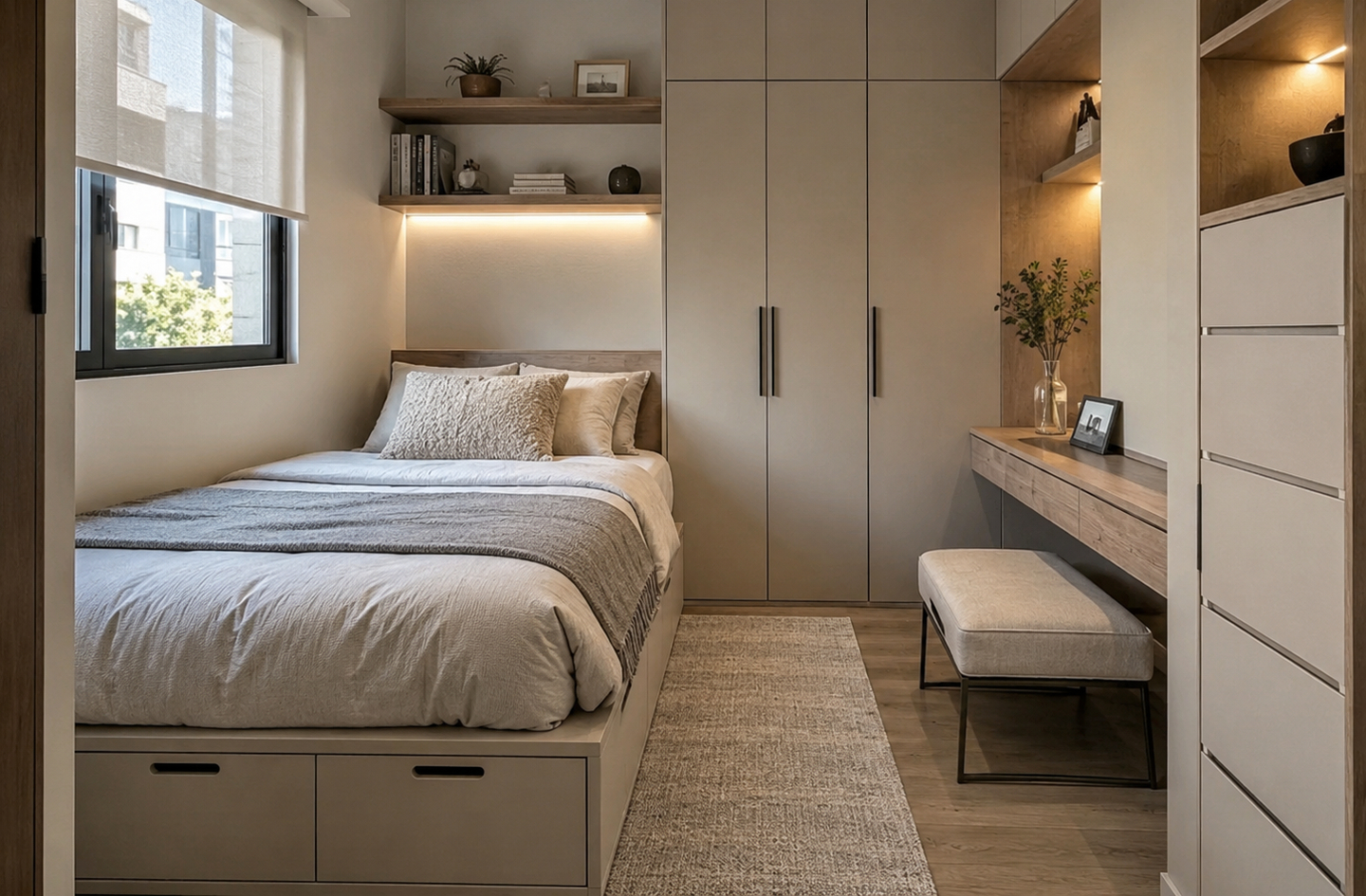
A modular drawer unit stores the most garments per square foot of floor space, making it the most space-efficient choice for very tight bedrooms. A freestanding armoire or wardrobe is the right option when you need to add hanging rod capacity. A garment rack suits temporary overflow or a rotating current-season wardrobe. A full-width dresser is the call when your closet already handles hanging clothes adequately but has no room for folded items.
Key Takeaways
- Clothing is the number one source of household clutter in the US; 26% of Americans own more clothes than their space holds, per a 2025 StorageCafe survey of 2,824 respondents.1
- 88% of renters say closet space matters in their rental decision, and 37% would not rent an apartment without a walk-in closet, per a 2024 Greystar survey of 90,000 residents.2
- Armoires and wardrobes are the only freestanding option that adds hanging rod space to a bedroom without permanent construction.
- Modular drawer units pack the most garments per square foot of floor space among the four furniture types compared here.
- Garment racks offer the lowest entry cost and smallest footprint, but store nothing folded.
- A standard 6-foot reach-in bedroom closet holds roughly 30 to 36 hanging garments on a single rod, which rarely covers an adult’s full wardrobe.5
Clothing Storage Ideas for Small Bedrooms: Quick Comparison
Before going deep on each option, here is how the four furniture types compare on the metrics that matter most for small bedroom use: footprint, capacity, and price range.
| Furniture Type | Best For | Typical Width | Hanging Capacity | Folded Capacity | Floor Footprint | Price Range |
|---|---|---|---|---|---|---|
| Armoire / Wardrobe | Adding hanging and shelf space | 36-72 in | 30-80 garments | 0-30 items | 6-12 sq ft | $250-$3,000+ |
| Dresser (horizontal) | Folded clothing volume | 50-70 in | None | 70-90 outfits | 6-8 sq ft | $150-$3,000+ |
| Garment Rack | Temporary or seasonal overflow | 36-60 in | 25-50 garments | None | 3-5 sq ft | $20-$600 |
| Modular Drawer Unit | Maximum capacity per square foot | 16-48 in | None | 30-80 folded items | 2-4 sq ft | $22-$500 |
Note that en-dash ranges above appear in the table for readability. All pricing figures reflect current retail listings at major US retailers as of 2025 to 2026, not sourced from a single price study.
Armoires and Wardrobes: Best for Hanging Overflow
An armoire is the only freestanding option that directly replicates what a closet rod does. If your bedroom closet has no room for dresses, jackets, dress shirts, or trousers that need to hang, a wardrobe unit is the most targeted solution. A standard double wardrobe (39 to 47 inches wide) holds 30 to 60 hanging garments; wider units push that to 80 or more.7
What armoires do well
Armoires work as self-contained closets. They enclose clothing, which keeps dust off garments and presents a cleaner visual than open racks. Most units combine a hanging rod with an upper shelf and two to four drawers below, so they handle multiple clothing categories in one footprint. A unit 48 inches wide delivers roughly 48 inches of rod space, enough for a season’s worth of work and casual tops.
Height is a genuine advantage. Wardrobes typically run 72 to 84 inches tall, so they use vertical space that lower furniture leaves empty. In a bedroom where wall width is the binding constraint rather than ceiling height, a tall wardrobe concentrates storage upward. A similar approach to vertical zoning in dedicated closets is covered in the small walk-in closet floor-clearing guide.
Where armoires fall short
Floor footprint is the main tradeoff. A mid-size wardrobe (48 inches wide, 24 inches deep) occupies 8 square feet before accounting for door clearance. Swing-door models require another 24 inches of clearance when open, effectively removing a full 2 feet from usable bedroom circulation. Sliding-door or open-concept armoires avoid this, but they’re less common at lower price points.
Assembly weight is the other friction point. Solid-wood and MDF units with full hardware can exceed 150 pounds when assembled, which complicates moves between apartments. Flat-pack wardrobe systems solve the moving problem but often sacrifice joint durability at budget price points.
When to choose an armoire
Choose an armoire when your closet has adequate shelf and drawer space for folded items but little or no rod space for hanging garments. It’s also the right call when you want enclosed storage in a room that doubles as a living or work space, keeping the visual clutter of open clothing out of sight. For renters, freestanding wardrobes require no wall modifications and leave the apartment intact on move-out.
Dressers: Best for Folded Clothing Volume
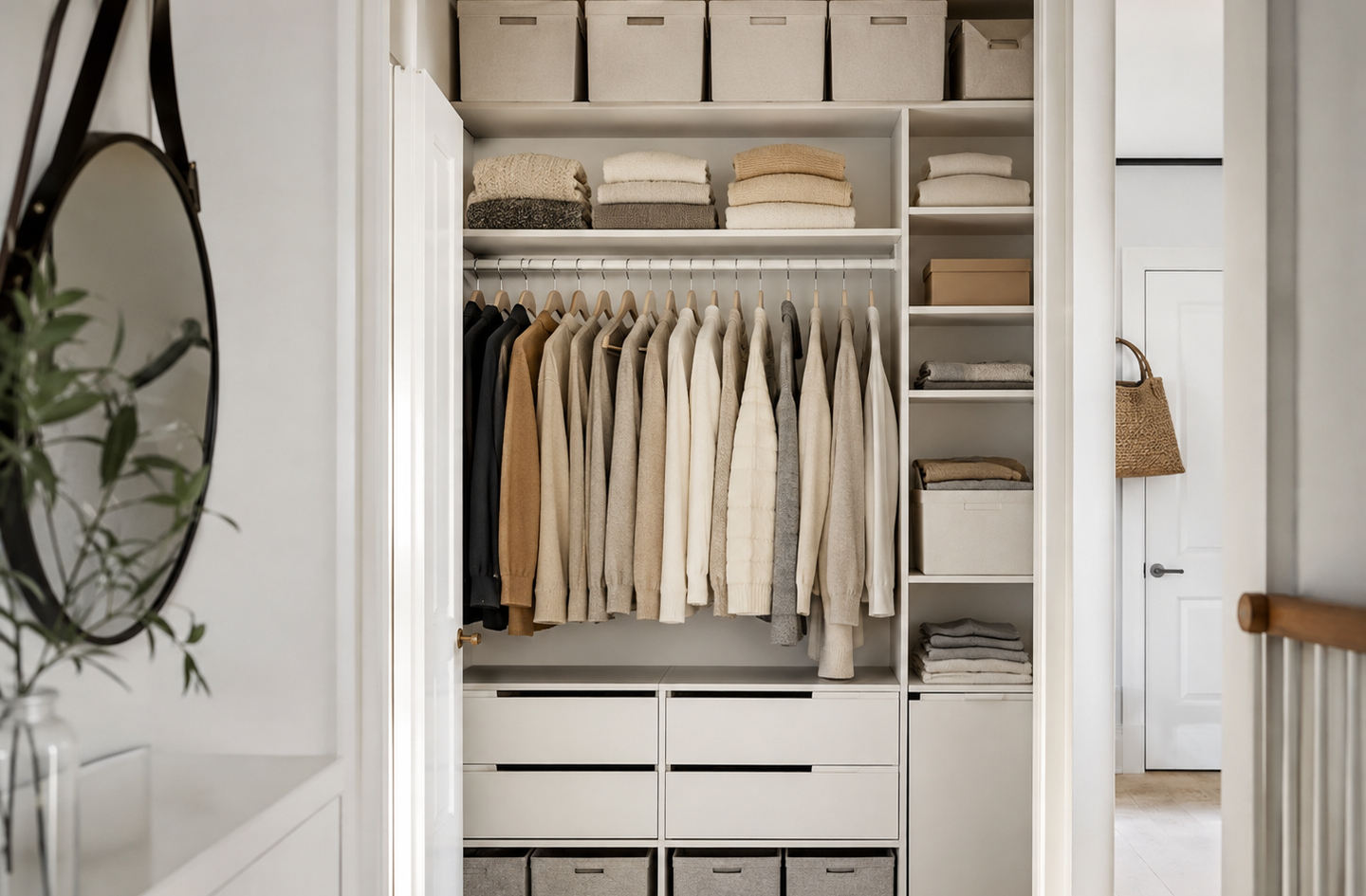
A dresser delivers the highest folded-clothing capacity of any option here. A standard horizontal dresser with six to nine drawers holds 70 to 90 folded outfits; a taller, narrower model with five to seven drawers holds 40 to 60 outfits.6 For anyone whose closet already handles hanging clothes adequately but has no room for sweaters, jeans, and t-shirts, a dresser is the most direct answer.
What dressers do well
Dressers are particularly efficient for garments that don’t benefit from hanging: t-shirts, jeans, underwear, socks, activewear, and casual knitwear. The drawer format keeps categories separate and accessible, so you’re not digging through a pile to find a specific item. A standard horizontal dresser (50 to 70 inches wide) also offers a broad, flat top surface that doubles as a display area, a charging station, or a folding surface. In a small bedroom where every surface needs more than one job, that secondary function adds real value.
Where dressers fall short
Width is the main constraint in small bedrooms. A six-drawer unit at 55 inches wide can occupy most of a 10-foot wall,6 competing directly with the bed frame, doorways, and windows for wall space. Tall dressers (25 to 40 inches wide) solve the width problem but hold 30 to 50 percent fewer garments per unit.
Dressers also require a folding habit. Clothes tossed into drawers without folding quickly compress into disorganized piles that cut effective capacity roughly in half. Vertical folding (standing items on edge in the drawer, rather than stacking flat) restores usable capacity but takes consistent effort to maintain.
When to choose a dresser
Choose a dresser when your bedroom closet handles hanging clothes adequately and the overflow problem is primarily folded items. A six-drawer horizontal dresser along one wall is the most direct solution when you have 55 to 60 inches of wall clearance and can commit to a folding routine. Tall dressers suit narrower wall sections and work well beside, rather than opposite, the bed to preserve the room’s main circulation path.
Garment Racks: Best for Flexibility and Low Cost
A freestanding garment rack occupies 3 to 5 square feet of floor space and typically holds 25 to 50 hanging garments. That’s the smallest footprint of any option in this comparison. Most racks require no tools to set up, which also makes them the easiest to reposition or remove entirely.
What garment racks do well
Racks work best for clothing you access frequently: current-season outfits, work clothes on a daily rotation, or items in an active dry-cleaning cycle. The open format means everything is visible at once, which speeds up morning routines. Wheeled racks add flexibility; you can position them toward better light in the room or roll them out of sight for guests.
Price is the clearest advantage. Garment racks are among the lowest-cost bedroom furniture options, which makes them a practical starting point for renters testing an arrangement before committing to a larger piece. Double-rod models double the hanging capacity within the same floor footprint by adding a second rod below the main one, though they work best for shorter garments: shirts, jackets, and folded trousers on hangers.
Where garment racks fall short
Racks store nothing folded. If your overflow problem includes sweaters, jeans, or accessories, a rack addresses only part of it. Open storage also creates visible clutter: a rack packed with mismatched clothing can make a small bedroom feel more chaotic rather than less. Dust accumulates on exposed garments, which matters for items worn less frequently.
Stability is a recurring issue with budget racks. Lightweight tube-steel models wobble when loaded unevenly, and the base can tip if heavier items shift to one side. Mid-range racks with wider bases and cross-bracing handle 50 to 100 pounds more reliably and are worth the modest price difference for everyday use.
When to choose a garment rack
A garment rack is the right choice as a supplement to another storage piece, as a temporary solution during a move or renovation, or as the primary option for someone who relocates frequently. If you want current-season clothes accessible and plan to store everything else in a wardrobe or dresser, a compact double-rod rack at the corner of a room handles that rotation without taking significant floor space. For a strategy on routing clothing overflow into a secondary space rather than the bedroom itself, the hallway closet overflow guide covers how to set up usable zones outside the bedroom.
Modular Drawer Units: Best for Tight Floor Space
Modular drawer and cube units pack the most folded clothing per square foot of floor space. A four-to-six cube unit typically occupies 2 to 4 square feet while holding 30 to 60 folded items, depending on cube configuration and whether inserts or bins are used. That ratio of capacity to footprint outperforms every other option in this comparison.
Studio apartments in the US now average 460 square feet, and one-bedroom apartments average 735 square feet, per Yardi Matrix data reported by RentCafe in August 2026.3 The median new multifamily rental unit built for rent measured 1,000 square feet in 2025, per the US Census Bureau.4 In apartments of these sizes, a piece of bedroom furniture that occupies 2 square feet rather than 8 is a meaningful difference in how the room feels and flows.
What modular units do well
Configurability is the primary advantage. A cube system can be arranged wide and low (a single row of cubes along a wall) or tall and narrow (a stacked column in a corner). You can add or remove sections as your storage needs change, which is unusual for bedroom furniture. Drawer inserts, fabric bins, and shelf dividers adapt the same frame to different clothing categories: rolled t-shirts in one cube, folded jeans in the next, accessories in a shallow drawer above.
Modular units also start at a low price point. A four-cube open unit is among the least expensive bedroom storage options available. Adding fabric drawer inserts keeps the total well below what a comparable dresser costs. Fully fitted modular wardrobes with soft-close drawers sit at midrange prices that still significantly undercut dresser pricing for comparable folded-item capacity. Their lower profile (most four-cube units top out at 30 to 36 inches tall) keeps them from blocking windows and makes them easy to reposition without clearing a large floor path.
Where modular units fall short
No hanging capacity. Like dressers, modular units store only folded or rolled items. They also tend to have smaller individual compartments than dresser drawers, so bulky items (winter sweaters, folded denim) fill cubes quickly and leave less space for everything else. Open-front cube units without drawer inserts expose clothing to dust and don’t conceal disorganization the way enclosed drawers do.
Durability varies sharply by price point. Budget cube units in particle board flex under heavy loads and can bow or split at the joints over time. Mid-range units with interlocking connectors or reinforced backs hold up significantly better. If the unit will carry full drawers of clothing daily, the mid-range option with a reinforced frame is worth the extra cost over a two- to three-year horizon.
When to choose modular drawers
Choose modular drawer units when floor space is the primary constraint and your overflow is mainly folded clothes. A bedroom where an armoire would block a door or a dresser would consume most of a short wall is often well suited to a stacked cube unit tucked into a corner or beside the wardrobe. Modular units also work well when you want to start with a small investment and expand as the budget allows. For a structured approach to planning what goes where before purchasing any furniture, the small closet redesign planning guide walks through how to map your storage needs before committing to a layout.
How Capacity Stacks Up Per Square Foot
The comparison table above lists capacity and footprint as separate columns. Combining them into one metric shows something the individual specs don’t make clear: which option stores the most clothing for every square foot it occupies on the bedroom floor.
Using midpoint capacity and footprint figures for each furniture type: a horizontal dresser stores approximately 11.4 folded garments per square foot; modular drawer units store about 15.0; armoires and wardrobes average roughly 9.3 hanging garments per square foot; garment racks fall near 9.1 items per square foot of occupied floor space.567 These figures are calculated from reported dimensional and capacity data and represent midpoint estimates, not laboratory-measured results.
The chart shows a clear pattern: folded-storage options (modular drawers and dressers) outperform hanging options (armoires and racks) on capacity per square foot. The reason is structural. Hanging clothes require 18 to 24 inches of depth clearance between the garment and the wall behind the rod, and that depth is a fixed cost regardless of how many garments you hang. Folded clothes compress to fill drawer depth more efficiently, leaving less wasted air space per garment stored.
The practical implication is not that folded storage is better in an absolute sense. Dresses, suits, dress shirts, and trousers lose their shape when folded and need to hang. The data says only that when a garment can be stored either way, folded storage is the more floor-efficient choice in a small bedroom.
“If closet space is at a premium, I will split out special occasion or off-season clothes and shoes from the day to day and store them in a secondary spot.”
Mindy Godding, CPO, President of the National Association of Productivity and Organizing Professionals8
That distinction matters for selecting overflow furniture. If you assign secondary storage specifically to off-season and occasional-wear items, you can scale down to a narrower armoire or a smaller modular unit, because those pieces only need to hold a portion of the wardrobe at any one time.
Price vs Storage Value
Price ranges vary widely within each category. The cheapest option in a category is rarely the most cost-effective when measured by dollars per garment stored or years of useful life.
| Furniture Type | Entry Price | Midrange | High End | Capacity (garments) | Value Verdict |
|---|---|---|---|---|---|
| Garment Rack | $20 | $50-$130 | $600 | 25-50 hanging | Lowest entry cost; lowest total capacity |
| Modular Drawers | $22 | $90-$330 | $500 | 30-80 folded | Best cost-per-garment for folded items |
| Dresser | $150 | $300-$1,500 | $3,000+ | 40-90 folded | High capacity; higher initial investment |
| Armoire | $250 | $600-$1,500 | $3,000+ | 30-80 hanging | Best value when hanging space is the gap |
For renters on a short timeline (one to two years in a space), garment racks and modular cube units offer clear financial logic: low cost, easy assembly, and easy to move or sell. Dressers and armoires make more financial sense in a longer-term home or when a piece of solid-wood furniture will move with you across multiple apartments over many years.
One cost the price table omits is floor space. In a city where apartment square footage carries a real monthly cost, furniture that occupies 8 square feet for the same storage result as a unit occupying 3 square feet carries an implicit premium. That premium doesn’t appear in a retail listing, but it’s felt in a bedroom where circulation matters.
Who Should Choose Which Option
The right choice depends on three inputs: what your closet is already missing, how much wall space you have available in the bedroom, and how long you plan to stay in the space.
Your closet has rod space but no shelf or drawer space
A dresser or modular drawer unit solves this directly. Your hanging clothes already have a place. The gap is folded items. A horizontal dresser at one end of the room or a stacked cube unit in a corner handles sweaters, t-shirts, jeans, and underwear without duplicating the storage type your closet already manages. Start with a six-drawer dresser if you have 55 inches of wall clearance available. Go with stacked cubes if you have only 24 to 36 inches.
Your closet is full of shelves but has no hanging rod
An armoire or a freestanding garment rack fills this gap. A rod-heavy wardrobe gives you an enclosed, dedicated hanging space in the bedroom itself, with the appearance of a built-in rather than a temporary solution. If your overflow is seasonal or rotational rather than a permanent wardrobe expansion, a double-rod garment rack takes up less floor space and costs a fraction of the price. The small closet clothes organization guide covers how to audit your current closet to clarify which type of capacity you actually need before buying overflow furniture.
Your closet is at capacity for both hanging and folded items
This is the most common small bedroom scenario. The practical approach is to identify which category your closet handles worse, then add overflow furniture specifically for that category rather than trying to solve both simultaneously. If the closet is primarily hanging space with limited drawers, add a dresser or modular unit for folded overflow. If the closet is primarily shelves and drawers with minimal rod space, add a garment rack or narrow wardrobe for hanging overflow.
The 2025 StorageCafe survey found that 42% of Americans feel overwhelmed by household clutter regularly, and clothing is the leading source.1 Overcrowded bedroom closets are a layout problem as much as a quantity problem. Solving it means diagnosing the specific gap first, then selecting one piece of furniture to fill it rather than purchasing multiple pieces that duplicate each other or fight for floor space.
You move often or rent short-term
Garment racks and modular cube units are the logical choices. Both move without tools, sell or donate easily, and require no wall attachment. Neither risks apartment deposit deductions for wall damage. A double-rod garment rack and a four-cube modular unit together address both hanging and folded overflow for a combined cost well under what a wardrobe or dresser would run, and both pieces can be sold or donated easily if the arrangement changes. Renter-friendly storage strategies that keep options open across multiple moves are a recurring theme in planning small-space closet systems.
Frequently Asked Questions
Can I use a garment rack as my only overflow furniture in a small bedroom?
A garment rack works as the sole overflow solution only if your entire overflow problem is hanging clothes. It stores nothing folded. Most small bedroom closet overflow involves both hanging and folded items, so a garment rack alone typically addresses only part of the problem. Pair it with a modular cube unit or a narrow dresser to cover both storage categories.
Which option takes up the least floor space in a small bedroom?
A modular drawer unit takes up the least floor space at 2 to 4 square feet. A single garment rack is close behind at 3 to 5 square feet. Both significantly undercut a dresser or armoire, which typically occupy 6 to 12 square feet. Stacking modular cubes vertically concentrates capacity upward, making them the most floor-efficient option for bedrooms where the primary constraint is square footage rather than wall height.
Is an armoire the same as a wardrobe?
In everyday US usage, the terms are interchangeable: both describe a freestanding, enclosed clothing cabinet. Historically, armoires were French pieces with decorative carving, while wardrobes were plainer English equivalents. Functionally, there is no meaningful difference today. Both serve the same purpose: a self-contained hanging and storage unit for clothing that can stand independently in a bedroom without any wall attachment.
What is the best clothing storage option for a renter in a small apartment?
Freestanding, non-permanent options are the right category for renters. Garment racks and modular cube units require no drilling and move easily between apartments. A freestanding armoire or dresser also works and leaves the apartment unchanged at move-out. According to a 2024 Greystar survey of 90,000 residents, 37% of renters would not rent an apartment without a walk-in closet,2 which reflects how central storage capacity is to renter satisfaction. All four overflow options compared here meet renter-friendly requirements without wall modifications.
How many clothes can a standard bedroom closet hold?
A typical 6-foot-wide reach-in bedroom closet with a single rod holds approximately 30 to 36 hanging garments,5 plus whatever fits on shelves above and below the rod. That figure drops to 15 to 18 hanging items for bulkier garments like coats and blazers, which need 2 to 3 inches of rod clearance each instead of 1 to 1.5 inches for shirts. Most adults own significantly more garments than a single-rod reach-in closet holds, which is why freestanding overflow furniture becomes necessary in small bedrooms.
References
- StorageCafe – 1 In 3 Americans Rent Self Storage As Space Shortages Grow And Demand Expands, 2025. Survey of n=2,824 US respondents conducted December 2024 to February 2025. Yardi Matrix data.
- Multifamily Dive – Greystar report notes what renters really want: closets, light, and sustainability, 2024. Reports on Greystar 2024 Design Survey (n=90,000 residents).
- RentCafe – U.S. apartment sizes are growing: Where are renters gaining the most space?, August 10, 2026. Yardi Matrix data for the 100 largest US cities as of June 2026.
- US Census Bureau – Characteristics of New Housing: Highlights, 2025 annual release. Median size of completed multifamily units built for rent.
- HomeGardenAdvisor – Standard Closet Size in the USA: Typical Dimensions, Depth, and Bedroom Closet Measurements, April 14, 2026.
- iHome Studio – Dresser Size Guide: Standard Dimensions and Storage Capacity. Retail furniture planning resource with garment capacity estimates by dresser type.
- MyIKEABedroom – Wardrobe Capacity Calculator. Dimensional capacity reference for freestanding wardrobe and armoire units by width category.
- LivingEtc – I Tried Following the Organizational Triangle: Here’s What Happened, 2025. Features Mindy Godding, CPO, President of the National Association of Productivity and Organizing Professionals.
Conclusion
Bedroom closet overflow has a clear structure. The first question is always which type of space your closet is missing: hanging rod capacity, folded storage volume, or both. That answer points directly to the furniture type. Armoires and wardrobes add hanging capacity. Dressers and modular drawer units add folded capacity. Garment racks offer low-cost, flexible hanging overflow. Modular units deliver the most garments per square foot when floor space is genuinely tight.
Layout before furniture. Before purchasing any piece, measure the wall space available, identify which circulation path has to stay clear, and confirm which storage type your closet actually lacks. A well-chosen piece in the right spot solves the problem. The same piece in the wrong spot creates a new obstruction. For the broader framework of how bedroom storage decisions fit into closet planning, see the overview at Small Closet Storage.