
Small closet storage is the mix of rods, shelves, drawers, door organizers, and nearby furniture that holds a wardrobe in a closet too small for it. The median new US apartment built for rent is 1,000 square feet2, so many homes have one shallow reach-in closet per bedroom. The useful question is not how much fits, but how much stays reachable. This guide puts closet decisions in one order and links to deeper guides on each.

Quick Answer
How do you organize a small closet?
Measure first, then sort the wardrobe into hanging, folded, shoes, and accessories. Give the clothes worn this week the easiest reach, between hip and shoulder height. Send off-season items to the top shelf or out of the closet. Add a second rod, shelf dividers, or door storage only after the daily zone works.
Why it matters:
A closet packed past its reach zone stops being used, and the overflow moves to a chair or the floor.
Key Takeaways
- Reach decides capacity. The ADA standards set a forward reach range of 15 to 48 inches above the floor1, a useful benchmark for daily clothes.
- Most small closets need four jobs covered: long and short hanging, folded storage, shoes, and accessories.
- A second rod under a short-hang section is usually the cheapest gain in hanging space.
- Overflow dressers and armoires need anchoring. The CPSC counts 17,800 tip-over injuries a year, and 82 percent involve furniture4.
- The common misconception is that a full closet needs more organizers. Usually it needs fewer items in the prime zone and a faster reset.
Small Closet Storage in 30 Seconds
| If the closet is… | Start here |
|---|---|
| A shallow reach-in with one rod | Add a lower rod under short clothes and shelf dividers above |
| A small walk-in | Rods and shelves on the walls, with the center aisle kept clear |
| Too small for a large wardrobe | Rotate off-season clothes out and keep only the current season inside |
| Shared by two people | Split the rod, shelves, and drawers into two equal personal zones |
| Missing entirely | Build a system from a wardrobe, a dresser, and a garment rack |
| In a rental with no drilling allowed | Tension rods, shelf risers, hanging organizers, and slim hangers |
What Is Small Closet Storage?
Small closet storage is the plan for where each type of clothing lives when the closet cannot hold everything at once. It covers the closet interior, the door, and the furniture that takes the overflow. The parts matter less than the order they are chosen in. Hanging clothes, folded clothes, shoes, and accessories each need one fixed home.
A reach-in closet is a shallow closet used from outside, usually with one rod and one shelf above it. Double hanging means two rods stacked one above the other, so short items like shirts use the height that long items need. The reach zone refers to the band of height a person can use without a step stool or bending low. It is the most valuable space in any closet.
Accessibility standards give useful reference points, even though they are written for public buildings rather than homes. The 2010 ADA Standards set the forward reach range at 15 inches minimum and 48 inches maximum above the floor1. They size the clear floor space for one person at 30 by 48 inches1. A person standing at a reach-in closet needs roughly that space in front of the doors.
Those figures explain why closet storage is a layout problem before it is a product problem. A top shelf full of daily sweaters fails because of height, not size. The scope here is planning and organization. Moving walls, built-in cabinetry fixed into structure, and new closet lighting circuits belong with a licensed contractor or electrician.
Why a Small Closet Needs a Storage Plan
A small closet needs a plan because it serves the busiest daily routine in the home: getting dressed and putting clothes back. When the closet cannot absorb that cycle, clothes land on a chair, the bed, or the floor. The bedroom then carries the overflow, and the closet still looks full.
The friction shows up in the words readers use:
- “I have no closet space.” The underlying issue is often an unused door, top shelf, or lower half of the rod.
- “My bedroom is too small for storage.” The underlying issue is overflow furniture chosen before the closet was planned.
- “I bought organizers, but it still looks cluttered.” The underlying issue is too many items in the reach zone, so nothing resets.
Renting shapes the options for a large share of households. The US counted 44.6 million rented homes in its latest five-year survey3, and many leases limit drilling. Closet storage for those homes has to work with tension rods, hanging organizers, and freestanding pieces.
Overflow furniture adds its own risk. Dressers and armoires that hold the clothes the closet cannot are tall and often top-heavy. The CPSC estimates 17,800 tip-over injuries a year, with 82 percent involving furniture4. A closet plan that keeps overflow small and anchored is a safer plan.
Planning turns those recurring problems into a sequence: measure the closet, count the wardrobe by category, protect the reach zone, then add storage where the gaps are. Square footage is fixed. Flow is a choice.
The Six-Part Small Closet Storage Framework
The Six-Part Small Closet Storage Framework groups the planning questions in this topic into six decisions, taken in order. Measuring and counting come first, because the closet and the wardrobe set every limit. Hanging space, folded storage, and shoes follow. Overflow furniture comes next, and only for what the closet cannot hold. Shared, rental, and upkeep needs adjust the choices at every step.
Planning and Measuring the Closet
Planning starts with four measurements: interior width, depth, height, and the door opening. Bifold and sliding doors often hide part of the rod, so note which sections are hard to reach. Then count the wardrobe by category: long hanging, short hanging, folded, shoes, and accessories. The count, not the photo, decides the layout. A walk-in adds one more check: the center aisle. The ADA benchmark of 36 inches of clear walking width1 is a sensible target where the room allows it. When a large wardrobe meets a small closet, seasonal rotation usually solves more than any organizer.
Count the wardrobe before buying anything, because the count tells you which zone is short.
Deeper read: how to plan a small closet redesign for clothes and shoes.
Deeper read: small reach-in closet organization for more storage.
Deeper read: small walk-in closet ideas that keep the floor clear.
Deeper read: organizing a small closet with lots of clothes, step by step.
Hanging Space
Hanging space is usually the first zone to run out. The most common fix is a second rod under the short-hang section, which turns one band of shirts into two. Tension rails do the same job in a rental. Cascading hangers stack several items on one hook, but they get heavy and hard to browse. A pull-down rod is a closet bar on a hinged arm that lowers a high rod into the reach zone. Slim, matching hangers also free space along the rod. Above the rod, the top shelf and the back of the door add storage without widening the closet.
Fill the reach zone with this week’s clothes, and send everything else up, down, or out.
Deeper read: how to add hanging space to a small closet.
Deeper read: vertical storage ideas for a small closet.
Shelves and Folded Clothes
Folded clothes need their own plan, because not everything should hang. Knit sweaters can stretch on hangers, and jeans fold neatly into stable stacks. Shelf dividers are upright panels that clip onto a shelf and stop stacks from leaning into each other. Keep stacks low enough to lift the top item without the pile collapsing. Bins work for loose items like scarves and gym clothes, but label them or choose clear ones. A deep shelf hides the back row, so use the front for daily items and the back for spares.
Set stack height by what you can pull out with one hand, not by how much the shelf can hold.
Deeper read: small closet shelf organization for folded clothes.
Shoes and Accessories
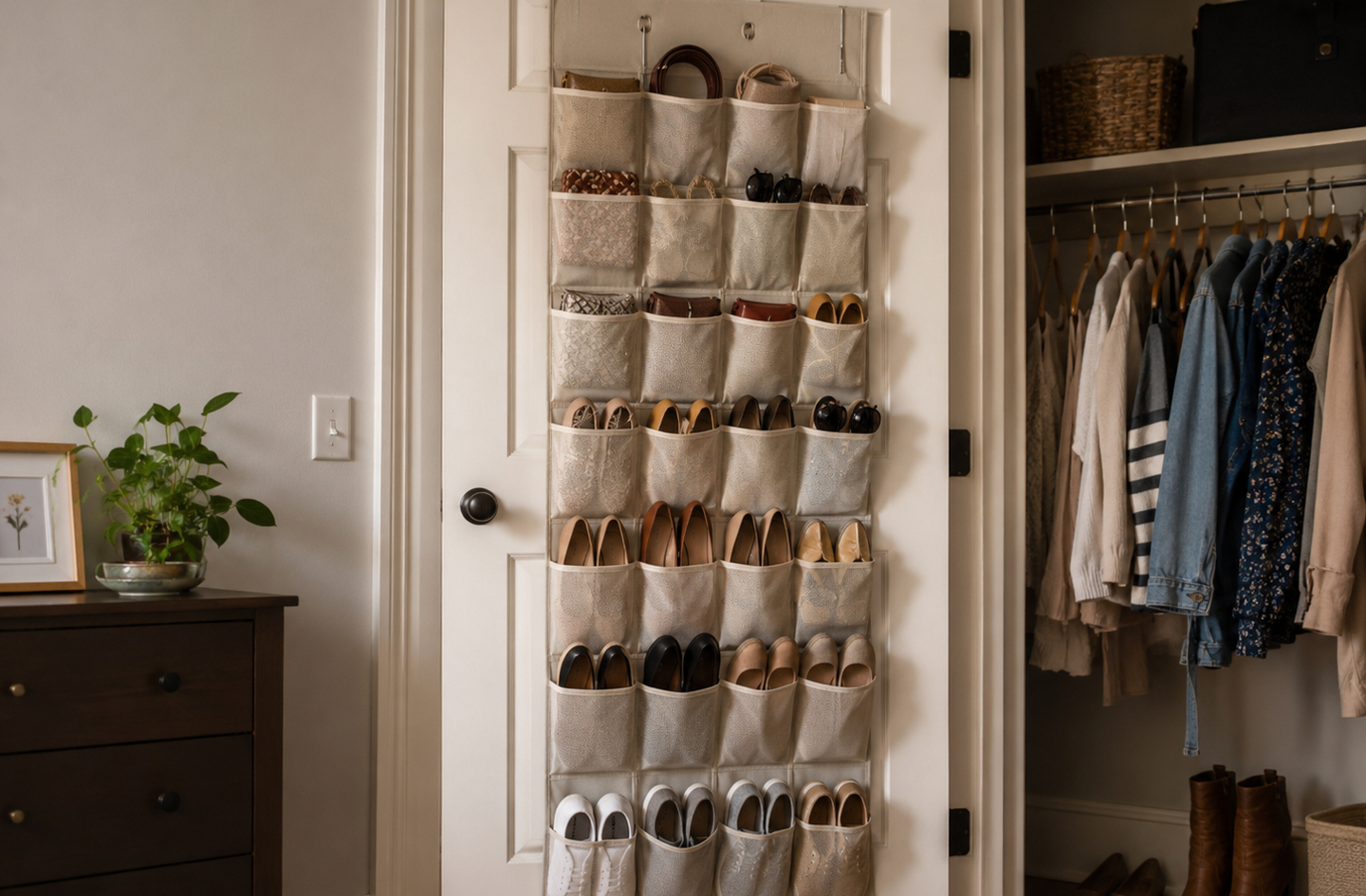
Shoes compete with long-hanging clothes for the closet floor. A low tiered rack fits under the short-hang section, where no hems reach. Over-door organizers hold flats, sandals, and small accessories with no floor cost. Cubbies and vertical shelves suit a closet with a spare side wall. Boots and bulky pairs may not belong in a small closet at all. Closed shoe storage, such as a slim cabinet or a storage bench in the bedroom or entry, takes them out. Belts, bags, and scarves need hooks or a narrow organizer rather than a shelf corner.
Store shoes where the hanging clothes are short, so neither zone gives up space.
Deeper read: shoe organization ideas for a small closet.
Deeper read: closed shoe storage for small bedrooms and entryways.
Overflow and No-Closet Storage
Overflow storage takes whatever the closet cannot hold, and it should be planned rather than bought in a hurry. An armoire adds closed hanging space. A dresser or modular drawers hold folded clothes, and a garment rack adds open hanging. A hallway closet can take coats, off-season clothes, and spare shoes. A coat closet works best when it holds only outerwear, bags, and umbrellas. A bedroom with no closet needs a full system built from these pieces. The CPSC advises anchoring furniture such as bookcases and dressers to the wall4, and 82 percent of tip-over injuries involve furniture4.
Choose overflow furniture for the category the closet lacks, not for the look of the room.
Deeper read: armoire, dresser, garment rack, or modular drawers for overflow.
Deeper read: no-closet clothing storage ideas for small bedrooms.
Deeper read: small hallway closet organization for clothing overflow.
Deeper read: small coat closet organization for outerwear and bags.
Shared Closets, Rentals, and Upkeep
Three conditions change the plan in almost every home. A shared closet needs clear personal zones, or one wardrobe slowly takes over the other. Renters rely on tension rods, shelf risers, hanging organizers, and slim hangers instead of new hardware. Upkeep matters most of all, because a closet that only works when tidy will fail by mid-week. Worn-again clothes need a hook or basket of their own. Damp clothes should dry before going into a closed closet. The EPA advises keeping indoor humidity below 60 percent5 to limit mold growth.
Drying time is the reason damp clothes stay out of a packed closet, as EPA guidance explains:
If wet or damp materials or areas are dried 24-48 hours after a leak or spill happens, in most cases mold will not grow.
Design for the reset, because the real test of a closet is laundry day.
Deeper read: small shared closet organization for two people.
Deeper read: renter-friendly storage for a very small closet.
Deeper read: small closet organization that stays tidy.
How to Choose Small Closet Storage
The most important choice is which zone to fix first, because the shortest zone decides where the space and money go. Work through these steps in order:
- Measure the closet and the door. Record width, depth, and height, and note any rod section hidden behind a bifold or sliding door.
- Count the wardrobe by category. Long hanging, short hanging, folded, shoes, and accessories. The category that overflows is the one to solve first.
- Rotate before you buy. Move off-season clothes to the top shelf, under the bed, or a hallway closet. Then recount what stays.
- Protect the reach zone. Daily clothes go between hip and shoulder height. Spares, bags, and seasonal bins go high or low.
- Add capacity where the gap is. A second rod or tension rail fixes hanging, shelf dividers fix folded stacks, and door organizers fix shoes and accessories.
- Plan overflow furniture last. Pick it by the category the closet still lacks, as covered in the small closet redesign plan.
Red flags: daily clothes on the top shelf, a rod so packed that hangers will not slide, shoes piled under long coats, and an overflow dresser left unanchored. In a rental, check the lease before replacing rods or adding screws, and keep the original hardware for move-out.
Compare Small Closet Storage Options
Small closet storage options differ most in what they add capacity for, how much reach they need, and whether a renter can install them. The table compares six common options side by side.
| Criteria | Second rod | Over-door organizer | Shelf dividers and bins | Pull-down rod | Garment rack | Dresser or modular drawers |
|---|---|---|---|---|---|---|
| Adds capacity for | Short hanging | Shoes and accessories | Folded clothes | Hanging up high | Hanging overflow | Folded overflow |
| Floor space used | None | None | None | None | Medium | Medium to high |
| Reach needed | Low, inside the reach zone | Low | Medium | Low once lowered | Low | Low |
| Hides clutter | Inside closet | No | Partly | Inside closet | No | Yes |
| Renter fit | High with a hanging or tension rod | High | High | Low; needs fixings | High | Medium; needs anchoring |
| Best for | Shirt-heavy wardrobes | Closets with a usable door | Sweaters and jeans | Tall closets | No-closet bedrooms | Closets with little shelf space |
Choose a second rod if: most hanging clothes are short and the lower half of the closet is empty.
Choose an over-door organizer if: shoes or accessories crowd the floor and the door swings freely.
Choose shelf dividers and bins if: folded stacks lean, topple, or hide the items behind them.
Choose a pull-down rod if: the closet is tall and the space above the main rod sits unused.
Choose a dresser or garment rack if: the closet is already fully zoned and still cannot hold one category.
Deeper read: armoire vs dresser vs garment rack vs modular drawers.
Common Mistakes
Small closet mistakes share one root cause: organizers are bought before the wardrobe is counted and the reach zone is understood.
Mistake 1: Buying Organizers Before Counting
Why it is a mistake: A shoe rack, bins, and a second rod may all help, but only one fixes the zone that is actually short.
What to do instead: Count by category first, then buy for the category that overflows.
Read more: a step-by-step method for a closet with lots of clothes.
Mistake 2: Storing Daily Clothes Out of Reach
Why it is a mistake: Items above the 48-inch forward reach limit in the ADA standards1 are hard for many people to use, so they go unworn.
What to do instead: Keep this week’s clothes in the reach zone and move spares and seasonal bins up high.
Read more: using the top shelf and door for vertical storage.
Mistake 3: Hanging Everything
Why it is a mistake: Knits stretch, the rod fills with items that fold well, and hangers jam together until nothing slides.
What to do instead: Fold sweaters, jeans, and T-shirts onto divided shelves or into drawers, and hang only what wrinkles or drapes.
Read more: shelf organization for folded clothes.
Mistake 4: Leaving an Overflow Dresser Unanchored
Why it is a mistake: A loaded dresser with open drawers can tip. The CPSC estimates 17,800 tip-over injuries a year, with children under 18 suffering 44 percent4.
What to do instead: Anchor dressers and armoires to the wall, and ask the landlord about fixings in a rental.
Read more: choosing overflow clothing storage for a small bedroom.
Best Small Closet Storage by Use Case
Small closet storage needs change with the home and the household. These four profiles cover the most common situations.
Best for Renters
A tension rod for a second hanging level, shelf risers, a hanging organizer, and slim hangers cover most gaps with no drilling. Over-door hooks suit lighter items, so heavy coats need a freestanding rack.
Deeper read: renter-friendly storage for a very small closet.
Best for Two People Sharing
Split every zone, not just the rod. Each person gets a rod section, a shelf, a drawer, and a shoe spot. The person who dresses first, or is shorter, takes the easier-to-reach side.
Deeper read: small shared closet organization for two people.
Best for a Bedroom With No Closet
Build the closet from parts. A wardrobe or garment rack covers hanging, a dresser covers folded, and under-bed drawers take the off-season. A screen or curtain can hide an open rack.
Deeper read: no-closet clothing storage ideas for small bedrooms.
Best for a Large Wardrobe
Rotate by season first, then zone by category. Keep the current season in the bedroom closet, and move the rest to a hallway closet or labeled bins. Visibility matters more than squeezing in one more hanger.
Deeper read: turning a hallway closet into clothing overflow storage.
Frequently Asked Questions
How do you fit more clothes in a small closet?
Start by rotating off-season clothes out, then use the space the closet already has. A second rod under short clothes adds a hanging level. Slim, matching hangers free room along the rod. Shelf dividers keep folded stacks upright, and an over-door organizer takes shoes and accessories off the floor. Keep daily clothes in the reach zone, which the ADA standards place between 15 and 48 inches above the floor1. Add overflow furniture only after these steps.
What should go on the top shelf of a small closet?
The top shelf suits items used a few times a year: off-season clothes, spare bedding, travel bags, and keepsakes. Store them in labeled or clear bins so the contents stay visible from the floor. Daily items do not belong there, because a step stool turns a quick choice into a chore. Light, bulky items are the safest fit up high. Heavy boxes are better stored lower, where lifting them down does not mean reaching overhead.
How do two people share a small closet?
Two people share a small closet best when every zone is split, not just the rod. Each person gets a defined rod section, at least one shelf, one drawer, and one shoe spot. A rod divider or different hanger colors mark the boundary. The more reachable side goes to whoever dresses first or is shorter. If one wardrobe is much larger, move that person’s off-season clothes elsewhere rather than shrinking the other person’s zone.
Where do clothes go when a bedroom has no closet?
Without a closet, clothes need a system built from furniture. A wardrobe or armoire covers closed hanging, and a garment rack covers open hanging at lower cost. A dresser or modular drawers hold folded clothes, and under-bed drawers take the off-season. Tall pieces need anchoring, and the CPSC advises anchoring furniture such as bookcases and dressers to the wall4. A screen or curtain can hide an open rack in a shared room.
How This Guide Was Built
The methodology behind this guide is layout-first. Each storage option is judged by how it fits the closet, the reach zone, and the daily dressing routine, not by looks. Figures come from federal accessibility standards, housing surveys, and product-safety and environmental agencies. Each one links to its source. The six-part framework groups the sixteen questions in this topic by the decision each one forces. Editorial responsibility rests with founder Oded Feigin. This version was drafted with AI assistance and reviewed on October 1, 2026. It is rechecked when a source changes or a new guide publishes. The guidance is engineering-informed education, not a certified design.
What This Hub Does Not Cover
- Moving closet walls, enlarging a closet, or custom built-in cabinetry – consult a licensed contractor or interior designer for the specific home.
- Wall fixings for heavy closet systems in plaster, masonry, or unknown wall types – a qualified installer should confirm the method.
- New closet lighting circuits or outlets – use a licensed electrician, with landlord approval in a rental.
- Exact prices – cost guidance here is relative, and local prices vary.
References
- U.S. Department of Justice, ADA.gov – 2010 ADA Standards for Accessible Design
- U.S. Census Bureau – Characteristics of New Housing, Highlights
- U.S. Census Bureau – American Community Survey 5-year estimates on homeowners and renters
- U.S. Consumer Product Safety Commission – news release on TV and furniture tip-over hazards
- U.S. Environmental Protection Agency – A Brief Guide to Mold, Moisture, and Your Home
Next Read
A small closet works when daily clothes sit in the reach zone and every category has one home. Measure the closet, count the wardrobe, and add capacity only where a zone runs short. Engineer the layout first, decorate second.