
A small hallway closet tends to become the place where clothing goes when the bedroom closet runs out of room. The small closet storage overview covers the wider topic; this guide works on the closet by the front door. These small hallway closet organization ideas treat it as two zones. The daily zone holds the coats and shoes you grab on the way out, and the overflow zone holds seasonal clothing. Each coat needs about 4 inches of rod1, so every 4 inches the overflow takes is a coat with nowhere to hang.
Quick Answer
How do you organize a small hallway closet for clothing overflow?
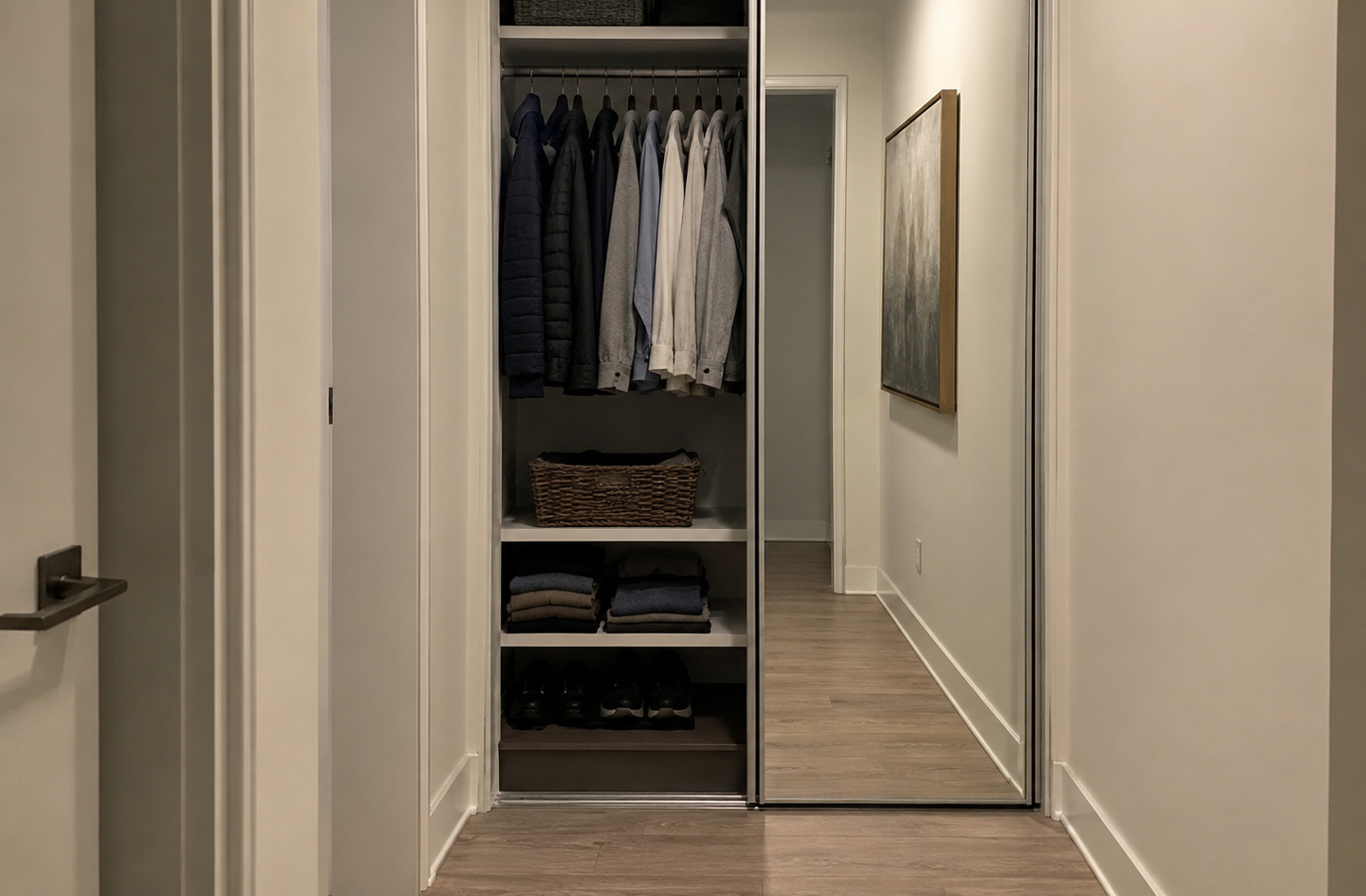
Split it into two zones. The daily zone sits behind the door opening, within easy reach. It holds in-season coats on the rod at about 4 inches each1, boots on a raised rack and gloves on the door. The overflow zone sits above and beside it, with off-season clothing in labeled bins on a 12-inch shelf2 and bagged coats in the hidden ends of the rod.
Key Takeaways
- A hall closet built to the 24-inch minimum hanging depth2 fits coats at full depth, while shoes, hats and folded clothes need only 10 to 13 inches2.
- A 1967 extension circular allows about 4 inches of rod per coat1, so a 36-inch rod holds about nine coats. Bulky modern coats need more.
- Wet coats and boots need to dry before the door closes on them. EPA notes that damp materials dried within 24-48 hours of a leak or spill will in most cases not grow mold5.
- The common mistake is filling the closet front to back with overflow, which pushes the daily coats onto chairs and hallway hooks.
Small Hallway Closet Organization Ideas Start With Two Jobs
A small hallway closet does two jobs at once, and most of its clutter comes from letting those jobs share the same space. The first job is daily: coats, shoes, umbrellas and bags that leave and return every day. The second is overflow: clothing the bedroom closet cannot hold, such as off-season coats, sweaters and spare shoes.
Overflow storage is space set aside for items you keep but do not use this week, such as a winter coat in July or sandals in January. An Oregon State University Extension circular sets out the daily list for an entrance closet. It says closets for outdoor wraps near the entrance should be planned for use by guests1, with provision for jackets, children’s coats, hats, umbrellas, purses and boots1.
Overflow therefore has to fit around that daily list, never on top of it. The organizing rule follows directly. The stretch of rod behind the door opening, the middle height band and the door belong to daily use. The top shelf and the hidden ends of the rod belong to overflow. A 1964 North Carolina extension guide states the same principle in general form, advising readers to store frequently used items within easy reach2.
A hall closet that feels full is usually a daily closet buried under overflow, not a closet that is too small for its job.
1. Split the Rod Into a Daily Stretch and Overflow Ends – Best for Closets Doing Two Jobs
The rod is the most contested part of a hall closet, so give each job a fixed share of it before buying anything. Oregon State’s circular allows 4 inches of rod space for each coat1. Count the coats your household wears this season, add room for a guest or two. That total becomes the daily stretch, directly behind the door opening.
By Small Space Logic arithmetic on that allowance1, a 36-inch rod holds about nine coats and a 48-inch rod holds about twelve. A household of three with two in-season coats each needs about 24 inches, plus about 8 inches for two guests. On a 48-inch rod, that leaves 16 inches of hidden ends for overflow: room for two or three bagged coats, fewer if they are bulky.
In a reach-in closet the ends of the rod sit behind the walls on either side of the opening, so they are the natural overflow zone. Mark both edges of the daily stretch with a rod divider or a strip of ribbon. When overflow creeps past a marker, it has run out of budget, and something has to move to the top shelf or out of the closet entirely.
The marker converts a vague sense of a full closet into a visible budget: daily coats first, overflow only in the inches that remain.
What about short jackets and children’s coats?
The same circular suggests providing for jackets as well as long coats by suspending a second rod from the main clothes pole1. Children’s clothes for ages 3 to 12 need 30 to 45 inches of hanging height, against 63 inches for adult coats1. A lower rod under the short jackets gives children a reachable zone of their own, and a strap-hung rod needs no drilling in a rental.
2. Measure the Depth Before Choosing a Rod – Best for Shallow Hall Closets
Closet depth decides how a hall closet can hold coats, so measure it before buying a rod, a rack or a single bin. Clothes on hangers, even heavy coats, can be hung in a closet 24 inches deep2, and that depth is the recommended minimum for hanging storage2. Measure from the back wall to the inside face of the door frame.
Below that depth, a standard rod running side to side leaves coat shoulders pressed against the closed door. Oregon State’s circular offers a solution for a shallow closet less than 24 inches deep: one or more extension rods1. Extension rods are rods mounted front to back, so clothes hang parallel to the back of the closet and a slight pull brings each garment out1.
Depth also decides what the door can carry. An over-the-door rack holding hangers makes good use of space when a closet is 30 inches or more deep1. In a closet built to the 24-inch minimum, those hangers would collide with the coats, so the door should carry flat items only.
Everything except hanging coats fits in roughly half the depth. That is why a shallow hall closet can still hold shelves and shoe racks at the sides or above the rod. If the rod or shelves need to move, the small closet redesign plan sets rod heights and shelf depths before anything is replaced.
Measure depth before width: depth decides whether coats, a door rack and a shoe shelf can share one closet at all.
3. Bag Off-Season Coats in the Hidden Ends of the Rod – Best for Winter Coats in Summer
Off-season coats belong in garment bags at the hidden ends of the rod, beside the door opening, where they stay protected and out of the daily path. The North Carolina guide notes that garment bags protect clothing against dust and provide excellent storage for out-of-season clothing2. In a hall closet, bags also stop the daily coats from rubbing against heavy wool all season.
Wool needs one more step before it goes in. Clothes moths are small insects that damage animal materials, including wool, fur, hides, hair and feathers6. The adults avoid light and tend to hide when disturbed6, and a closed closet used mainly for storage is exactly that kind of dark, quiet space.
The National Pesticide Information Center advises washing or dry-cleaning clothes before long-term storage and keeping them in airtight bags and containers6. Use airtight garment bags for wool coats that hang through a season and sealed, lidded bins for folded wool. A breathable fabric bag keeps dust off, but it is not the airtight storage NPIC describes. Keep the closet floor clear of dust and pet hair, which NPIC also lists as a prevention step6.
Overflow that hangs untouched for months is the overflow most worth bagging; daily coats stay unbagged so they leave in one motion.
4. Give Boots a Drip Rack Instead of the Closet Floor – Best for Wet-Weather Entries
Boots need a raised, drained spot in a hall closet, or they leave a damp floor under the coats. Oregon State’s circular describes a slotted wooden rack or a shelf of hardware cloth about 6 inches above the floor to hold boots1. It adds that aluminum foil, a plastic sheet or heavy paper below will catch drips1.
A drip rack is a slatted or mesh shelf that lifts footwear off the floor so water falls into a tray underneath. A rubber boot tray under a wire shoe rack does the same job today, and neither needs a single screw. Empty and wipe the tray after wet days, because standing water in a closed closet becomes a moisture source for everything stored above it.
Overflow shoes go higher. The North Carolina shoe-shelf table allows 9 inches of width and 13 inches of depth for men’s shoes, and 7 inches by 10 inches for women’s2. At those widths, a 36-inch shelf holds about four pairs of men’s shoes or five pairs of women’s. A 12-inch shelf takes most women’s pairs, while men’s pairs need a shelf about 13 inches deep.
Daily shoes sit low on a rack that drains; overflow shoes sit high in boxes that stay dry.
5. Let Wet Coats Dry Before the Door Closes – Best for Rain and Snow Climates
A wet coat closed into a packed hall closet shares its moisture with every overflow item around it. The U.S. Environmental Protection Agency advises keeping indoor humidity below 60 percent, ideally between 30 and 50 percent5. A humidity meter is a small instrument costing about $10 to $50 at many hardware stores5, so checking the closet after a wet week is inexpensive.
Relative humidity is the amount of water vapor in the air compared with the most the air could hold at that temperature. The EPA mold guidance sets the drying window plainly:
“If wet or damp materials or areas are dried 24-48 hours after a leak or spill happens, in most cases mold will not grow.”5
U.S. Environmental Protection Agency, A Brief Guide to Mold, Moisture and Your Home5
Hang a dripping coat on a hook or a door-mounted rack outside the closet until it is dry to the touch, then move it to the rod. Oregon State’s circular went a step further, noting that the door should include vents if wet wraps are to be stored there1. Replacing a solid door with a louvered one is a landlord decision in a rental; leaving the door ajar on wet days is the non-permanent alternative.
Moisture is an overflow problem: the daily coat leaves again tomorrow, but the bagged wool beside it sits in that damp air for months.
6. Give the Top Shelf to Labeled Bins, One Season Each – Best for Sweaters, Hats and Off-Season Accessories
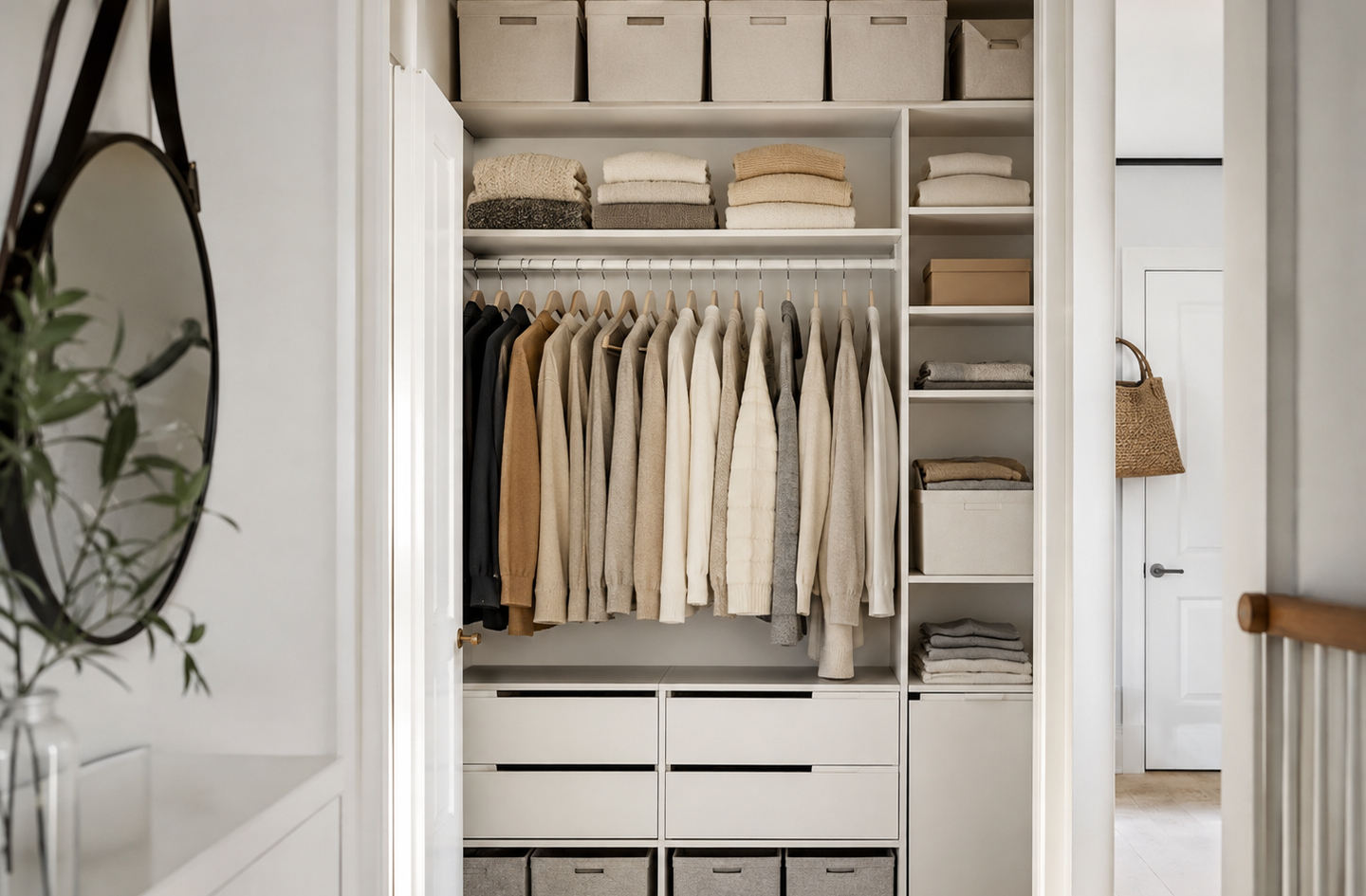
The shelf above the rod is the natural overflow zone, because reaching up there is slower and should happen only a few times a year. A 12-inch shelf will hold most hats, folded garments, shoes and clothing accessories2. Oregon State’s circular adds that out-of-season and seldom-used articles can be kept on the higher shelves1.
Accessibility standards set the high forward reach at 48 inches maximum and the low forward reach at 15 inches minimum3. That band is drawn for a person using a wheelchair, so it is a conservative guide to easy reach rather than a limit for every adult. A shelf above a coat rod sits well beyond it, which is precisely why it suits items needed once a season.
Use one bin per category and season: winter hats and gloves, summer sun hats, spare scarves. Label the short end that faces the room, and keep a folding step stool on a hook inside the closet. The seasonal swap then takes a few minutes instead of a balancing act on a dining chair.
Put on the top shelf only what you would be content to reach for twice a year.
7. Put Flat Accessories on the Inside of the Door – Best for Scarves, Gloves and Caps
The inside of a hall closet door is storage that costs no rod and no shelf, as long as whatever it carries stays flat. Oregon State’s circular calls the closet door a handy place for shallow racks or bins to hold scarves, gloves or caps1. It also suggests lining doors with pegboard to hang umbrellas and jackets1.
Flat matters because of depth. In a closet built to the 24-inch minimum2, coats already fill the space up to the door. A deep pocket organizer presses into them and stops the door from closing. Keep door pockets for gloves, hats, dog leashes and reusable bags. Leave hanger racks for closets 30 inches or more deep1.
Over-the-door hooks and pocket organizers need no tools, which makes them the renter-friendly default. Choose a model whose hooks are thin enough for the door to close fully, and keep its heaviest pockets at the bottom.
Daily accessories on the door mean the overflow bins above can stay closed for the whole season.
8. Keep Hallway Hooks Shallow and Few – Best for Coats That Spill Out of the Closet
When the closet overflows, coats migrate onto hallway hooks, and the hallway pays for it. Accessibility standards set the clear width of walking surfaces at 36 inches minimum4. They also limit wall-mounted objects between 27 and 80 inches above the floor to 4 inches of protrusion into a circulation path3.
The protrusion limit is illustrated with a person using a cane walking along a wall3. A private hallway is not bound by that standard, but it is a useful test. A coat on a hook projects well beyond 4 inches, so a row of loaded hooks quietly consumes the width people walk through.
Keep outside hooks to one per person, mounted at the end of the hallway nearest the door. Treat them as a drying station for wet coats rather than a second closet. Adhesive hooks rated for the coat’s weight avoid drilling in a rental.
A hallway lined with coats is the closet’s overflow made visible; fix the rod budget and the hooks empty themselves.
9. Swap the Overflow Twice a Year – Best for Keeping the Hall Closet From Silting Up
Overflow storage only works if it rotates, so tie the seasonal swap to the calendar. The North Carolina guide suggests washing closet walls two or three times a year, when you put away each past season’s clothing2. That swap is the moment to move this season’s coats to the daily stretch and bag last season’s.
“Another closet without thought of how items are to be stored may do very little to relieve cluttered and crowded closets.”
Bernice Strawn, Extension Home Management and Equipment Specialist, Oregon State University1
That line, from a circular reprinted in 19671, still describes the hall closet that turns into a second junk drawer. During each swap, anything that has not left the closet for a full year goes back to its owner, to donation or to another room. When the bedroom closet is the real problem, the step-by-step wardrobe guide covers rotation and editing at the source.
If overflow still fills the hall closet after editing, the clothing may need furniture rather than another closet. The armoire, dresser or garment rack comparison weighs those options for a small bedroom.
A swap that happens twice a year keeps overflow honest; one that never happens turns the hall closet into permanent storage for the wrong things.
Which Small Hall Closet Organization Idea Fits Your Closet
The nine ideas differ mainly in where they sit and what they store. Coats need the full 24-inch hanging depth2, while the door, the top shelf and the floor rack carry everything else. Read the table by zone first, then by the items each idea holds.
| Idea | Zone | Space used | Stores | Renter-friendly version |
|---|---|---|---|---|
| 1. Split the rod | Rod | About 4 in per coat | Daily and off-season coats | Rod divider or ribbon |
| 2. Measure depth | Whole closet | 24 in minimum for coats | Decides the layout | Tension or strap-hung rod |
| 3. Garment bags | Hidden rod ends | Rod space only | Off-season coats | Zippered garment bags |
| 4. Drip rack | Floor | Rack about 6 in high | Daily boots and shoes | Boot tray and wire rack |
| 5. Dry first | Outside, then rod | One hook | Wet coats | Adhesive hook, door ajar |
| 6. Top-shelf bins | Above the rod | 12 in shelf | Sweaters, hats, accessories | Lidded bins and a stool |
| 7. Door storage | Door | Flat items only | Scarves, gloves, caps | Over-the-door pockets |
| 8. Hallway hooks | Hallway wall | One hook per person | Wet or spill-over coats | Adhesive hooks |
| 9. Seasonal swap | Whole closet | None | Keeps overflow rotating | Calendar reminder |
Fill the closet in order of use: daily items claim their zones first, and overflow takes only what is left.
How We Selected These Ideas
Small Space Logic selected these nine ideas from a research-only review of published guidance. The sources are two university extension guides on closet storage, the 2010 ADA accessibility standards, EPA moisture guidance and NPIC pest guidance. No idea was hands-on tested, and every measurement comes from those sources or from arithmetic on them.
Each idea was kept only if it passed four criteria:
- Daily access: it keeps the coats and shoes used every day within easy reach.
- Depth fit: it works in a closet built to the minimum hanging depth, or states the extra depth it needs.
- Renter fit: it has a freestanding, tension, adhesive or over-the-door version that needs no drilling.
- Moisture and pests: it does not trap damp clothing or leave wool unprotected for a season.
Product-first ideas, such as decorative baskets bought before measuring, were dropped. This article carries no affiliate links, and no retailer paid for a place on the list.
Frequently Asked Questions
How do you organize a small hall closet for coats and overflow?
Split it into zones. Keep in-season coats on the stretch of rod behind the door opening, allowing about 4 inches of rod each1. Bag off-season coats in the hidden ends beside the opening, put folded overflow in labeled bins on the top shelf, and keep boots on a raised drip rack.
How deep should a hallway coat closet be?
At least 24 inches for coats on a standard side-to-side rod, the minimum recommended depth for hanging clothes2. A shallower closet can use extension rods mounted front to back. An over-the-door rack of hangers needs a closet about 30 inches deep or more1.
How many coats fit in a hall closet?
Plan on about 4 inches of rod per coat1. On that allowance, a 36-inch rod holds about nine coats and a 48-inch rod about twelve. Bulky winter coats and bagged coats take more room, so measure the space your thickest coat actually uses on its hanger.
Should you store wet coats in a hall closet?
Not until they dry. EPA notes that damp materials dried within 24-48 hours of a leak or spill will in most cases not grow mold5. It advises indoor humidity below 60 percent, ideally 30 to 50 percent. Hang a wet coat on an outside hook first, then move it to the rod once it is dry.
How do you protect off-season wool coats in a hall closet?
Clean them first, then store them sealed. The National Pesticide Information Center advises washing or dry-cleaning clothes before long-term storage and keeping them in airtight bags and containers6. Check the bagged coats at each seasonal swap, and keep the closet floor free of dust and pet hair.
Limitations and Edge Cases
- The rod, shelf and shoe figures come from extension guides published in the 1960s. Coats and hangers have changed since, so measure your bulkiest coat on its hanger before setting the rod split.
- The reach, clear-width and protrusion figures come from accessibility standards drawn for public buildings and for wheelchair and cane users. They are a conservative planning band for a private home, not a residential code requirement.
- A hall closet deep enough to walk into works more like a small walk-in, and the walk-in floor guide covers that layout.
- Replacing a closet door, adding vents or wiring a light is project-specific work for a licensed contractor or electrician, and it needs written landlord approval in a rental.
References
Methodology: every sourced figure in this article comes from an independent published source and links to the page that carries it; the rod capacities, the daily and overflow rod split and the depth chart are Small Space Logic calculations from those figures. The article is written by Small Space Logic’s founder and updated when a source or a recommendation materially changes.
- Oregon State University Extension – Ideas for Better Clothes Closets, Extension Circular 691, Bernice Strawn, reprinted April 1967 (ScholarsArchive at Oregon State University).
- North Carolina Agricultural Extension Service – My Clothing Storage Area: Idea Guide for Early Teens, 4-H Home Improvement Project, Edith B. McGlamery, February 1964 (NC State University Libraries archive).
- U.S. Access Board – ADA Accessibility Standards, Chapter 3: Building Blocks, sections 307 Protruding Objects and 308 Reach Ranges, 2010 ADA Standards for Accessible Design.
- U.S. Access Board – ADA Accessibility Standards, Chapter 4: Accessible Routes, section 403.5.1 Clear Width.
- U.S. Environmental Protection Agency – A Brief Guide to Mold, Moisture and Your Home (updated February 18, 2026).
- National Pesticide Information Center – Clothes Moths, Oregon State University and U.S. EPA cooperative program (updated May 1, 2026).
Conclusion
A small hallway closet holds clothing overflow well when the daily job claims the front and the overflow takes what is left. Budget the rod at about 4 inches per coat1 and bag off-season coats in the hidden ends. Then lift boots onto a drip rack and send folded overflow to the top shelf. Engineer the layout first, decorate second.
For how the hall closet fits the wider topic of closet storage, see the small closet storage overview.