
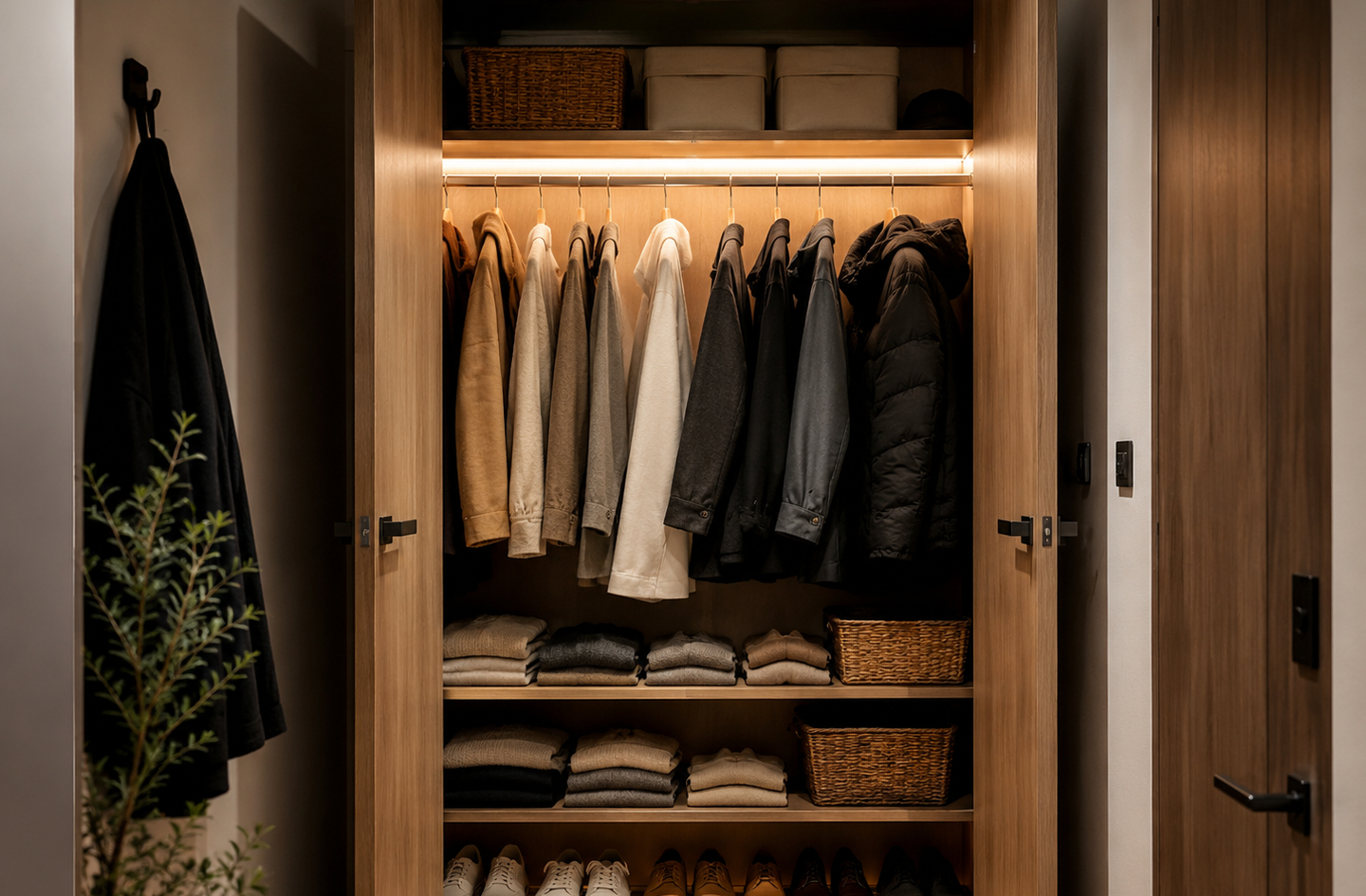
A small coat closet has to hold far more than coats. Bags, backpacks, hats, gloves, umbrellas and boots all arrive at the same door, and each needs a different kind of space. The small closet storage overview covers the wider topic; this guide works on the closet by the entry. These small coat closet organization ideas sort every item by its shape first. A closet built around hooks needs only 16 inches of depth, against 24 inches for a rod1, so shape decides the layout.
Quick Answer
How do you organize a small coat closet for outerwear and bags?
Sort what you store by shape, then give each shape its own place. Long coats go on a short stretch of rod at about 4 inches each1. Daily jackets, bags and backpacks go on staggered rows of hooks. Hats and purses go on a 12-inch shelf1, umbrellas go on the door, and boots sit on a ventilated rack near the floor.
Key Takeaways
- Clothes stored on hooks need a closet only 16 inches deep, while a rod running parallel to the opening needs 24 inches1.
- Accessibility guidance sets the highest children’s reach at 36, 40 or 44 inches by age3, so children’s hooks belong below the 48 inches a 1953 circular used1.
- A 36-inch clear walking width4 is a useful yardstick for the entry, and every bag that lives outside the closet eats into it.
- The common mistake is hanging bags and backpacks on the coat rod, where each strap takes rod space a coat needs.
Small Coat Closet Organization Ideas Start With Item Shape
A coat closet is a closet near the main entrance that holds the outerwear and gear people pick up on the way out. An Oregon State University Extension circular sets out what it must hold. It says closets for outdoor wraps near the entrance should be planned for guests2, with provision for jackets, children’s coats, hats, umbrellas, purses and boots2.
That list, plus the daily bags and backpacks, sorts into five shapes. Long coats hang full length. Jackets, bags, backpacks and scarves hang from a single point. Hats, gloves and purses sit flat or upright. Umbrellas are tall and narrow, and boots sit on the floor and arrive wet. A closet with only a rod and a shelf serves two of those shapes well and forces the other three onto the rod or the floor.
A University of Illinois circular from 1953 made the same point about storage in general. It based its recommended storage dimensions on measurements of the items stored1, and its author named the usual error:
“Volume, rather than the specific way these storage places are to be used, is too often the basis for design.”
Helen E. McCollough, University of Illinois Small Homes Council, Household Storage Units (1953)1
The same circular states its rule plainly: store items at point of use1. In a coat closet, the point of use is the door, so each shape gets the spot closest to the hand that reaches for it.
A coat closet rarely fails for lack of space; it fails because five shapes of item compete for the single shape of storage it was built around.
1. Put Daily Jackets and Bags on Hooks, Not Hangers – Best for Shallow Coat Closets
Hooks need far less closet depth than a rod, which makes them the efficient choice in a small coat closet for anything that hangs from a single point. The Illinois circular notes that work clothes and children’s play clothes are usually stored on hooks rather than hangers1. Such a closet, it says, needs to be only 16 inches deep, although 20 to 24 inches is preferred1.
A hook closet is a closet, or one section of a closet, where items hang from wall-mounted hooks instead of from hangers on a rod. It suits the daily layer of a coat closet: the rain shell, the tote, the school backpack and the scarf worn every morning. Oregon State’s circular agrees that work clothes can usually be hung on hooks to save space2.
The Illinois layout places two rows of hooks 12 inches apart, staggered for accessibility, across the back of the closet and around both ends1. It sets adults’ hooks 60 inches above the floor and puts the top shelf 4 inches above the hooks1. Staggering matters for bags, because a strap on the upper row falls between the hooks below instead of covering them. For a household member who uses a wheelchair, the adult reach band of 15 to 48 inches is the better guide for that person’s hooks3.
Depth is where hooks earn their place. A closet 16 to 23 inches deep is too shallow for a rod parallel to the opening, yet deep enough for a full hook closet1. In a rental, a hook rail on a freestanding back panel or a set of over-the-door hooks gives the same layout without drilling.
Hooks take the daily layer off the rod, which frees the rod for the long coats that genuinely need hangers.
2. Keep a Short Rod Stretch for Long Coats Only – Best for Wool and Down Outerwear
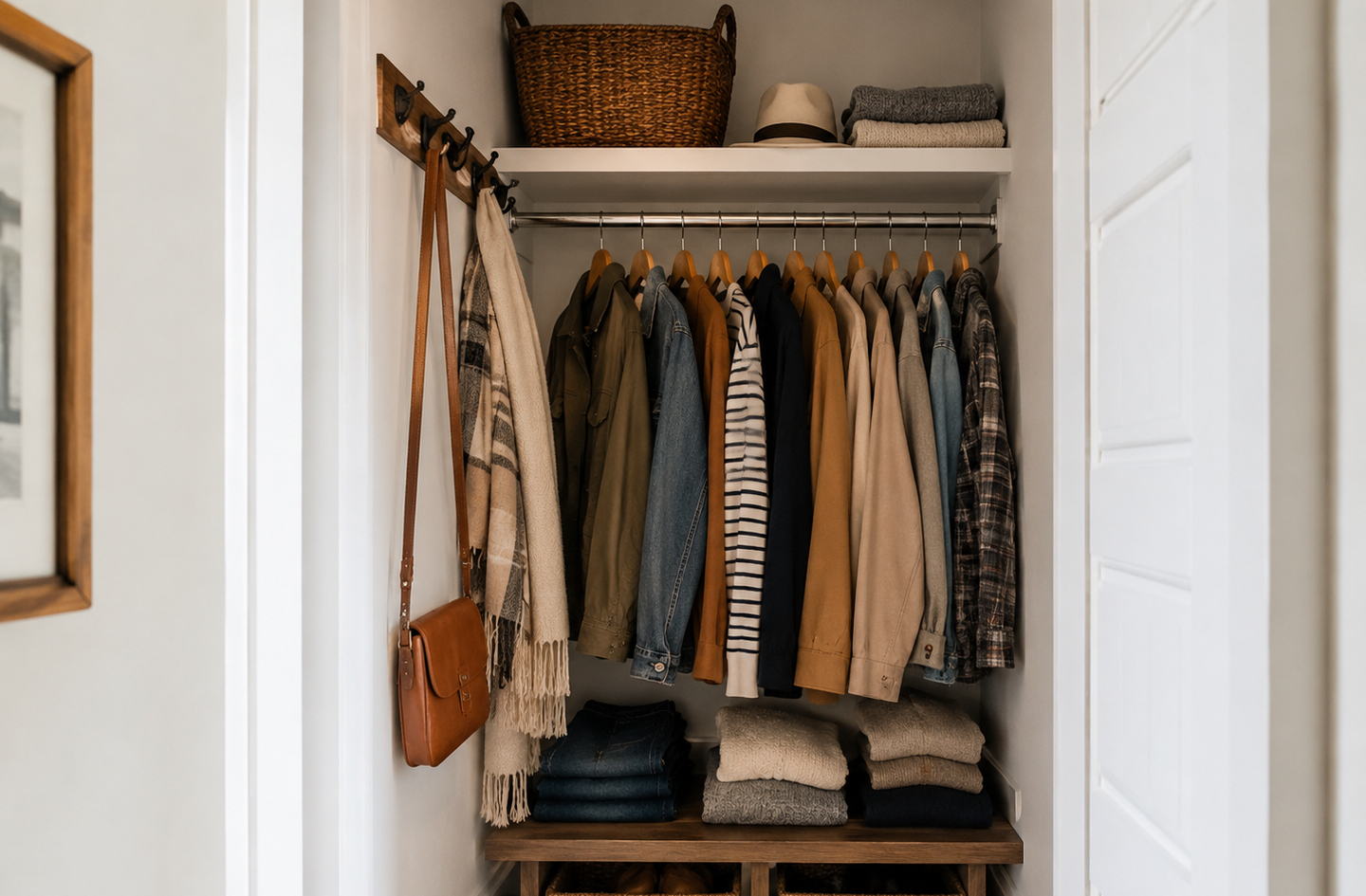
Long coats need hangers and a rod, but in a small coat closet the rod should be only as long as those coats require. The Illinois circular allows 4 inches of rod space for each heavy coat1, the same allowance Oregon State gives for each coat2. It sets the rod for adults’ clothing at 64 inches above the floor1.
On that allowance1, Small Space Logic’s arithmetic gives about six heavy coats per 24 inches of rod. Size the rod to the long coats in season, and let the remaining width go to hooks. The hallway closet overflow guide covers splitting a longer rod between daily coats and bagged off-season ones.
Keep bags off this rod entirely. A tote hung by its handles on a hanger takes rod space, and its strap tangles with the coat beside it. If the closet is shallower than 24 inches, Oregon State suggests extension rods, with clothes hanging parallel to the back of the closet2. If the interior needs new rods or shelves, the small closet redesign plan sets heights and depths before anything is replaced.
The rod is for garments that must hang full length; everything else that hangs belongs on a hook.
3. Set Children’s Hooks at Their Own Reach – Best for Families With Backpacks
Children’s hooks belong inside children’s reach, and that is lower than the 1953 circular set them. The 1953 Illinois circular set hooks for children’s clothing 48 inches above the floor1. The 2010 ADA Standards now carry an advisory table of children’s reach ranges, and the Access Board names coat hooks directly:
“The following table provides guidance on reach ranges for children according to age where building elements such as coat hooks, lockers, or operable parts are designed for use primarily by children.”
U.S. Access Board, Advisory 308.1, 2010 ADA Standards for Accessible Design3
Reach range is the band of heights above the floor within which a person can reach an object, from the lowest point to the highest. The table’s high reach is 36 inches at ages 3 and 4, 40 inches at ages 5 to 8 and 44 inches at ages 9 to 123. The low reach runs from 20 inches for the youngest group down to 16 inches3.
Every one of those maximums sits below the 1953 hook height1. A hook at 48 inches is 12 inches above a preschooler’s high reach and 4 inches above a 12-year-old’s3. Set the children’s row at or just under the youngest user’s high reach, and raise it as they grow. The adult band in the chart is drawn for a person using a wheelchair, so it is a conservative guide rather than a standing adult’s reach3. Adhesive hooks or a strap-hung rail make that change quick in a rental.
A backpack hook a child cannot reach becomes a backpack on the floor, which is where entryway clutter usually starts.
4. Stand Purses and Handbags Upright on a Side Shelf – Best for Structured Bags
Structured purses and handbags keep their shape best standing upright on a shelf, and the side shelves of a coat closet suit them. Oregon State’s circular says shelves at the sides can be used to hold purses, gloves and hats2. It also suggests a rubber-covered plate rack to store purses in a vertical position on closet shelves2.
A shelf does not need much depth for this. The Illinois circular notes that a shelf 12 inches deep will hold hats, folded garments, shoes and purses1. A file sorter or a row of shelf dividers does the plate rack’s job today, and neither needs tools.
Sort bags by how often they leave the house. The everyday bag goes on a hook at the front. Structured bags used weekly stand in the dividers at shoulder height. Evening and travel bags go to the top shelf, where reaching up a few times a year costs little. A soft tote can hold a second soft tote inside it, so one hook serves both.
Upright bags on a shelf stay visible and keep their shape; a heap of bags on the closet floor does neither.
5. Give Hats, Gloves and Scarves Small Shelves of Their Own – Best for Winter Accessories
Small accessories need small compartments, or they collect in one basket that nobody can search. The Illinois circular suggests a tier of shelves for children’s caps, mittens and scarves across one end of the closet1. It spaces those shelves 8 inches apart and widens the closet by 8 inches to fit them1.
Oregon State’s circular places a hat rack above an umbrella rack on the door, holding two hats2. It also calls the door a handy place for shallow racks or bins to hold scarves, gloves or caps2. One small bin per person on a side shelf works the same way and keeps one person’s gloves out of another person’s pile.
Wool accessories need care through the off-season. Clothes moths are small insects whose larvae feed on animal materials such as wool, fur, hides, hair and feathers6. The National Pesticide Information Center advises washing or dry-cleaning items before long-term storage and keeping them in airtight bags and containers6. Each spring, move winter hats and scarves into a sealed bin on the top shelf.
One compartment per person for each kind of accessory turns a morning glove search into a single reach.
6. Rack Umbrellas on the Door, Not in the Corner – Best for Rainy Climates
Umbrellas are tall, narrow and often wet, so they need a spot that holds them upright and lets them drip. Oregon State’s circular describes an umbrella rack built from wood slats attached to a closet door2. It also suggests lining a closet door with pegboard to hang umbrellas and jackets2.
Leaning umbrellas in a back corner is the usual alternative, and it fails twice. The umbrellas topple when the closet opens, and a wet canopy rests against stored coats. The U.S. Environmental Protection Agency advises keeping indoor humidity below 60 percent, ideally between 30 and 50 percent5. A closed closet full of damp fabric works against that target.
Open a wet umbrella to dry outside the closet, then hang it closed on the door. A slim over-the-door rack, or two hooks with a drip tray beneath, does the job without drilling. Compact folding umbrellas can live in a bag pocket or a door bin instead, which leaves the rack for full-length ones.
An umbrella on the door is one less tall object competing with the coats for the corners of the closet.
7. Lift Boots Onto a Ventilated Shelf – Best for Wet and Snowy Entries
Boots belong on a raised, ventilated shelf rather than the closet floor, because they arrive wet and otherwise claim the whole closet floor. The Illinois circular specifies a removable shelf of slats 4 inches from the floor as a ventilated place for damp overshoes, boots and shoes1. Oregon State’s version is a slotted rack about 6 inches above the floor2.
Tall boots need one more device, because their shafts fold over and cover the slats. Oregon State’s circular describes a boot rack made from a single board fitted with as many dowel rods as there are boots2. Today a freestanding peg rack or a set of boot shapers does the same job, holding each shaft upright so air reaches the inside.
Keep the boot shelf for the pairs worn this week and send the rest back to bedroom closets. Knock off snow and standing water before boots go in, and drying routines for soaked gear stay outside the closet entirely.
Boots stored upright on slats take a fraction of the floor that a pile of boots takes, and they stop being a moisture source for the coats above.
8. Reserve a Landing Zone for Guests and the Everyday Bag – Best for Entries With No Room to Spare
The space just inside the closet opening decides whether bags land in the closet or on the entry floor. Oregon State’s circular suggests a rack on the inside of the closet door, below a small mirror, for purses and other belongings of guests or family members2. The same circular plans entrance closets for guests from the start2.
A landing zone is a reserved spot where items set down on arrival get a home before they reach a chair or the floor. In a coat closet, that means the space nearest the opening. It holds one hook for the everyday bag, one spare hook kept empty for a guest’s coat and a small tray for keys.
Clear width means the unobstructed width of a walking path, measured between whatever projects into it. Accessibility standards set it at 36 inches minimum for walking surfaces and 32 inches for door openings4. A backpack on a wall hook sticks out far beyond the 4 inches those standards allow for wall-mounted objects3, so it narrows the entry.
When the overflow really comes from a bedroom closet, the step-by-step wardrobe guide deals with it at the source.
One empty hook by the opening catches the guest’s coat and the everyday bag before the entry floor does.
Which Coat Closet Idea Fits Each Item
The eight ideas differ mainly in the shape of item they serve and the space that shape needs. Hooks need a closet 16 inches deep, while a parallel rod needs 24 inches1. Read the table by item first, then check the space column against your own closet.
| Item | Shape | Storage | Space it needs | Renter-friendly version |
|---|---|---|---|---|
| Long coats | Full-length hanging | Short rod | About 4 in of rod each, 24 in deep | Tension or strap-hung rod |
| Daily jackets, scarves | Single-point hanging | Two staggered hook rows | Closet 16 in deep or more | Hook rail on a freestanding panel |
| Bags, backpacks | Single-point hanging | Hooks at user height | Adults about 60 in; children 36 to 44 in | Adhesive hooks rated for the load |
| Purses, handbags | Upright | Side shelf with dividers | 12 in shelf | File sorter or shelf dividers |
| Hats, gloves, caps | Flat and small | Small shelves or bins | Shelves 8 in apart | One bin per person |
| Umbrellas | Tall and narrow | Door rack | Door face only | Over-the-door rack and drip tray |
| Boots | Floor, often wet | Slatted shelf or peg rack | 4 to 6 in above the floor | Freestanding peg rack or boot shapers |
| Guest coat, everyday bag | Landing zone | Hooks nearest the opening | One spare hook kept empty | Over-the-door hook rack |
Give each shape its own place before buying anything, and the closet usually needs fewer organizers than expected.
How We Selected These Ideas
Small Space Logic selected these eight ideas from a research-only review of published guidance. The sources are two university extension circulars on closet storage, the 2010 ADA accessibility standards, EPA moisture guidance and NPIC pest guidance. No idea was hands-on tested, and every measurement comes from those sources or from arithmetic on them.
Each idea was kept only if it passed four criteria:
- Shape fit: it matches the way an item actually hangs, stands or lies.
- Reach: it keeps daily items within easy reach of the people who use them, including children.
- Renter fit: it has a freestanding, tension, adhesive or over-the-door version that needs no drilling.
- Moisture: it lets wet boots, umbrellas and coats dry instead of trapping damp inside the closet.
Decor-first ideas, such as matching baskets bought before measuring, were dropped. This article carries no affiliate links, and no retailer paid for a place on the list.
Frequently Asked Questions
How do you organize a small coat closet with bags?
Put bags on hooks, not on the coat rod. Daily bags and backpacks hang on staggered rows of hooks, with adults’ hooks about 60 inches above the floor1. Structured purses stand upright in dividers on a side shelf, and evening or travel bags go to the top shelf.
How deep does a coat closet need to be?
About 24 inches for a rod running parallel with the opening1. A closet used mainly for hooks can be only 16 inches deep, although 20 to 24 inches is preferred. A closet shallower than 24 inches can also use extension rods mounted front to back.
How high should coat hooks be for kids?
At or below the child’s high reach: 36 inches at ages 3 and 4, 40 at ages 5 to 8 and 44 at ages 9 to 123. Raise the hook row as children grow; adhesive or strap-hung hooks make that easy in a rental.
Where should umbrellas go in a coat closet?
On the inside of the door, in a slim rack or on hooks above a drip tray. Dry a wet umbrella open outside the closet first. EPA advises keeping indoor humidity below 60 percent5, and a damp canopy closed in with wool coats works against that.
How many coats fit in a small coat closet?
Allow about 4 inches of rod per heavy coat1; on that allowance, a 24-inch stretch of rod holds about six. Moving daily jackets and bags to hooks frees that rod for long coats, often the difference between a closet door that closes and one that does not.
Limitations and Edge Cases
- The rod, hook and shelf figures come from extension circulars of the 1950s and 1960s. Coats and bags are often bulkier now, so measure your thickest coat on its hanger before sizing the rod.
- The reach, clear-width and protrusion figures come from accessibility standards for public buildings. They are a conservative planning band for a private home, not a residential code requirement.
- A coat closet deep enough to walk into works more like a small walk-in, and the walk-in floor guide covers that layout.
- Moving a closet door, adding vents or wiring a light is project-specific work for a licensed contractor or electrician and needs written landlord approval in a rental.
References
Methodology: every sourced figure in this article comes from an independent published source and links to the page that carries it; the five-shape sort, the rod capacity and the reach-versus-hook chart are Small Space Logic calculations from those figures. The article is written by Small Space Logic’s founder and updated when a source or a recommendation materially changes.
- University of Illinois Small Homes Council – Household Storage Units, Circular C5.1, Helen E. McCollough, 1953 (IDEALS repository, University of Illinois Urbana-Champaign).
- Oregon State University Extension – Ideas for Better Clothes Closets, Extension Circular 691, Bernice Strawn, reprinted April 1967 (ScholarsArchive at Oregon State University).
- U.S. Access Board – ADA Accessibility Standards, Chapter 3: Building Blocks, sections 307 Protruding Objects and 308 Reach Ranges with Advisory 308.1, 2010 ADA Standards for Accessible Design.
- U.S. Access Board – ADA Accessibility Standards, Chapter 4: Accessible Routes, sections 403.5.1 and 404.2.3 Clear Width.
- U.S. Environmental Protection Agency – A Brief Guide to Mold, Moisture and Your Home (updated February 18, 2026).
- National Pesticide Information Center – Clothes Moths, Oregon State University and U.S. EPA cooperative program (updated May 1, 2026).
Conclusion
A small coat closet holds outerwear and bags well when each shape of item gets its own place. Daily jackets and bags go on staggered hooks, long coats on a short rod at about 4 inches each1, and purses upright on a side shelf. Umbrellas go on the door, boots on a slatted shelf, and the entry keeps one drying hook. Engineer the layout first, decorate second.
For how the coat closet fits the wider topic of closet storage, see the small closet storage overview.