
A small closet with lots of clothes feels impossible because every garment competes for the same short stretch of rod. The small closet storage overview covers the wider topic; this guide works on one problem. Here is how to organize a small closet with lots of clothes, in order: edit, rotate by season, zone the rod by length, and shelve folded items and shoes. Extension planners have long allowed at least 4 feet of rod space per person1, and a packed closet is usually holding far more than that.
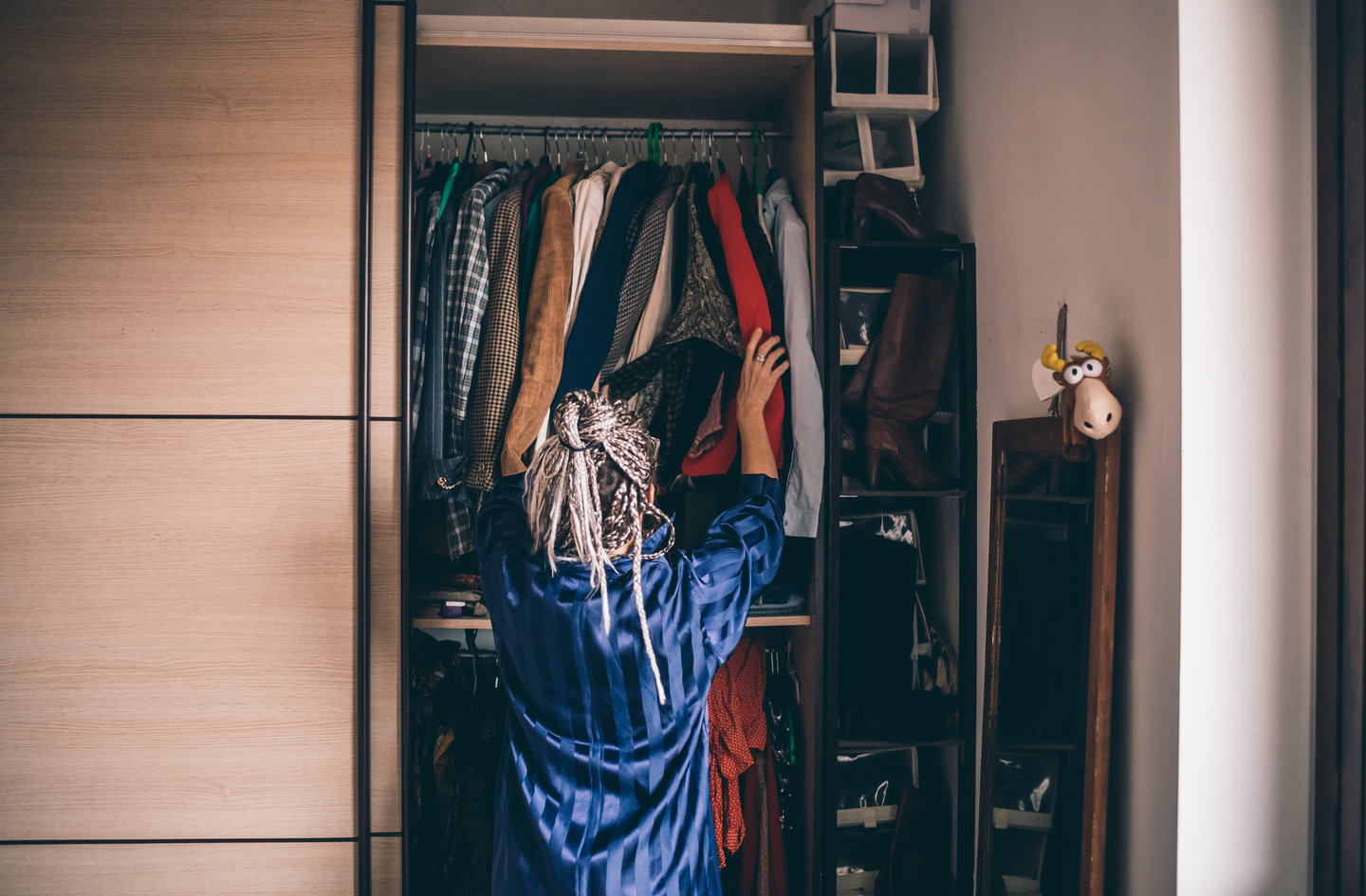
Quick Answer
How do you organize a small closet with lots of clothes?
Remove what you no longer wear, then pack the off-season half of the wardrobe clean and sealed. Group what remains by garment length, so short items can hang on two rods and long items on one. Long dresses and coats need about 63 inches of hanging height1, while shirts, skirts and trousers need 39 to 45. Folded clothes and shoes go on shelves, not the floor.
Key Takeaways
- Rod length is the real budget: extension guidance allows at least 4 feet of rod per person1, and every hanger spends part of it.
- Short garments need only 39 to 45 inches of height1, so two stacked rods hold twice the short clothing on the same wall width.
- Off-season clothes should be washed or dry-cleaned first and stored in airtight containers, the two steps that guard against clothes moths5.
- The common mistake is buying organizers first. A new bin does not fix a rod that is too short or a daily zone hung out of reach.
How to Organize a Small Closet With Lots of Clothes: Start With the Rod
Organizing a small closet with lots of clothes is a capacity problem first and a product problem second. A closet has a fixed length of rod, a fixed shelf depth and a fixed clear height, and every garment uses some of each. A 1964 North Carolina extension guide set a floor of at least 48 inches of rod space for a bedroom closet2. If your rod is shorter than that, the closet starts below a planning minimum that is six decades old.
Rod inches are the horizontal inches of hanging rod a wardrobe uses, counted hanger by hanger. Thinking in rod inches turns “I have no closet space” into a number you can measure, compare and plan against. It also explains why a closet can feel full long before its floor or shelves are.
Before buying anything, decide which kind of problem the closet actually has. Small Space Logic sorts closet friction into four types:
- Layout: rods, shelves and doors sit in the wrong place for the clothes you own.
- Storage: shoes, folded knits or accessories have no assigned home.
- Furniture scale: bulky hangers, deep bins or a wide dresser waste the space they occupy.
- Routine: clothes come out easily but never go back to the same spot.
Most overflowing closets have two or three of these at once. The steps below handle them in a set order, because each fix makes the next one cheaper. Oregon State University’s extension specialist put the routine problem plainly in a closet guide that still reads as current:
“When clothes do not get put back in their proper place, there is usually a reason. The item must be suited to the type of storage and be easy to reach and replace.”
Bernice Strawn, Extension Home Management and Equipment Specialist, Oregon State University1
A closet that holds too much is rarely fixed by a new container. It is fixed by matching each garment to the space its length, fold and frequency of use actually need.
Before You Begin: Measure the Closet and Count the Wardrobe
A tape measure and a notepad tell you more about a small closet than any organizer catalog. Measure four things and write them down before you move a single hanger:
- Rod length: wall to wall, in inches, including any section hidden behind a door panel.
- Depth: from the back wall to the door frame. Hanging clothes need at least 24 inches of depth2.
- Clear height: from the floor to the underside of the top shelf, and from that shelf to the ceiling.
- Door type: hinged, bypass sliding, bifold or no door at all.
Then count the wardrobe by category, not by quality: long garments, short hanging garments, folded clothes, shoes and accessories. A rough count is enough. The point is to see which category is overflowing, because each category has a different fix and a different home.
What you need: a tape measure, a notepad, a few boxes or bags for sorting, and an afternoon. The difficulty is beginner level. Nothing here requires drilling unless you choose to move a rod, and renters can complete every step with freestanding, hook-over or tension-mounted parts.
| Planning item | Figure | Source |
|---|---|---|
| Rod space per person | At least 4 feet | Oregon State Extension1 |
| Rod space in a bedroom closet | At least 48 inches | North Carolina Extension2 |
| Depth for hanging clothes | 24 inches minimum | North Carolina Extension2 |
| Street dresses and coats | 63 inches of hanging height | Oregon State Extension1 |
| Trousers, suits, blouses and skirts | 39 to 45 inches of hanging height | Oregon State Extension1 |
| Shelf for folded clothes and shoes | 12 inches deep holds most items | North Carolina Extension2 |
| Rod allowance per coat | 4 inches | Oregon State Extension1 |
| Conservative reach band | 15 to 48 inches above the floor | U.S. Access Board3 |
If the wardrobe needs more rod inches than the closet has, folding faster will not fix it. Something has to leave the rod: to a shelf, to off-season storage or out of the home.
Step 1: Edit the Wardrobe by Wear, Not by Guilt
By the end of this step, every garment left in the closet is one you wore in the current or most recent season. Editing comes first because every later step costs less time and money with fewer garments to place.
Realistic editing is not minimalism. The goal is not to own less on principle. It is to remove clothes that cost rod inches without earning them: pieces that no longer fit, unworn duplicates, and outfits saved for an occasion that never comes.
- Pull out one category at a time, such as all trousers, rather than emptying the whole closet at once.
- Sort that category into four piles: wear, store, repair and release.
- Return only the wear pile to the rod. The store pile waits for Step 2.
- Bag the release pile for donation or textile drop-off the same day, so it does not drift back.
The release pile matters beyond your own closet. The EPA estimated that the United States generated 17 million tons of textiles in 20184. It put the recycling rate for textiles in clothing and footwear at 13 percent4. Donation and textile drop-off programs keep usable garments out of that waste stream.
When a category is hard to judge, run a wear test instead of guessing. Turn every hanger in that category backward on the rod. When you wear a garment and hang it again, turn its hanger forward. At the end of the season, the backward hangers show exactly what the closet is holding but not using.
You are done when every remaining garment has a clear reason to be in this closet this season. Anything still uncertain goes into the store pile, not back on the rod.
Editing is the only step that adds closet capacity without adding hardware, so it belongs before any purchase.
Step 2: Rotate Off-Season Clothes Out of the Closet
Seasonal rotation is the practice of storing the out-of-season part of a wardrobe somewhere else and swapping it back in when the weather changes. In a small closet, rotation is the largest capacity gain after editing. Heavy coats, sweaters and boots are also the bulkiest things a wardrobe owns.
The storage method decides whether those clothes come back in good shape. The National Pesticide Information Center advises washing clothes in hot water or dry-cleaning them before long-term storage, then keeping them in airtight bags or containers5. For a wool item that cannot be washed, it notes that freezing it in a sealed bag for 2 weeks kills clothes moths5.
- Wash or dry-clean every garment before it goes into storage, including pieces that look clean.
- Pack each category into its own airtight bin or sealed bag, without punctures.
- Label every container with the season and the category, on the side you will see.
- Store the bins somewhere dry, away from exterior walls that turn cold and damp.
Dry matters as much as sealed. The EPA advises keeping indoor humidity below 60 percent, ideally between 30 and 50 percent6. A damp basement or an unvented storage unit fails that test in many climates, so check before you commit a season of clothes to it.
Good places for the off-season bins, in order of preference, are the top shelf of the same closet, under the bed, and a second closet elsewhere in the home. A coat or linen closet can take that role; the guide to hallway closet overflow storage shows how to zone one for seasonal clothes, shoes and accessories.
When no second closet exists, the overflow needs furniture. The comparison of armoires, dressers and garment racks weighs which piece suits clothing that the closet cannot hold.
You are done when the closet holds one season, and the other season sits in labeled, sealed containers in a dry spot.
Rotation turns a closet that must hold a whole year into a closet that only has to hold the next few months, which is a far smaller design problem.
Step 3: Zone the Rod by Garment Length
Grouping hanging clothes by length is the step that makes double hanging possible. Oregon State University Extension listed the average height clothes need to hang. Street dresses and coats need 63 inches1. Trousers, suits, blouses and skirts need 39 to 45 inches1.
Double hanging is a setup with two rods stacked on one wall, so two rows of short garments share the width that one row of long garments would use. It is the most direct way to add rod inches without adding wall.
- Move every long garment to one end of the rod. That end stays single-hung.
- Group the short garments by category: shirts, then jackets, then trousers and skirts.
- Add a second rod under the short section. A hanging rod that hooks over the existing one needs no drilling.
- Within each category, order garments by color or by how often you wear them, whichever way you scan.
Check the height before you buy the second rod. Two short zones stacked need roughly 78 to 90 inches of clear height under the top shelf, using the extension figures. If your closet has less, hang the shortest items, such as shirts and folded trousers, on the lower rod and keep jackets above.
If you plan to move rods or shelves permanently, the closet redesign planning guide covers rod heights, shelf depths and drawer placement before any interior is replaced.
Length zoning is the layout fix underneath most small-closet storage gains. Without it, a second rod has nowhere to go.
Step 4: Put Daily Clothes in the Easiest Reach
The rod you can reach without stretching should hold the clothes you wear most. The reach band is the height range a person can reach without stretching up or bending deeply. The 2010 ADA Standards set an unobstructed forward reach of 15 inches minimum to 48 inches maximum above the floor3.
Those figures are drawn for a person using a wheelchair, not for a standing adult. That makes them a conservative band for any household. A standing adult can reach higher. Even so, the lower band is where clothes go back on the rod with the least effort, which is the point of a daily zone.
Assign each height in the closet a job, from the most used to the least:
- Lower rod, inside the band: the clothes you wear every week, such as work shirts and everyday trousers.
- Upper rod, above the band: jackets and garments you wear less often.
- Top shelf: labeled off-season bins and rarely used items, as the Oregon State guide advised for higher shelves1.
- Floor zone: a shoe rack and a laundry bag, nothing loose.
If someone in the household uses a wheelchair or has limited reach, push the logic further. Daily items go on the lower rod and side shelves, and the upper rod holds only seasonal clothes. A pull-down closet rod is one option, but mounting it into the wall framing is a job to confirm with a contractor or the landlord first.
Height is a frequency decision, not an aesthetic one. Put the most worn clothes where returning them takes one easy motion, and the closet stays organized on its own.
Step 5: Switch to Slim, Matching Hangers
Slim hangers are thin hangers, usually with a flocked or rubber-coated surface, that take less rod width than wooden or tubular plastic hangers. Hanger thickness is the hidden rod-inch cost. On a packed rod, a few extra fractions of an inch per hanger repeat across every garment you own.
A worked example shows the scale. Extension coat-closet guidance allows 4 inches of rod for each coat1. At that allowance, a 48-inch rod holds 12 coats. That same rod holds far more shirts on slim hangers, which is why bulky items should be the first to leave a small closet’s main rod.
Multi-garment hangers stretch the rod further. The Oregon State guide noted that a special hanger holds 3 pairs of trousers or 3 skirts. A blouse rack holds 5 blouses in the space of one1.
- Replace hangers one category at a time, starting with the most crowded one.
- Use one hanger style throughout, so shoulders line up and nothing snags its neighbor.
- Face every hook the same way, so garments slide off in one motion.
- Keep tiered trouser hangers on the lower rod, where their extra weight hangs within reach.
Watch the load as the rod fills. A long rod carrying tiered hangers and heavy coats can sag in the middle. A center support bracket solves that, and in a rental a freestanding rack beside the closet is the reversible alternative.
You are done when every hanger matches and you can slide any garment aside with one finger.
Matching hangers are one of the few closet purchases that add capacity directly, which is why they come after editing and zoning, not before.
Step 6: Give Folded Clothes and Shoes Their Own Level
Folded clothes and shoes need shelves, racks or drawers, because anything left on the closet floor gets buried. The North Carolina extension guide found that a 12-inch shelf will hold most hats, folded garments, shoes and accessories2. That shallow depth matters in a closet that must also keep 24 inches clear for hangers.
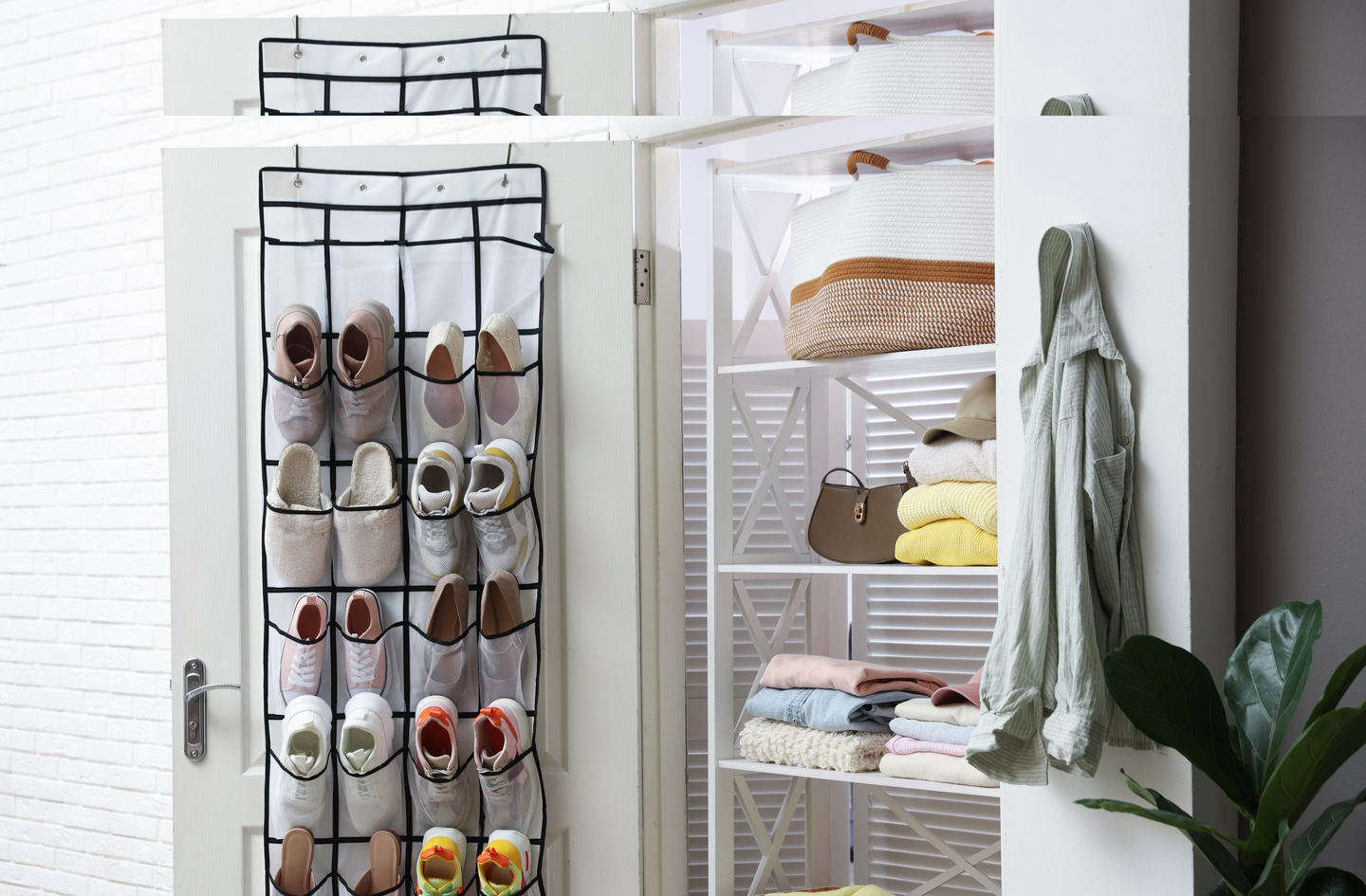
How to organize a small closet with lots of clothes and shoes
Shoes take more planning than they look, because each pair needs width, depth and height. The same guide sized a shoe shelf at about 7 inches wide, 10 inches deep and 7.5 inches high per pair of women’s shoes2. Men’s shoes needed about 9 inches wide and 13 inches deep2.
Choose the shoe home by door type and depth. A floor rack under the short garments uses space that hanging clothes leave empty. A hinged door can carry a hanging shoe bag, and the Oregon State guide noted that an over-the-door rack suits a closet 30 inches or more deep1.
Where should folded clothes go?
Knits, jeans and sweaters fold better than they hang, and folding them returns rod inches to the hanging zone. Keep stacks low enough that you can pull one item without toppling the rest, and use a shelf divider to stop stacks from leaning.
Under the short garments, a narrow chest of drawers or a stack of drawer units can take what the shelves cannot. Anchor any tall drawer unit against tipping, and never stand on drawers to reach the top shelf.
Every item that moves to a shelf or drawer gives rod inches back to the clothes that genuinely need to hang.
Step 7: Plan Around Sliding Closet Doors
Bypass sliding doors save swing space in a small bedroom, but they show only part of the closet at a time. With two equal panels, about half of the opening is visible at once, and one panel always covers the other half.
How to organize a small closet with sliding doors
Plan the closet as two halves, each one complete on its own. Put the daily zone behind the panel you open most, with its lower rod, slim hangers and a shoe rack below. Put long garments and labeled bins behind the panel that stays closed most days.
Avoid any zone that spans the split. A shelf tower or a drawer stack centered on the meeting point of the panels is half hidden whichever door is open, so it never fully opens to you.
Sliding panels cannot hold an over-the-door organizer, so shoes and accessories need another home. Use a floor rack, hooks on the closet’s short side walls, or a slim hanging shelf on the rod itself. Check the side-wall depth first, because hooks there must not cut into the 24 inches hangers need2.
Some renters take the panels off their track and hang a curtain on a tension rod instead, which exposes the full width at once. That is reversible only if you store the doors and hardware safely and the lease allows it, so check before you start.
With sliding doors, access is the constraint, so the layout has to follow the panels rather than fight them.
Common Mistakes When Organizing a Small Closet
The most common mistake is solving a layout problem with a product. Oregon State’s closet guide made the same point about adding whole new closets:
“Another closet without thought of how items are to be stored may do very little to relieve cluttered and crowded closets.”
Bernice Strawn, Extension Home Management and Equipment Specialist, Oregon State University1
Buying organizers before editing
Bins and caddies bought first get sized to clothes you are about to release. The fix is to edit and rotate, measure what is left, and only then buy what the remaining wardrobe needs.
Hanging everything at one height
A single rod at one height wastes the space under every short garment. Zone by length, and double-hang the short section so that empty space holds a second row.
Storing off-season clothes dirty or damp
Soiled wool attracts clothes moths, and a damp spot invites mold. Clean every item, seal it, and store it where indoor humidity stays under the EPA’s 60 percent ceiling6.
Letting the floor and top shelf become piles
Loose items on the floor or top shelf hide each other and never get used. Give the floor one rack and the top shelf labeled bins, and nothing else.
Each of these mistakes treats the closet as a place to hold things, when it works better as a system for returning them.
What a Well-Organized Small Closet Looks Like
If the steps worked, you can see every in-season garment without moving another one, and you can return any piece with one hand. Run four quick checks:
- Hangers slide along the rod without force, and no garment is crushed between its neighbors.
- The clothes you wear most hang on the rod you reach without stretching.
- The floor holds a shoe rack and a laundry bag, and nothing else.
- Off-season clothes sit sealed and labeled, out of the closet or on the top shelf.
To keep it that way, set a one-in, one-out rule for each category and swap seasons twice a year. The 1964 North Carolina guide tied closet cleaning to that swap, two or three times a year2. Those moments are also when the wear test from Step 1 gets its answer.
If your closet is a small walk-in rather than a reach-in, the same zoning applies around a center aisle. The guide to walk-in closet floor planning shows how perimeter rods and corner shelves keep that aisle clear.
A small closet with lots of clothes is organized when the daily reset takes less effort than leaving clothes on a chair. Design for the reset.
Frequently Asked Questions
How much rod space do you need for a lot of clothes?
Extension planning guidance allows at least 4 feet of rod space per person1. A wardrobe that outgrows the rod has three fixes: double-hang short garments, fold knits onto shelves, or rotate the off-season half into storage. Measure the rod first so you know the size of the gap.
How do you organize a small closet with sliding doors?
Treat the closet as two halves, because bypass doors show only about half the opening at once. Put daily clothes behind the panel you open most and bins behind the other. Over-door organizers cannot hang on a sliding panel, so use floor racks or side-wall hooks, keeping 24 inches of depth clear for hangers2.
Where should shoes go in a small closet with lots of clothes?
Shoes belong on a rack or shelf, never loose on the floor. A 12-inch shelf holds most shoes, folded garments and accessories2, and a floor rack fits under short hanging garments. A hinged door can also carry a hanging shoe bag, which keeps every pair visible.
How should you store off-season clothes in a small apartment?
Wash or dry-clean each item, then seal it in an airtight bin or bag, as the National Pesticide Information Center advises against clothes moths5. Keep the bins somewhere dry, where indoor humidity stays between 30 and 50 percent6. Under the bed or a top shelf works well.
Is double hanging worth it in a small closet?
Double hanging is worth it whenever most of the wardrobe is short. Shirts, skirts and trousers need 39 to 45 inches of hanging height1, so two rows fit where one row of long dresses would hang. Check for roughly 78 to 90 inches of clear height first.
Limitations and Edge Cases
- The rod, depth and shoe figures come from extension closet guides published in 1964 and reprinted in 1967. Garment and hanger sizes vary, so measure your own clothes before buying rods or shelves.
- The 15 to 48 inch reach band is an accessibility standard drawn for wheelchair users3. It is used here as a conservative planning band, not as a requirement for a private home.
- Moving a rod into new wall blocking, removing doors or building in shelves can involve the wall structure and, in a rental, the lease. Confirm with the landlord, and bring in a contractor for any change to the wall itself.
References
Methodology: every sourced figure in this article comes from an independent published source and links to the page that carries it; the stacked double-hang height and the coat-capacity example are Small Space Logic calculations from those figures. The article is written by Small Space Logic’s founder and updated when a source or a recommendation materially changes.
- Oregon State University Extension – Ideas for Better Clothes Closets, Extension Circular 691, Bernice Strawn, reprinted April 1967 (ScholarsArchive at Oregon State University).
- North Carolina Agricultural Extension Service – My Clothing Storage Area: Idea Guide for Early Teens, 4-H Home Improvement Project, Edith B. McGlamery, February 1964 (NC State University Libraries archive).
- U.S. Access Board – Guide to the ADA Standards, Chapter 3: Building Blocks, section 308 Reach Ranges, 2010 ADA Standards for Accessible Design.
- U.S. Environmental Protection Agency – Textiles: Material-Specific Data, Facts and Figures about Materials, Waste and Recycling (2018 data; page updated March 19, 2026).
- National Pesticide Information Center – Clothes Moths, Oregon State University and U.S. EPA cooperative program (updated May 1, 2026).
- U.S. Environmental Protection Agency – A Brief Guide to Mold, Moisture and Your Home (updated February 18, 2026).
Conclusion
A small closet with lots of clothes works when every garment fits the space its length and frequency of use require. Edit by wear, rotate the off-season half out, zone the rod by length, keep daily clothes in easy reach, and move shoes and folded items onto their own level. Engineer the layout first, decorate second.
For how this fits the wider topic of small closet storage, see the small closet storage overview.