
A hallway closet built for two winter coats ends up holding six coats, stray scarves, and overflow from every other closet in the home. That door gets avoided instead of used. The small hallway closet organization ideas in this guide turn that space into a clear, zoned overflow system for coats, seasonal clothes, shoes, and accessories. See Small Closet Storage for the broader compact storage framework. A 2025 survey found that 42% of Americans feel overwhelmed by clutter frequently or all the time1, and a separate StorageCafe report put the share who own more clothes than they have space for at 26%2; the hallway closet, organized correctly, absorbs a meaningful share of both pressures.
Quick Answer
What are the best small hallway closet organization ideas for clothing overflow?
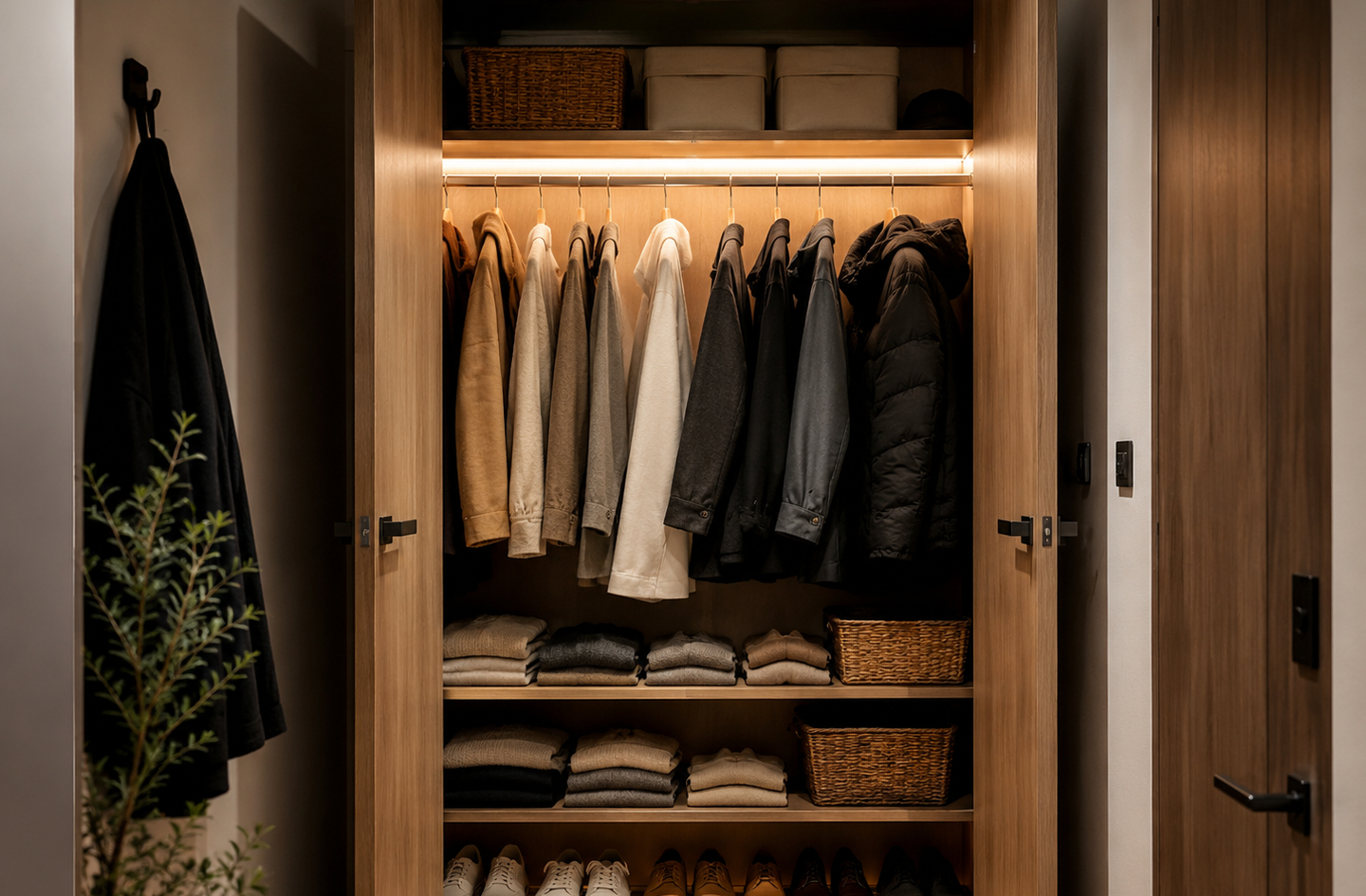
Audit what the closet needs to hold, then set up three zones: a hanging rod zone for coats and outerwear (coats need 3-4 inches of rod space each4), a floor and shelf zone for shoes and folded seasonal clothing, and a door zone for bags and small accessories. Replace standard plastic hangers with slim velvet ones and rotate seasonal clothing twice a year to keep the system from reverting to a pile.
Key Takeaways
- A standard hallway closet rod holds 10 winter coats or up to 48 shirts at standard rod-spacing rules – garment type determines how much capacity you actually have.4
- Switching from standard plastic hangers to slim velvet hangers roughly doubles rod capacity on the same rod, allowing 35-40 items where 20 previously fit.7
- 26% of Americans own more clothes than they have storage space for, making the hallway closet a critical relief valve – but only with a clear zone-and-rotation system.2
- The average person owns 12 pairs of shoes5; fitting even half of those into a hallway closet requires a dedicated, structured floor zone rather than a loose pile.
- A seasonal rotation twice a year is what keeps the system running after setup – without it, the closet returns to overflow within two seasons.
What You’ll Need Before You Start
Initial setup takes 2-3 hours; seasonal rotation takes about 30 minutes twice a year. The Step 1 audit tells you what to buy before spending anything.
- Tape measure: to record rod length, shelf depth, and floor area before buying organizers
- Slim velvet hangers: to replace plastic hangers and roughly double rod capacity
- Over-door hook rack: for bags and small accessories (renter-friendly; no drilling)
- Clear bins or lidded boxes: for the top shelf (seasonal clothing, spare linens)
- Adhesive labels: to mark bins for fast daily reset
- Shoe rack (optional): for the floor zone; a simple slanted rack works in most standard depths
- Vacuum compression bags (optional): for bulky coats moving off the rod during off-season
Difficulty: Beginner. Time: 2-3 hours setup; 30 min per rotation. All solutions are freestanding or tension-mounted and work in rentals without drilling.
Step 1: Audit What Needs to Live in the Closet
By the end of this step, you will have a clear, categorized list of every item that belongs in the hallway closet and a first pass at what does not. That list determines the zone structure and guides every purchase decision that follows.
Pull everything out of the closet and sort it into four categories on the floor:
- Daily-use outerwear: coats, jackets, and shoes that are reached for at least once a week during the current season. These earn prime rod space and floor space at the front of the closet.
- Current-season overflow: clothes and shoes that belong to the active season but are not daily-use, such as a dress coat worn monthly or rain boots used occasionally. These go on the rod behind daily items or on a secondary floor zone.
- Off-season items: winter coats in summer, summer dresses in winter, and seasonal accessories. These belong in the top shelf zone in labeled bins or vacuum bags, not on the rod.
- Does not belong here: items that migrated into the hallway closet but have a better home elsewhere, such as sporting equipment, rarely used tools, or clothing that simply has no other spot and needs to be edited from the wardrobe entirely.
A 2018 Movinga study of 18,000 households found that 82% of Americans’ clothing items went unworn in the previous year6. That figure does not mean every unworn item should be removed, since seasonal rotation is a feature of a working system, not a failure. But it does mean that anything in the “does not belong here” category is almost certainly not being worn either and does not need closet space.
How to decide what earns rod space
An item earns rod space if it is wearable in the current season and gets reached for at least occasionally during that season. Anything that has not been reached for in a full year (outside its off-season period) is a candidate to leave the closet entirely. The goal is not minimalism; it is a closet where every item hanging on the rod has a reason to be there.
If you are working through organizing a closet with many clothes in a limited space, the guide on organizing a small closet with lots of clothes covers the wardrobe editing and category-zone process in more depth.
Record what you have
Before moving to Step 2, note the count in each category: daily coats, current-season overflow pieces, off-season items, and pairs of shoes that belong here. That count drives the rod and shelf calculations in Step 2.
Step 2: Measure the Closet and Calculate Its Capacity
By the end of this step, you will know exactly how much rod space, shelf space, and floor area you have, and whether the items from your audit will actually fit with the zone structure you are planning.
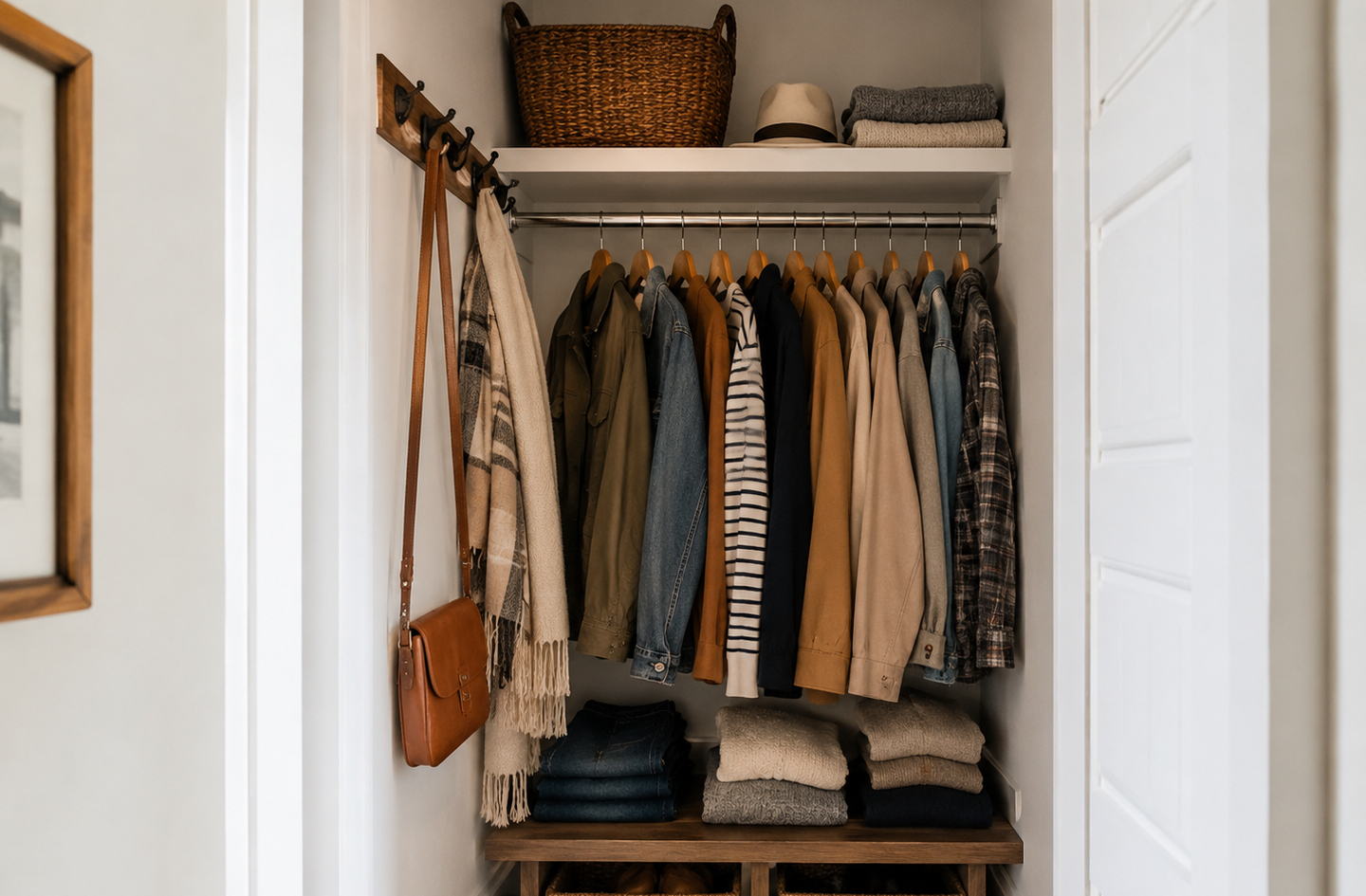
Standard hallway and coat closets are typically 36-72 inches wide, a minimum of 28 inches deep (30 inches is better for bulky coats), and 80-84 inches tall3. The hanging rod usually sits 60-65 inches from the floor, leaving 15-24 inches of clearance below the rod for a floor zone and about 16-24 inches above the rod for a top shelf zone.
Calculate your rod capacity in inches
Measure the rod length in inches. That number tells you the maximum hanging capacity before you add anything. Use these per-item spacing rules to calculate how many pieces of each garment type will fit4:
- Shirts and blouses: 1 inch per item
- Blazers and light jackets: 2 inches per item
- Dresses and skirts: 2-6 inches per item (4 inches is a safe average)
- Standard winter coats: 3-4 inches per item (3.5 inches is a safe average)
A 36-inch rod holds 36 shirts but only 10 winter coats.4 If your audit produced 8 daily and seasonal coats plus 4 jackets, that is 8 x 3.5 + 4 x 2 = 36 inches – a perfect fit on a 36-inch rod with no breathing room. Knowing this before buying anything tells you whether you need to edit the coat count, add a second rod section, or move some pieces to the off-season bin on the top shelf.
Map the shelf and floor zones
The top shelf (above the rod) typically accommodates one or two rows of flat bins or boxes in a standard 80-inch-tall closet. Measure the shelf depth: 12 inches is common and fits most standard bins. The floor zone below a 60-inch rod gives you about 24-30 inches of vertical clearance, which is enough for a slanted shoe rack or a set of low cubbies. Record these dimensions before buying any organizers, since depth varies enough between closets to make standard-size products either too shallow or unusable without modification.
For a detailed look at how to redesign the internal layout of a closet before replacing or rearranging hardware, the small closet redesign guide walks through rod heights, shelf depths, and drawer placement in sequence.
Step 3: Set Up the Hanging Zone for Coats and Outerwear
By the end of this step, every coat and jacket that belongs in this closet will have a designated spot on the rod, with daily-use items at the front and seasonal overflow behind them, and the rod will hold noticeably more than it did before without any permanent modification.
Switch to slim velvet hangers first
Before placing anything on the rod, replace standard plastic hangers with slim velvet ones. Standard plastic hangers are typically 10-12 millimeters thick at the shoulder; velvet hangers measure 5-6 millimeters. The same rod that holds 20 plastic hangers can hold 35-40 velvet hangers comfortably7. For a hallway closet where every inch of rod space is a constraint, this single swap is the highest-yield step in the whole process and costs less than other storage additions. Use non-slip velvet hangers for coats and jackets specifically, since smooth-shoulder outerwear slides off standard velvet hangers easily.
Arrange by access frequency, not by category
Place daily-use outerwear at the front of the rod (the end closest to the door). Current-season overflow goes in the middle section. Off-season items that have not yet been moved to the top shelf – because it is mid-transition between seasons – can occupy the back of the rod temporarily. This arrangement means the daily grab never requires pushing items aside. Keep like garments grouped within each zone: all coats together, then all jackets, then any lighter-weight seasonal pieces that belong on the rod.
“Our excess becomes a visible sign of unaccomplished work that constantly challenges our deeply ingrained notions of tidy homes and elicits substantial stress.”
Anthony P. Graesch, anthropologist, UCLA Center on Everyday Lives of Families8
That finding describes what a disorganized hallway closet does every time the door is opened. A rod zoned by access frequency and fitted with consistent slim hangers resets itself: hanging a coat back in its zone takes no more effort than dropping it on any open section.
When to add a double-hang section
If the closet is at least 80 inches tall with the rod at 60-65 inches, there is room for a lower rod at 40 inches for shorter garments: blazers, jackets, shirts on hangers. A 36-inch lower tension rod doubles that section’s capacity without any drilling. Reserve the full-height section for coats and longer outerwear.
Step 4: Build Floor and Shelf Zones for Shoes and Folded Clothing
By the end of this step, shoes will have a dedicated floor zone and folded seasonal clothing will have labeled bins on the top shelf, converting the two least-used areas of the closet into its most efficient storage zones.
Design the floor zone for shoes first
The average American owns 12 pairs of shoes5. Fitting even six pairs into a hallway closet floor zone requires deliberate placement rather than a loose pile. Four options work in most standard hallway closet depths (28-30 inches):
| Storage Option | Pairs Stored | Floor Space Used | Best For |
|---|---|---|---|
| Slanted shoe rack | 6-8 pairs | Full closet width | Everyday shoes, family households |
| Over-door shoe organizer | 12-24 pairs | Zero floor space | Seasonal shoes, lightweight footwear |
| Stackable cubbies | 4-6 pairs per tier | Half closet width per tier | Mixed households, varied shoe heights |
| Floor baskets | 2-4 pairs per basket | Full closet width per basket | Kids’ shoes, sandals, soft footwear |
For a hallway closet used by one or two people, a slanted shoe rack holding 6-8 pairs handles daily and current-season footwear. Off-season shoes can move to a labeled bin on the top shelf alongside seasonal clothing. If there is no floor space because coats hang long, the over-door organizer keeps shoes visible and accessible without competing for floor area.
Set up the top shelf for folded overflow
The top shelf holds current-season overflow and off-season clothing in labeled bins. A 12-inch-deep shelf fits two standard bins side by side. Group by season and type: one bin for winter accessories (hats, gloves, scarves), one for off-season folded clothing, one for spare linens. Keep the heaviest bins at the shelf’s front edge for easier retrieval.
Leave breathing room at the rod-to-shelf transition
The zone between the hanging rod and the bottom of the shelf is where items accumulate in unorganized closets. Keep it clear or use a small labeled basket for accessories only. Avoid stacking loose items on top of hanging clothes – it compresses garments, damages shoulders, and makes the rod zone unusable within a season.
Step 5: Add Door and Wall Storage for Bags and Small Items
By the end of this step, the back of the closet door and the wall beside it will carry bags, backpacks, umbrellas, and small accessories without taking any rod or shelf space, and every item will be reachable in a single gesture.
Use the back of the door for high-frequency small items
An over-door organizer with hooks or pockets is one of the highest-yield additions for a small hallway closet because it adds a vertical storage surface that costs no floor or shelf space and requires no drilling in rental-friendly versions. Use heavy-duty over-door hooks (rated at least 10 pounds per hook) for bags and backpacks that are reached for daily. Use pocketed over-door organizers for small accessories: gloves, hats, scarves, sunglasses cases, and dog leashes. Arrange by household member or by category, whichever makes the daily-reset faster. Limit to two or three hooks for bags; more than that and the weight pulls the door organizer loose on standard hollow doors.
Add wall hooks beside the closet opening for the daily grab
A coat rack or a row of wall hooks mounted beside the closet door (not inside it) handles the single most common hallway closet failure mode: the daily coat that never actually makes it onto the rod. A row of two to four hooks at shoulder height, positioned within arm’s reach of the door handle, keeps the daily-use coat visible and off the floor without requiring the closet door to be opened for a 30-second errand. This is a behavior-matching addition: the hook is where the coat already wants to go. Freestanding coat racks are the renter-safe version when wall mounting is not permitted.
For a broader look at keeping the floor clear in any compact closet, the walk-in closet floor ideas article covers perimeter rods, corner storage, and vertical zone strategies that also apply to hallway configurations.
Keep umbrellas and sport items separate
A single umbrella stand or narrow hook at the closet opening keeps umbrellas and reusable bags off the floor. Bulky sport items (helmets, skates, yoga mats) belong elsewhere: a mudroom bench, utility closet, or under-bed storage. Non-clothing items in a clothing-overflow closet are the primary reason these systems revert to disorganized within a season.
Step 6: Apply Seasonal Rotation to Keep the System Working
By the end of this step, you will have a twice-a-year routine that prevents the hallway closet from accumulating off-season items on the rod, which is the single most common reason these systems stop working.
When and what to rotate
Run a rotation twice a year: once in early spring (March or April in most US climates, when heavy coats are no longer daily-use) and once in early fall (September or October, when summer-weight outerwear stops being enough). Each rotation involves three moves: (1) pull off-season coats and jackets from the rod and move them to vacuum compression bags or large bins in the top shelf zone; (2) pull current-season bins from the top shelf back onto the rod; (3) restock the door organizer with season-appropriate accessories. A full rotation for a single-person hallway closet takes about 30 minutes. The 2025 StorageCafe data shows that 18% of self-storage items across American households are clothing2, meaning a large share of what goes into off-site storage is actually seasonal clothing that could stay at home with a functional rotation system.
Use vacuum compression bags for bulky outerwear
Down coats, heavy wool coats, and winter duvets compress to roughly a third of their original volume in a vacuum compression bag. This is the most effective way to move bulky winter outerwear off the rod and onto the top shelf without requiring a separate storage unit. Store compressed bags flat on the shelf, not standing upright, since standing upright puts stress on the seam and shortens the bag’s life. Label each bag clearly with a strip of masking tape and a marker: “Winter coats – Oded” or “Off-season jackets.” The label is what makes the spring retrieval fast enough that you will actually do it instead of pulling everything out to find the right coat.
Build the rotation into a calendar reminder
The rotation works only if it is scheduled. Set recurring reminders for the first weekend in April and the first weekend in October. Pair the rotation with another seasonal task – switching bedding, adjusting the thermostat – so it is one already-planned block rather than a separate chore. Without a scheduled date, off-season coats stay on the rod until the system collapses.
Common Mistakes That Undercut Small Hallway Closet Organization Ideas
The following three mistakes cause organized hallway closets to revert within a season. Each one is preventable with a single decision made during setup.
Overcrowding the rod and skipping the hanger swap
The mistake: keeping standard plastic hangers and hanging everything that came out of the audit back onto the same rod without editing. Why it happens: it feels counterintuitive to spend money on hangers when the goal is organization, not aesthetics. The fix: replace hangers first, then hang only the items that passed the Step 1 category filter. A 36-inch rod fitted with slim velvet hangers holds 35-40 items; the same rod with standard plastic hangers holds about 20. Skipping the hanger swap cuts usable capacity roughly in half before anything else is done.
Ignoring the back of the door
The mistake: treating the closet interior as the only usable space and leaving the back of the door empty. Why it happens: the door surface is not visible when the closet is closed, so it does not register as storage space during planning. The fix: install an over-door hook rack before finalizing the interior layout, since the door zone handles accessories and bags that would otherwise compress the rod or end up on the floor. The door surface in a standard 30-inch-wide closet adds roughly 6-8 square feet of accessible vertical storage at no structural cost.
Skipping the seasonal rotation schedule
The mistake: setting up the closet, filling it with all-season and off-season items together, and expecting the system to hold. Why it happens: the rotation step feels optional when the closet looks good after the initial setup. The fix: schedule the rotation dates before finishing the setup – put them in a calendar the same day. A well-organized hallway closet that never rotates fills up with off-season coats by December and returns to a crowded, hard-to-use state within one winter. Rotation is what converts a one-time organization session into a durable system.
What a Working Hallway Closet Looks Like
If the six steps are complete and the rotation is scheduled, the hallway closet should now meet these four conditions:
- The rod is accessible from the first item to the last. No coat is buried behind another. Daily-use outerwear is at the front, seasonal overflow behind it, and no off-season items are on the rod at all.
- The floor has a clear zone for shoes with no overflow onto the closet floor. Shoes are on a rack or in cubbies, not in a loose pile. The floor beside the rack has at least a few inches of open space.
- The top shelf holds labeled bins that can be pulled out and returned without disturbing other items. Off-season clothing is in compression bags or labeled boxes, not stacked loosely.
- The door organizer handles daily-use bags and small accessories without requiring the main rod. Opening and closing the closet door is a one-second action, not a negotiation with falling items.
A hallway closet that meets all four conditions is functioning as an overflow zone, not just as a coat storage space. That is the standard a small hall closet organization system should hold itself to.
Frequently Asked Questions
How many items fit on a standard hallway closet rod?
On a 36-inch rod, you can hang 36 shirts (1 inch each), 18 blazers (2 inches each), 9 dresses (4-inch average), or 10 winter coats (3.5 inches each)4. Most hallway closets range from 36 to 72 inches wide. Garment type – not rod length alone – determines how crowded the rod becomes, which is why the Step 1 audit matters before buying anything.
Can you double-hang clothes in a hallway closet?
Yes, in most standard hallway closets with ceilings of 80 inches or more3. Install a lower rod at 36-40 inches from the floor for blazers, jackets, and shirts on hangers. Coats require the full hanging height and cannot double-hang. A tension rod works in rentals without permanent installation – keep the double-hang section away from the coat zone.
How do you store shoes in a hallway closet with limited floor space?
The average person owns 12 pairs of shoes5, so fitting all of them in one hallway closet is rarely practical. Keep 6-8 daily-use pairs on a floor shoe rack and move off-season footwear to a labeled top-shelf bin. If floor space is too tight, an over-door shoe organizer stores 12-24 pairs with no floor footprint.
How often should you rotate seasonal clothes out of a hallway closet?
Twice a year: early spring (March or April) when heavy outerwear moves to the top shelf in compression bags, and early fall (September or October) when it comes back. A single-person rotation takes about 30 minutes. Without a scheduled rotation, off-season coats stay on the rod year-round and displace active outerwear until the system fails.
What is the best way to use the top shelf in a small hallway closet?
Use labeled, flat-lidded bins for off-season clothing and accessories. A 12-inch-deep shelf typically holds two bins side by side. Clear-sided bins make contents identifiable without pulling them down; keep the heaviest at the front edge. Avoid stacking loose folded clothing directly on the shelf – it collapses and becomes unsortable within a week.
Limitations and Edge Cases
- This guide covers a single-door or bi-fold hallway closet, typically 36-72 inches wide. Narrower coat alcoves (under 24 inches) may not accommodate a standard shoe rack on the floor; an over-door organizer is the more practical shoe storage choice in that case.
- All rod-spacing figures are US-standard guidelines and assume standard-weight outerwear on non-padded hangers. Very heavy leather coats or heavily padded items may need 4-5 inches of rod space per item and shift capacity estimates downward.
- This spoke covers hallway closet overflow organization for clothing. For planning a full redesign including new rod systems, built-in shelving, or structural changes, consult a licensed interior designer or contractor for your specific home – that falls outside the scope of this guide.
References
- AZ Big Media – Why Americans are running out of space at home in 2026: StorageCafe 2025 annual self-storage demand survey data; 42% of Americans overwhelmed by clutter frequently or all the time; average new single-family home dropped to 2,150 sq ft in 2024. Published 2026.
- StorageCafe – Self-Storage Demand and Trends 2025: 26% of respondents own more clothes than they have storage space for; clothing accounts for 18% of self-storage items; 35% of self-storage renters lack sufficient space at home. Published 2025.
- Designing Idea – Coat Closet Dimensions (Sizes and Design Guide): standard dimensions 36-72 in. wide, 28 in. deep minimum, 80-84 in. tall; rod height 60-65 in. from floor. Published 2024.
- Creative Closet Design – How Much Hanging Space Do You Need for Shirts, Dresses and Coats: shirts/blouses 1 inch per item; dresses 2-6 inches; coats 3-4 inches; a 48-inch rod holds approximately 48 shirts, 16 dresses, or 12 coats. Published 2024.
- KURU Footwear – American Footwear Spending: A 2023 Survey (1,000-person US survey, 95% confidence interval): average American owns 12 pairs of shoes. Published August 2023.
- FashionUnited – People do not wear at least 50 percent of their wardrobes, says study: reporting on Movinga 2018 study of 18,000 households in 20 countries; 82% of Americans’ clothing items went unworn in the previous year. Published 2018.
- Beddora – Do Velvet Hangers Really Save Closet Space: standard plastic hangers 10-12 mm thick; slim velvet hangers 5-6 mm thick; the same rod that holds 20 plastic hangers holds 35-40 velvet hangers. Published 2024. Note: vendor-produced content; figures are based on hanger dimension measurements, not an independent study.
- UCLA Newsroom – The Clutter Culture: research by Anthony P. Graesch, anthropologist, UCLA Center on Everyday Lives of Families; findings on clutter, stress, and household organization. Published 2012.
Conclusion
A small hallway closet organized into three clear zones – a hanging rod for coats and outerwear, a floor zone for shoes, and labeled top-shelf bins for seasonal overflow – becomes a functional relief valve for the whole home instead of a space everyone avoids. The hanger swap and the seasonal rotation schedule are what keep it working past the initial setup. Small hallway closet organization ideas are not about owning less; they are about building a system where every item has a home it can be returned to in seconds. Square footage is fixed. Flow is a choice.
For the broader context on how hallway closet storage fits into a compact home’s overall clothing storage system, see the overview in Small Closet Storage for how all the zones connect.