
A compact entryway holds the most-handled items in the home: keys, mail, sunglasses, and the bag you grab on the way out. Most end up on the floor. The fix is a designated drop zone, and a shallow floating shelf provides one in 4 to 8 inches of wall depth, leaving the floor and the walking path clear. This spoke builds on the overview in small entryway storage for compact entrances. The average American spends 2.5 days per year searching for misplaced items1, and a shelf at the right height removes most of that friction at the door.
Quick Answer
How do you use a floating shelf as an entryway drop zone?
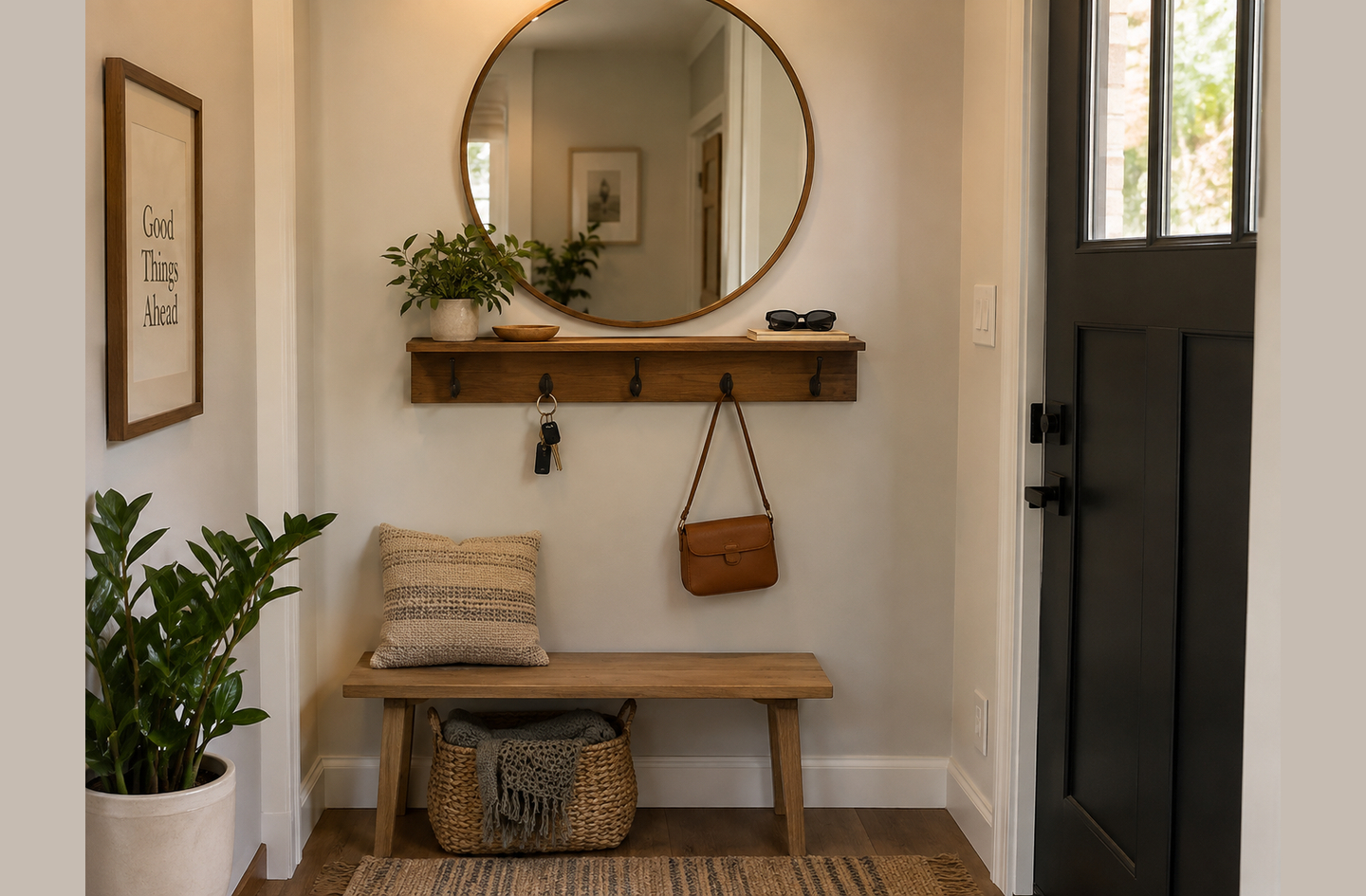
Mount a shelf 4 to 8 inches deep at 44 to 48 inches from the floor2. That height sits inside the 15 to 48-inch unobstructed forward reach zone defined by the U.S. Access Board2, which means you can set items down without bending. Add a small bowl, a hook or two, and a tray for mail. In an entryway too narrow for a console table, a shallow shelf solves the drop-zone problem without consuming any floor space.
Key Takeaways
- A shelf 4 to 8 inches deep takes no floor space and leaves the code-minimum 36-inch clear path intact in the narrowest compliant residential entry3.
- Mount between 44 and 48 inches from the floor2 to land in the primary forward reach zone, so there is no bending to place or retrieve daily items.
- A standard console table runs 12 to 18 inches deep6; in a tight entry, that floor depth cuts usable walkway by up to one-third.
- The shelf works only when you assign specific categories to it. A shelf without a system is a flat surface that accumulates clutter.
What Makes a Floating Shelf Entryway Drop Zone Work
A drop zone is a dedicated surface near a home entrance where you deposit and retrieve the items you carry every time you leave: keys, phone, wallet, sunglasses, and outgoing mail or returns. When no fixed location exists for those items, they end up on the floor, a kitchen counter, or a chair. The search cost is real. A survey conducted by Survey Sampling International for Pixie Technology found that the average American spends 2.5 days per year looking for misplaced items, with 28 percent regularly misplacing car or house keys1.
A floating shelf is a wall-mounted horizontal surface with no visible support brackets on the front face. Unlike a console table, it contacts no floor space. The support hardware, typically concealed steel rods or a wall-mounted cleat, is hidden inside the shelf or behind it. This means the shelf can serve as a landing surface while the floor below it stays completely clear.
A landing surface refers to any horizontal surface placed at a convenient height to receive items set down in passing, without requiring the user to bend, search, or step around floor obstacles. The floating shelf is a landing surface that earns its place in a compact entry because it consumes no floor depth.
Three things make a floating shelf drop zone work in practice. It sits at the right height, reachable without bending and visible at a glance. It is shallow enough that it does not intrude into the walking path. And each item type has a designated container: a bowl for keys, a hook for the dog leash, a slim tray for mail. Without those containers, the shelf collects random items and the system fails within days.
The shelf is not the system; the assigned categories on the shelf are. A shelf that holds “everything dropped at the door” will be cluttered within a week. One that holds only keys, today’s mail, and one outgoing item converts the same piece of furniture into a reliable daily reset.
Step 1: Choose the Right Shelf Depth for Your Entryway
In a compact entry, depth is the constraint that matters most. A console table 14 to 16 inches deep6 will feel useful against a wall but may cut the walkable corridor to an uncomfortable width. A floating shelf 4 to 8 inches deep provides the same landing-surface function without touching the floor.
The International Residential Code sets a minimum clear width of 36 inches (3 feet) for residential hallways3. That is the narrowest a compliant residential entry corridor can be. In a 36-inch space3, a 14-inch-deep console table6 leaves only 22 inches of clear path, which is tighter than comfortable single-person passage. A 6-inch floating shelf leaves 30 inches because it occupies no floor area below shoulder height.
For small homes and apartments under 1,500 square feet, entryway floor areas typically run 15 to 28 square feet5. The median new US rental apartment is 1,000 square feet4. In those spaces, any floor-standing furniture in the entry competes with the door swing and the walking path at the same time.
To find the right depth for your entry, measure the clear path you currently have from wall to opposite wall or wall to door when fully open. Subtract the minimum walking width you need to preserve: 30 inches works for one person, 36 inches for shared use with bags or a stroller. The remaining figure is the maximum floor depth you can allocate to a floor-standing piece. A floating shelf takes none of that floor depth, though its wall protrusion reduces clearance at shoulder height.
For a drop-zone shelf, aim for 4 to 6 inches of depth. That accommodates a bowl, a row of keys on hooks, and a slim mail tray. A shelf at 8 to 10 inches starts to act more like a display shelf, which invites accumulation. The 4 to 6-inch shelf is the drop-zone anchor; the 8 to 10-inch shelf is better suited to display or secondary storage.
If your entry measures fewer than 36 inches wall to door, a floor-standing piece is not worth the trade-off. A wall-mounted shelf becomes the only floor-preserving option, and that decides the depth question for you: mount flush and keep the protrusion at 6 inches or less.
Step 2: Mount at the Right Height for Daily Use
The right mounting height eliminates the bending friction that makes drop zones fail. When a shelf is too low, you bend to place items. When it is too high, you reach up and scan for them. Both increase the chance that the item ends up on the floor or a different surface instead.
The 2010 ADA Standards for Accessible Design define the unobstructed forward reach range as 15 to 48 inches above the finish floor2. The 48-inch high point is reachable without stretching for most adults. The practical zone for a drop-zone shelf is the upper half of that range: 36 to 48 inches. Within that band, 44 to 48 inches is the best placement for an adult user. At that height, the surface lands near hip-to-chest, where hands move naturally when you arrive at the door.
“Where a forward reach is unobstructed, the high forward reach shall be 48 inches (1220 mm) maximum and the low forward reach shall be 15 inches (380 mm) minimum above the finish floor or ground.”2
U.S. Access Board, 2010 ADA Standards for Accessible Design, Section 308.2.1
Test the height before drilling. Hold a firm book against the wall at your estimated mounting height. Walk through the door and set a key on top of the book without pausing or looking directly at it. If the motion feels natural and requires no bending, mark that height. If you bend even slightly, move up 2 to 4 inches and repeat. For households shared with older children, mount at the lower end of the 44 to 48-inch band. Add a hook below the shelf at 36 to 40 inches for items those users handle.
Why lower than 40 inches creates friction
At 36 to 40 inches, the shelf is at counter height. That is productive in a kitchen where you stand and work, but it creates bending friction in an entry where you pass through while carrying bags. Items placed at that height feel like they are being stored rather than dropped. The drop-zone habit breaks when placement requires a deliberate downward motion.
Above 52 inches: the visibility problem
Above 52 inches, items on the shelf are out of natural sight when you walk through the door. You cannot confirm at a glance that your keys are present. Visibility is part of the function: the shelf should sit at a height where everything on it is visible without looking up.
Step 3: Check the Wall Before You Mount
A floating shelf at 44 to 48 inches2 holds the items you handle most. The mounting needs to be proportional to that. Most drop-zone shelf loads are light: a set of keys, a phone, a small bowl, a few letters, and sunglasses typically weigh under 3 to 5 pounds combined. The structural requirement is low, but the mounting must still be reliable because a failed shelf at entry height creates both a hazard and a daily failure in the routine.
Floating shelf brackets or concealed rod systems mounted into wall studs carry the most reliable load. One stud connection provides approximately 45 to 50 pounds of capacity7. A two-stud mount supports roughly 100 pounds, which far exceeds anything a drop-zone shelf will hold. For a shallow 4 to 6-inch shelf carrying only keys and a bowl, even a single well-positioned stud mount is more than sufficient.
When studs are not at the right position for your chosen location, toggle bolts or hollow-wall anchors rated for your drywall thickness are the fallback. Check the packaging weight rating for the specific anchor type and drywall gauge; wall anchors vary widely in load capacity. If you are unsure what is inside your wall (older construction may include plaster, masonry, or metal studs), contact a licensed contractor before mounting. This is an engineering judgment, not a design one, and getting it wrong is harder to fix than getting it right first.
Renter-friendly mounting options
For renters who cannot drill, adhesive mounting systems work for very shallow 4-inch drop-zone shelves carrying only a bowl and a few keys. Check the load rating on the product packaging for your specific wall surface: adhesive strips perform differently on painted drywall, tile, and textured surfaces. For anything heavier or deeper, a freestanding ladder shelf or a hook rail that leans rather than mounts is the renter-safe alternative.
Step 4: Assign the Five Drop-Zone Categories
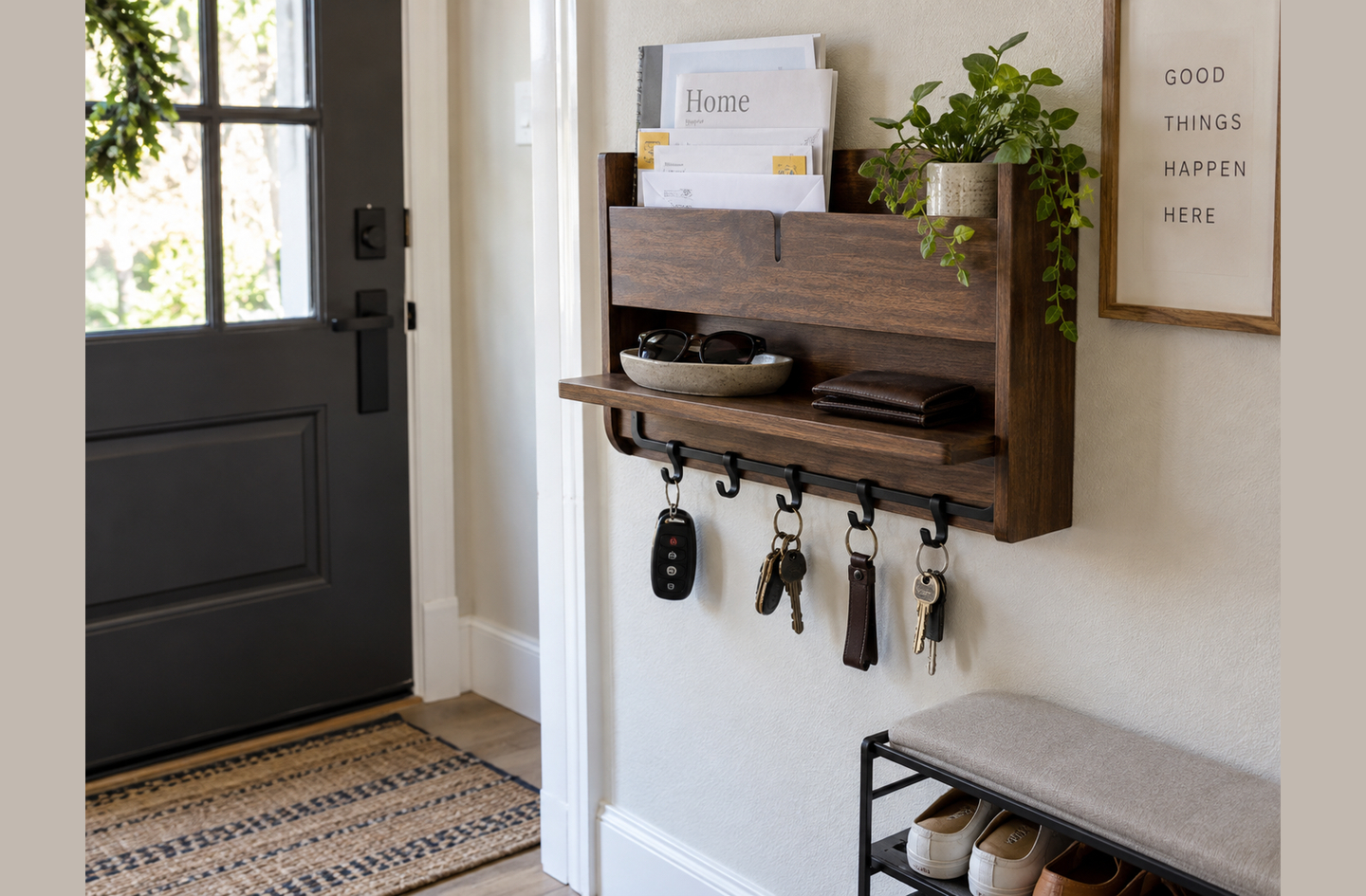
The shelf fails as a drop zone when it becomes a general landing surface. Assigning categories in advance prevents that. Five categories cover most households: keys, outgoing items, daily carry, exit items, and pet or seasonal items. Each gets a container on the shelf. The container defines the boundary and makes daily reset a one-step action.
Keys
One hook or small bowl per key set. Wall hooks mounted below the shelf are more reliable than a bowl on the shelf surface, because they require an active hang motion that is easier to perform consistently. If the entry has multiple household members with separate key sets, label or color-code the hooks. Any keys not on that hook are misplaced, which makes the shelf a built-in accountability point.
Outgoing items
A small designated tray or zone for things that need to leave the house: library books, packages to return, signed permission slips, borrowed items. This is a staging area, not storage. Anything in the outgoing tray should leave within a day or two. If items accumulate past that, the outgoing category needs a defined exit protocol, not a bigger tray. The broader overview on small entryway storage covers how a drop zone fits within the complete entrance system.
Daily carry
Sunglasses, earbuds, a transit card, a spare charger: items you grab every day but not from a bag. A small flat dish keeps them visible and contained. The rule is one container, and only items that genuinely leave and return daily belong in it. Items that come and go weekly belong elsewhere.
Exit accessories and pet items
A leash hook below the shelf, a small clip-basket for poop bags: these are exit-routine items for households with dogs. For households without pets, this slot works for umbrella storage (a hook rather than a floor stand) or a small seasonal item like sunscreen during summer months. Keeping exit accessories close to the door reduces the delay that causes backtracking. For coat and outerwear storage close to the entry, see the guide on entryway coat rack ideas for hook rails and slim freestanding options.
What should not go on the shelf
Charging cables, decorative items with no daily function, seasonal items that rotate less than once a month, and anything that arrives and does not leave within a week. These displace the active-use items and break the system. Once a shelf accumulates non-drop-zone items, it stops functioning as a drop zone and starts functioning as a catch-all. The daily clear check described in the Results section is the correction mechanism.
For shoe storage at the base of the entry zone, a slim rack, tray, or cabinet keeps footwear off the walking path without interfering with the shelf system above. The guide on small entryway shoe storage covers shoe pair counts, depth requirements, and how to keep the door path clear.
When a Floating Shelf Works Better Than a Console Table
A console table and a floating shelf both provide a landing surface near the door. The practical differences come down to floor depth, floor contact, and the cost of the footprint in a tight entry.
A standard console table is 12 to 18 inches deep6. Narrower models run 10 to 12 inches. In both cases, those inches come from the walking path. In the narrowest code-compliant residential hallway (36 inches), a 14-inch console table leaves 22 inches of clear path. A 6-inch floating shelf leaves 30 inches. The shelf wins on floor clearance in any entry where depth is a constraint, which is most entries in apartments and smaller homes.
The floating shelf wins clearly in four scenarios. The entry is 42 inches wide or narrower, and a console table would create a tight pass-through. The household rents and cannot put furniture against a wall without blocking a door or closet. The goal is a landing surface only, with no need for storage or drawer access below. And the budget is limited: a simple wall-mounted shelf costs less than a console table with similar surface area.
The console table wins in specific situations. If the entry is wide enough to spare the floor depth, a console adds storage below and a decorative anchor. If you want drawers or shelf space under the landing surface, a console provides that. If you may want to rearrange later without patching walls, a freestanding piece is the right choice. For entries wider than 48 inches, a console table with a landing surface at 30 to 32 inches and a decorative mirror above is a complete system that a floating shelf alone cannot replicate.
The hybrid that works in many small entries is a shallow floating shelf at 44 to 48 inches paired with a narrow bench below. The shelf handles drop-zone items. The bench provides a seating option for shoes and hides a basket for footwear or bags below the seat. The bench guide on shoe storage benches covers seat height, depth, and what storage configurations fit under the seat without crowding the entry path.
The floating shelf and the console table are not competing for the same role in the same space. The shelf is a floor-preserving drop zone; the console is a floor-occupying landing with optional storage. In entries under 42 inches wide, only one of those options is viable without compromising the walkway.
Common Mistakes in Entryway Shelf Setup
Choosing a shelf that is too deep
A shelf at 10 to 12 inches is a display shelf. At that depth, items accumulate in rows, and the front items obscure the back ones. The drop-zone function depends on everything being immediately visible. Go no deeper than 6 inches for a pure drop zone. If the space you found is 10 inches deep, consider mounting two slim shelves stacked vertically rather than one wide one.
Mounting at counter or table height
A shelf mounted at 32 to 36 inches (kitchen-counter height) feels logical because it matches familiar work surfaces. In an entryway, it creates bending friction. Items placed at that height feel like they are being stored, not dropped. The ADA forward reach zone starts at 15 inches but the productive drop-zone band starts at 40 inches, and 44 to 48 inches is better. If the shelf already exists at a lower height and moving it requires new holes, add a hook rail at the correct height and use the lower shelf for a less-used item.
No containment on the shelf surface
A flat, bare shelf surface invites items to slide and migrate. Keys placed on a bare shelf end up at the back edge. A small bowl, a 2-inch-deep tray, or a clip hook eliminates that problem. Each container defines one category. Without containers, a shelf 6 inches deep and 24 inches wide will hold twelve different items by the end of the first week, none of which are where you expect them.
Treating the shelf as general entry storage
The drop zone works when it holds items that arrive and leave every day. It stops working when it holds items that arrive and stay for a week or more. Chargers, decorative objects, seasonal items, and items waiting to be put away elsewhere all belong somewhere else. If the shelf becomes a queue for items waiting to leave, it is no longer a drop zone. It becomes a holding area, and holding areas fill without a reset system.
What a Working Drop Zone Looks Like
A working floating shelf drop zone passes the daily clear check. Every item on the shelf can be confirmed or cleared in a brief sweep before you leave. Keys in the bowl. Mail in the outgoing tray or gone. Daily carry items visible at a glance. If the sweep takes more than a moment, either the system has accumulated non-drop-zone items or the categories need narrowing.
A working shelf holds between 3 and 7 items total across all categories. More than 7 items is a sign that the categories have expanded beyond daily-use items. The reset is the check: at the end of each day, the shelf should be clearable in one pass. Everything goes to its category container or leaves the shelf entirely. If anything resists being cleared, it does not belong on the drop-zone shelf.
For narrow shoe storage at the base of the entry, the guide on narrow shoe cabinets for tight entryways covers depth, capacity, and clearance. It explains how to pick a cabinet that fits without narrowing an already-tight corridor. For a more complete system that adds seating and under-seat basket storage below the floating shelf, the guide on shoe storage benches covers configurations that pair with a wall-mounted shelf above.
Frequently Asked Questions
What is the best depth for a floating shelf used as an entryway drop zone?
4 to 6 inches is the ideal depth. That accommodates a bowl, a row of hooks, and a slim mail tray without protruding into the walkway. A 6-inch shelf in a 36-inch hallway leaves 30 inches of clear path, which meets the IRC minimum clear-path standard3 with room to spare. Shelves deeper than 8 inches start to function as display surfaces and invite clutter.
How high should a floating shelf be mounted in the entryway?
44 to 48 inches from the floor is the target range for most adults. That height falls within the 15 to 48-inch unobstructed forward reach zone defined by the U.S. Access Board2, which means items can be placed and retrieved without bending. Test the height with a book before drilling: walk through the door and set a key on the book without pausing to check whether the motion feels natural.
Can a floating shelf replace a console table in a small entryway?
Yes, for drop-zone use in an entry under 42 inches wide. A floating shelf takes no floor space; a standard console table is 12 to 18 inches deep6 and cuts the walkable corridor by that amount. In the narrowest code-compliant 36-inch entry, a console table leaves as little as 18 to 22 inches of clear path. The floating shelf preserves the full 36 inches. It cannot replace a console table’s below-surface storage or drawers, but for a landing surface and daily item drop-off it is the better choice in a tight entry.
How much weight can a floating shelf hold?
A floating shelf bracket mounted into one wall stud supports approximately 45 to 50 pounds7. A two-stud mount supports roughly 100 pounds. A typical drop-zone load (keys, a bowl, sunglasses, and a few letters) weighs well under 5 pounds, so a single stud mount is more than adequate. For heavier items or a wider shelf, use two stud connections or a wall cleat spanning multiple studs. If your wall is plaster, masonry, or includes metal studs, consult a contractor before mounting.
What if I rent and cannot drill into the wall?
Adhesive mounting systems work for a very shallow 4-inch shelf carrying only a bowl and keys; check the rated load on the product packaging for your specific wall surface. Performance differs between painted drywall, tile, and textured surfaces. For anything heavier or deeper, a freestanding over-the-door organizer or a hook rail that leans against the wall is the non-permanent alternative. The guide on entryway coat rack ideas covers hook rails and renter-friendly coat storage options that pair well with a mounted shelf above.
Limitations and Edge Cases
- The 44 to 48-inch mounting height assumes an adult user. Households where young children are the primary drop-zone users should lower the shelf to 36 to 40 inches. Alternatively, add a hook rail at a child-reachable height and keep the adult shelf at the standard height.
- Adhesive mounting is not covered by the weight capacity figures in this article. Those figures apply to stud-mounted bracket systems. Adhesive strips have their own load ratings and surface-specific performance characteristics.
- This article covers a wall-mounted shelf as a landing surface and drop zone, not as a display or decorative shelf. Depth, height, and category guidance are optimized for daily-use drop-zone function only.
References
Methodology: every figure below comes from an independent published source and links to the specific page that states it; figures were verified against live sources before publication on September 28, 2026.
- PR Newswire / Pixie Technology – “Lost and Found: The Average American Spends 2.5 Days Each Year Looking for Lost Items,” Survey Sampling International survey of 1,700 respondents, 2017.
- U.S. Access Board – Chapter 3: Operable Parts, ADA Standards for Accessible Design, Section 308. U.S. Access Board, current edition.
- Fine Homebuilding – “Minimum Dimensions in the IRC,” The Taunton Press, 2024. Covers IRC Section R311.6 minimum hallway width of 36 inches.
- U.S. Census Bureau – 2025 Characteristics of New Housing, Highlights. U.S. Department of Commerce, 2025.
- SketchUp Guru – “Welcoming Entryways: Standard Dimensions,” architectural design reference, 2023.
- iHome Studio – “Console Table Size Guide,” Furniture Buying Guide, October 2025.
- Shelfology – “How Much Weight Can a Floating Shelf Hold?” installation technical guidance, Shelfology, current edition.
Conclusion
A floating shelf entryway drop zone solves the lost-item problem with 4 to 6 inches of wall depth and no floor furniture. Mount at 44 to 48 inches, assign categories to containers, and keep the shelf limited to items that arrive and leave daily. The floor below stays clear. The walking path stays open. The system resets in a daily sweep.
For the broader context on organizing a compact entrance, including shoe storage, coat systems, and bench configurations, see the overview in small entryway storage.