
Coats pile up on the floor or a chair because the entryway has no place for them. Finding the right entryway coat rack ideas for small spaces comes down to three options: wall hooks, a hook rail, or a slim freestanding rack. Each borrows a different dimension from the room. For a full picture of the entry as a drop-zone system, see the small entryway storage overview. A standard adult coat hanger spans 17 inches across5, and the 2021 IRC sets a minimum hallway width of 36 inches2. Both numbers shape every decision that follows.
Quick Answer
What are the best entryway coat rack ideas for small spaces?
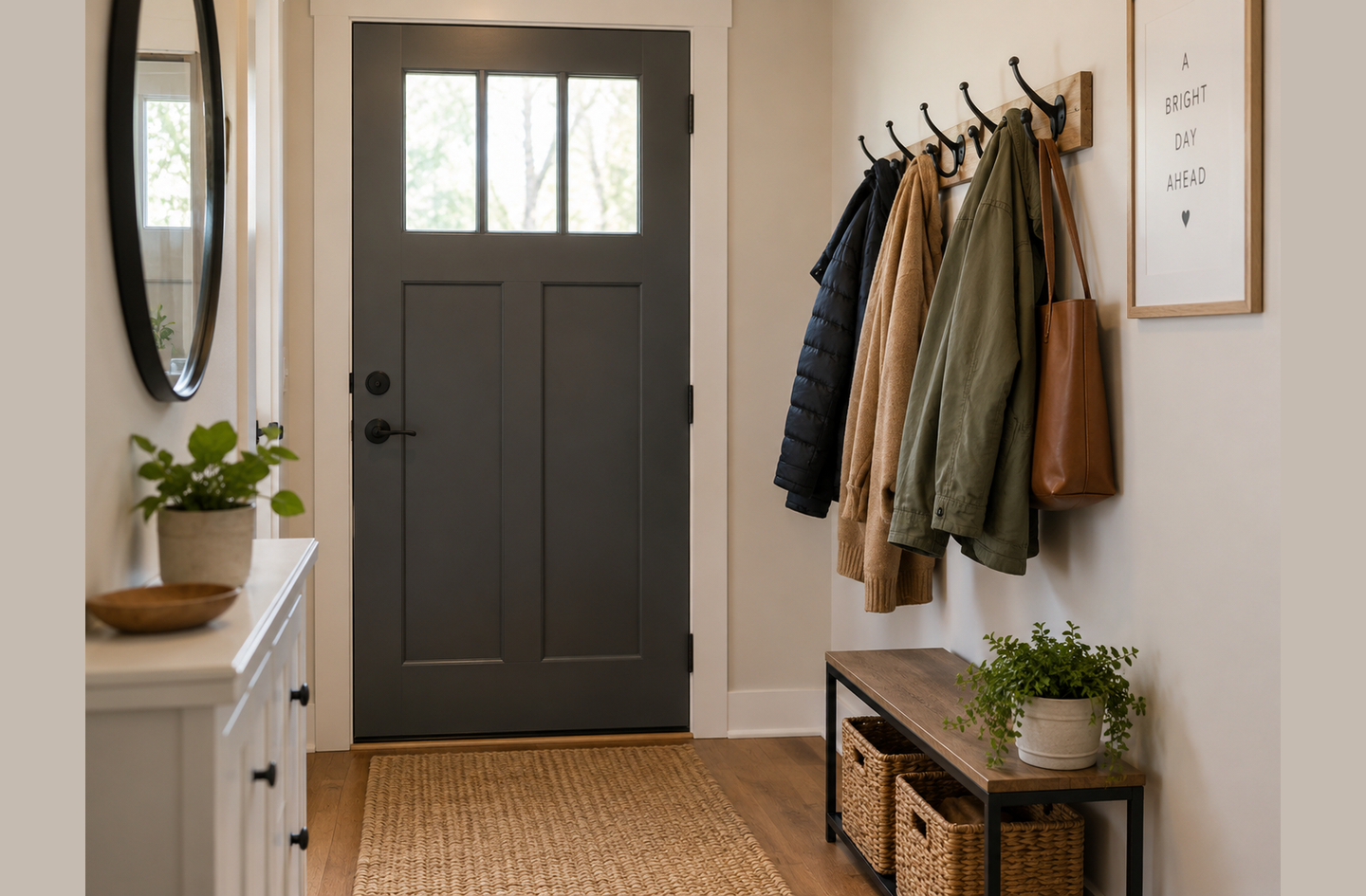
Wall hooks and hook rails mount to the wall and use zero floor space, but a hung coat projects 17 inches from the wall based on standard hanger width5. A slim freestanding rack stands without drilling and moves easily, but its base footprint measures 12 to 16 inches in diameter6. For a 36-inch entry, wall-mounted options preserve more walkway when no coat is hanging. With a coat hung, both types are comparable. Standard adult coat hooks mount at 60 to 66 inches from the floor7.
Key Takeaways
- A standard coat hanger spans 17 inches, so a wall hook with a coat on it projects that width from the wall regardless of how thin the hook body is.
- A hook rail fits 4 to 8 coat positions in 36 inches of wall space, making it the highest-capacity wall-mounted option per square inch used.
- A slim freestanding rack needs no drilling and moves between rooms, but its 12 to 16 inch base diameter occupies floor space instead of wall space.
- The 2021 IRC sets a 36-inch minimum hallway width. At that width, a wall hook with one coat hung leaves roughly 19 inches of clear path.
- Standard adult coat hooks mount at 60 to 66 inches from the floor. A second row at 36 to 48 inches handles children or accessible-reach needs.
Quick Comparison: Hooks, Rails, and Slim Racks
The three options differ most in where they place the clearance demand. Wall-mounted types use wall space; once a coat is on the hook, the hanger projects 17 inches into the room. Freestanding racks use floor space instead. Here is how the options compare across the dimensions a compact entry requires.
A hook rail is a wall-mounted panel carrying multiple hooks at fixed, evenly spaced intervals, typically sold in lengths from 18 to 36 inches. It uses the same wall projection as a single hook but multiplies coat capacity across that span. A slim freestanding rack is a floor-standing unit with a central pole, multiple arm pegs, and a weighted or wide base, designed to hold coats without any wall attachment. Coat hook projection refers to the horizontal distance a hanging coat extends from the wall; with a standard 17-inch hanger, the coat projects that distance whether the hook body is 2 inches thick or 55.
| Category | Wall Hooks | Hook Rail | Slim Freestanding Rack |
|---|---|---|---|
| Best For | 1-2 person households, 2-4 daily coats | 3+ person households, high daily rotation | Renters, flexible or temporary placement |
| Floor footprint | Zero | None | 12-16 in diameter base6 |
| Coat projection from wall | 17 in (coat hanger width)5 | 17 in per position | None (floor-based) |
| Coat capacity | 2-4 coats per set | 4-8 coats per 36-in rail | 4-6 coats |
| Bag handling | Good with larger hooks | Varies by hook size | Limited (top pegs only) |
| Installation | Screws to studs or anchors | Screws to studs or anchors | No drilling required |
| Rental-friendly | No | No | Yes |
| Typical hook height (adult) | 60-66 in from floor7 | 60-66 in from floor | Fixed at 66-68 in total height6 |
| Relocatable | No (leaves wall holes) | No (leaves wall holes) | Yes |
| Verdict | Simplest, lowest cost | Best capacity per wall area | Best for renters and flexible layouts |
Wall Clearance and Projection Depth
Wall-mounted storage wins on floor clearance. It does not automatically win on walkway clearance. A wall hook or rail projects a coat 17 inches from the wall once a hanger is on it5. The hook body itself may extend only 2 to 4 inches from the surface, but the coat does not hang flush against the wall. It hangs at the end of the hanger, 17 inches out. That is the clearance depth that matters when someone walks past.
In an entry narrower than 42 inches, the type of storage matters less than where you position it on the wall.
Why 17 Inches Is the Key Number
The standard adult coat hanger spans 17 inches across the crossbar5. When a coat hangs from a wall hook, the hanger rests at the hook tip and the coat falls from the hanger shoulders. The outer surface of the coat sits at roughly the hanger width from the wall: 17 inches. A bulkier jacket pushes that closer to 18 or 19 inches, but 17 is the floor for planning clearance. The difference between a 2-inch hook body and a 5-inch hook body is irrelevant for walkway planning. What matters is whether the 17-inch coat hang is acceptable at your entry width.
How a Freestanding Rack Handles Projection Differently
A slim freestanding rack does not project from the wall at all. Its 12 to 16 inch base sits on the floor6. Coats hang from arm pegs radiating outward from the central pole. Positioning the rack against a wall lets coats hang toward the wall instead of out into the room. In practice, a slim rack placed flush against a wall has a similar walkway impact to a wall hook when a coat is on it, but with the base consuming floor depth rather than wall projection. The trade-off is horizontal space vs. vertical wall space.
The Door Clearance Problem
Wall hooks positioned on the wall the door swings toward create a collision risk. A standard interior door swings 32 to 36 inches wide. If a coat is hanging on a hook on the door-side wall, the open door and the hanging coat occupy the same floor arc. Position hooks on a perpendicular wall instead, or far enough down the entry wall that the door clears the outermost coat before it opens fully.
Coat and Bag Capacity
A hook rail delivers the most coats per linear foot of wall. A 36-inch rail carries 4 to 8 hook positions depending on spacing, handling the daily outerwear for a 3 to 4 person household in one installation. Individual hooks grouped in a set handle 2 to 4 coats in 16 to 24 inches of wall. A slim freestanding rack holds 4 to 6 coats in a 360-degree radius, but because you place it against a wall in a small entry, the usable capacity is closer to 4.
“A standard coat closet is at least 36 inches wide and 24 inches deep, but often larger.”
Mike Costello, Contractor, Family Handyman4 (February 2025)
That 24-inch closet depth is the full-containment baseline. A hook rail meets the same coat count with zero floor depth and no door.
A hook rail is the only option in the three that scales coat capacity without adding floor footprint or requiring a second installation point.
Hook Spacing and Coat Interference
Hooks set too close together on a rail cause coats to overlap at the shoulders. When two heavy winter coats hang on adjacent hooks with only 6 inches between them, both shoulders press together and neither coat comes off cleanly. Most hook rails designed for outerwear space hooks at 8 to 10 inches apart. At 8-inch spacing, a 36-inch rail fits four hooks with clear separation. At 10-inch spacing, three to four hooks work depending on rail length and end-bracket placement.
Bags and Accessories on Each Type
Bags add significant weight and need a larger hook opening than a coat hanger. A wall hook with a 1-inch or wider hook diameter handles a tote bag alongside a coat without slipping. Hook rails often mix hook sizes, with larger lower hooks for bags and smaller upper hooks for scarves or hats. Slim freestanding racks handle bags least reliably. Their arm pegs are sized for hangers, and a heavy bag loaded on one peg shifts the rack’s center of gravity sideways. If bags are a daily part of the entry routine, wall hooks or a rail with a dedicated large-hook position handle them more stably.
Installation Method and Rental Suitability
Wall-mounted options require screws. Freestanding racks require nothing. That difference determines which option works in a rental or any shared space where permanent wall changes are not permitted.
If you rent and your lease prohibits wall fasteners, the decision ends at the slim freestanding rack before any other variable applies.
Screwing Into a Stud vs. a Drywall Anchor
A wall hook or rail rated for coats and bags should anchor to a stud wherever possible. A stud-anchored hook carries far more load than a drywall anchor alone. Toggle-bolt anchors rated for 50 to 75 pounds handle a light-to-moderate daily load, but a fully loaded rail with 4 to 6 heavy coats and bags approaches 30 to 40 pounds total. Find the stud first, then position the rail so at least one mounting point aligns with it. If no stud falls in the desired location, use a toggle bolt anchor rated above the expected load, not the cheapest option in the hardware aisle.
Rental-Friendly Coat Storage Without Drilling
A slim freestanding rack is the default answer for renters who need outerwear storage without wall holes. It assembles without tools and stands against any wall or in a corner near the door. For narrow entryways where the narrow entry requires careful footprint planning, a slim rack with a 12-inch base leaves the least floor depth consumed. Over-door hook strips on the back of the front door add 2 to 4 coat positions without any fasteners, supplementing the rack’s capacity for households with more coats than the rack holds.
Stability of Freestanding Racks
A base diameter under 12 inches becomes tippy when heavy coats and bags load one side. A base at 14 to 16 inches handles 3 to 4 heavy coats without rocking on a level floor6. If the entryway floor has any slope, or if the rack sits in a high-traffic path where it gets bumped regularly, test it fully loaded before committing to that position. A rack that tips when the last person out grabs their bag is not a functional solution, regardless of how little floor space it occupies.
Walkway Width Requirements
The 2021 International Residential Code requires a minimum 36-inch hallway width in residential buildings2. That 36 inches includes the path from the door to the interior. Coat storage in a 36-inch entry must leave enough of that path open for daily use. Residential design guidance puts the minimum comfortable width at 42 inches, not 36; 36 is the code floor, not the functional target3.
A slim freestanding rack placed against a wall consumes about 14 inches of floor depth (the midpoint of its 12 to 16 inch base range6), leaving 28 inches of clear walkway in a 42-inch entry. A wall hook with one coat hung projects 17 inches5, leaving 25 inches. At these numbers in a standard 42-inch entry, the freestanding rack preserves more walkway than a wall hook with a coat on it, despite occupying floor space. The chart below shows this comparison, using the 42-inch minimum functional width as the baseline3.
At the Narrowest Entries (36 Inches)
At the IRC code minimum of 36 inches, both options tighten further. A 14-inch rack base leaves 22 inches of walkway. A wall hook with a coat leaves 19 inches. Neither is generous, but both remain passable for a single person passing through. Two people moving in opposite directions at the same time through 19 to 22 inches is not comfortable, which is the functional reason the design guidance puts the comfortable minimum at 42 to 54 inches rather than 363.
Position Matters as Much as Type
Hooks or a rack placed on the wall directly opposite the door interrupt the main walking path. A perpendicular wall, the wall to the left or right as you enter, keeps storage out of the primary movement line. Even shifting a hook set 3 to 4 feet down the perpendicular wall from the door frame reduces traffic interference significantly in a tight entry.
Mounting Height and Reach
Standard adult coat hooks mount at 60 to 66 inches from the finished floor7. That height sits at average adult shoulder level, which means coats go on and come off without overhead reaching or bending down. Slim freestanding racks arrive at a fixed total height of 66 to 68 inches6, placing the top arm pegs in roughly the same zone.
“Coat hooks provided within the room shall be located within one of the reach ranges specified in 308.”
U.S. Access Board, 2010 ADA Standards for Accessible Design1, Section 803.5
The ADA reach range standard (Section 308) sets a maximum of 48 inches and a minimum of 15 inches for accessible hook placement1. Standard adult hooks at 60 to 66 inches sit above that accessible zone by design: they are sized for standing adults. If the entry serves people who use a wheelchair or children as daily users, a second lower row at the accessible height handles the full range of users without a separate installation.
Two rows of hooks at different heights serve a mixed household better than one perfectly-positioned single row.
Adding a Lower Hook Row
A second row at 36 to 48 inches meets the ADA reach range for accessible spaces and handles children’s coats without bending down awkwardly to a floor-level hook. On a hook rail, a second lower rail section below the first is a clean implementation: the upper row handles adult outerwear, the lower row handles children’s coats, bags, or daily items like lunchboxes and helmets. The two rows together use a narrow strip of wall and clear almost all daily hanging needs.
Coat Length vs. Hook Height
A standard coat hangs 44 to 66 inches in length once on a hanger, and a long overcoat extends up to 70 inches8. A hook at 60 to 66 inches from the floor keeps even the longest coat clear of the floor. A hook positioned at 48 inches or lower with a long coat risks the hem dragging, which scuffs the coat and makes the entry look cluttered. The practical reason the standard adult height is 60 to 66 inches is coat length clearance, not arm reach alone.
Load Rating and Weight Considerations
A wall hook rated for 15 to 20 pounds per hook handles a coat and a light bag without issue. A fully loaded hook with a heavy winter parka, a tote bag, and a backpack can approach 20 to 25 pounds on a single hook6. Total daily load on a hook rail with 4 to 6 hooks and 3 to 4 loaded positions could reach 60 to 80 pounds. The wall anchor, not the hook itself, is usually the weak link.
Check the anchor type and load rating before installation; the hook’s listed capacity only matters if the wall connection behind it can support the same load.
Stud vs. Anchor Load Differences
A wood stud anchor point in 2×4 construction typically handles 80 to 100 pounds at a single screw in shear6. A drywall toggle anchor rated for 50 to 75 pounds handles the load when no stud is available, but the rating applies only if the toggle is installed correctly in standard 1/2-inch drywall. If the wall is plaster, older drywall, or thicker material, consult the anchor manufacturer’s data for the specific substrate. Do not use standard nail-in wall anchors for coat racks; they pull out under sustained load and are not rated for the shear forces a loaded coat creates.
Rack Base Weight and Stability
A freestanding rack’s base weight determines how much load the pegs can accept before the rack tips. Most freestanding racks designed for outerwear use a cast-iron or weighted base of 4 to 8 pounds to provide a low center of gravity6. Racks with a heavy base and a wide foot diameter (14 to 16 inches) handle 3 to 4 heavy coats distributed around the pegs without rocking. Loading all weight on one side of the rack shifts the center of gravity outside the base footprint, which tips the rack on any floor surface.
Hook Projection and Coat Leverage
A hook that extends 4 to 5 inches from the wall creates more leverage on the wall anchor than a hook extending 2 to 3 inches, when the same coat weight loads both. Longer hooks with more projection apply greater torque at the mounting point. For heavy daily use with bulky coats and bags, choose a hook with a shorter projection distance (2 to 3 inches) and install it at a stud anchor. The hook body projection distance matters more to wall anchor health than to coat clearance, since the coat hanger, not the hook body, determines clearance depth.
Choosing Entryway Coat Rack Ideas for Small Spaces
The right option depends on your entry width, household size, whether you rent, and what combination of coats and bags you hang daily. Here is how each type fits different households.
One or two people, own the home, entry at least 42 inches wide: Wall hooks or a short hook rail work well here. Two to four hook positions on a 24-inch rail handle a 2-person daily load without requiring a full 36-inch rail. The entry width keeps 25 to 28 inches of clear walkway even with coats hung. For more guidance on pairing coat storage with shoe organization in a tight entry, see the small entryway shoe storage overview.
Three or more people, family with children, coats and school bags daily: A 36-inch hook rail at two heights, adult row at 63 inches and a lower children’s row at 42 inches, handles the full coat and bag load in one wall installation. The rail capacity at 4 to 8 positions on the upper row and 3 to 4 on the lower row covers a 4-person household without overflow to chairs or floor.
Renters, shared housing, or apartments with no drilling: A slim freestanding rack is the only option when the lease prohibits wall fasteners. A 14 to 16 inch base in a corner near the door handles 3 to 4 coats without taking up the walking path. For those who also need shoe storage in the same space without floor drilling, see the shoe storage bench guide for no-drill alternatives.
Entry narrower than 36 inches: Any coat storage in an entry this narrow demands careful positioning. An over-door hook strip on the back of the front door is the only option that adds coats without consuming any floor or wall clearance in the path. If the entry connects to a hallway, shifting coat storage to the first hallway wall instead of the entry itself keeps both spaces more functional. See the hub page for the full small entryway storage system for sequencing storage zones in these entries.
Verdict by Category
| Category | Winner | Why |
|---|---|---|
| Floor footprint | Wall hook / Rail | Zero floor depth consumed |
| Walkway clearance with coat hung | Slim rack | 14-in base vs. 17-in coat projection |
| Coat capacity per wall area | Hook rail | 4-8 positions in 36 inches |
| Rental suitability | Slim rack | No drilling required |
| Bag handling | Wall hook / Rail | Larger hook options; stable under heavy bag weight |
| Multi-height / mixed household | Hook rail | Second lower row added easily |
| Flexibility and portability | Slim rack | Moves between rooms, no holes left behind |
| Smallest entryway (under 36 in) | Over-door hooks | No wall or floor clearance consumed at all |
Frequently Asked Questions
What is the best coat rack for a small entryway?
For owners with an entry at least 42 inches wide, a hook rail gives the most coat positions per inch of wall space. For renters or anyone who cannot drill, a slim freestanding rack with a 14 to 16 inch base is the best option. Over-door hook strips are the answer for entries narrower than 36 inches where any floor or wall clearance consumed makes the path impassable.
How deep does a coat rack stick out from the wall?
The hook body itself extends 2 to 5 inches from the wall. The coat, however, projects 17 inches because a standard adult coat hanger spans 17 inches across the crossbar5. The coat hanger width, not the hook body depth, is the number to use when calculating how much walkway remains after a coat is hung.
How high should entryway coat hooks be mounted?
Standard adult coat hooks mount at 60 to 66 inches from the finished floor7. This height keeps even a long overcoat (up to 70 inches) clear of the floor while remaining reachable without overhead stretch for most adults. For children or accessible-reach needs, a second row at 36 to 48 inches handles those users while the upper row stays at the adult standard.
Can I install coat hooks without drilling in a rental?
A slim freestanding rack requires no drilling and stands against any wall. Over-door hook strips hang on the top of the door without fasteners and add 2 to 4 positions. Adhesive hooks rated for 5 to 10 pounds per hook exist, but coat and bag loads often exceed that rating, especially with winter outerwear. For reliable daily use without drilling, a freestanding rack or over-door strips are the more dependable choices.
What is the minimum hallway width for a coat rack?
The 2021 IRC sets a minimum residential hallway width of 36 inches2. In a 36-inch entry, a wall hook with one coat hung leaves roughly 19 inches of clear path; a slim rack with a 14-inch base leaves 22 inches. Neither is comfortable for two people side by side, but both remain passable for daily single-person use. Residential design guidance recommends 42 to 54 inches as the comfortable functional target3.
Limitations and Edge Cases
This article covers the three primary small-entryway coat storage types. A few situations fall outside that scope:
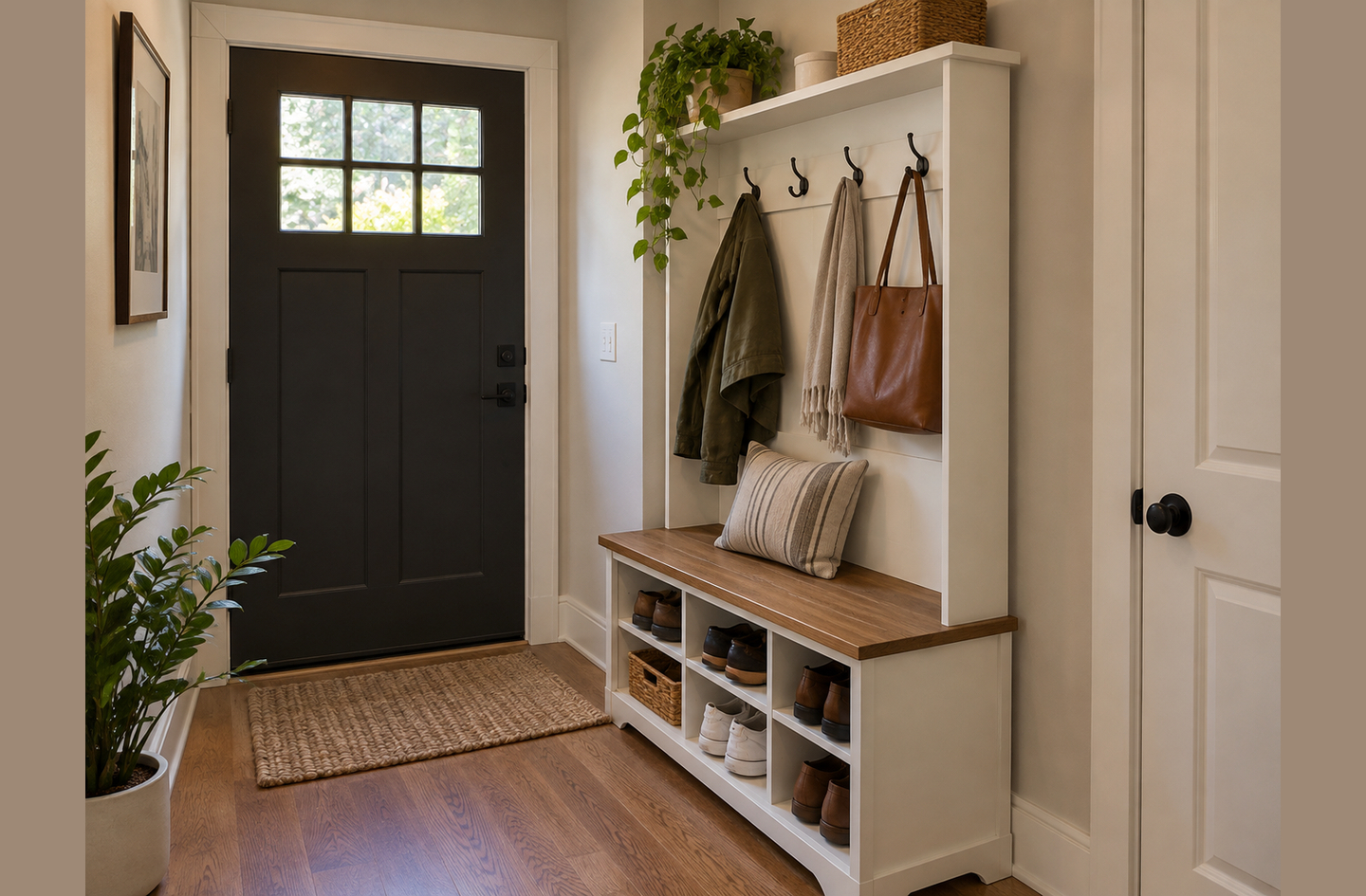
- Hall trees and mudroom benches: A hall tree combines a coat rack overhead with a bench seat and often shoe storage below in one footprint. It is covered separately in the entryway storage hub, as its selection criteria differ significantly from a standalone coat rack.
- Climate-specific needs: In climates with heavy winter outerwear, the weight per coat (a down parka plus a bag) can exceed 15 pounds per hook position. Verify the stud anchor rating, not just the hook rating, for this load.
- Wet gear: Ski jackets, rain gear, and wet coats benefit from ventilated storage or a dedicated drying zone, neither of which a standard hook rail provides. A dedicated boot tray and open rack near a door with airflow handles wet gear better than a closed entry setup.
- Load data limitations: The base diameter, height, and stability figures used in this article are derived from Dimensions.com’s product-type dataset (July 2026)6. Individual product specifications vary; verify the exact dimensions of any specific rack before purchasing.
References
- U.S. Access Board. 2010 ADA Standards for Accessible Design, Section 803.5. United States Access Board, September 2010. Available at: access-board.gov/ada.
- International Code Council. 2021 International Residential Code for One- and Two-Family Dwellings, Section R311.6: Hallways. ICC, 2021. Available at: codes.iccsafe.org.
- Houzz Editorial. “Entryway Design Guide.” Houzz, 2024. Available at: houzz.com.
- Costello, Mike. “Average Closet Depth.” Family Handyman, February 2025. Available at: familyhandyman.com.
- Homenish. “Standard Coat Hanger Size.” Homenish, August 2023. Available at: homenish.com.
- Dimensions.com. “Coat Racks.” Dimensions.com, July 2026. Available at: dimensions.com.
- The Spruce Editors. “How High to Hang Coat Hooks.” The Spruce, 2024. Available at: thespruce.com.
- Craftsy. “Coat Length Guide.” Craftsy, 2023. Available at: craftsy.com.
Conclusion
Square footage is fixed. Flow is a choice. The right coat storage in a small entryway is not the one that looks best in a photo; it is the one that keeps the walking path clear on the worst morning of the year, when everyone is leaving at once with winter gear and bags. Wall hooks and rails trade floor depth for 17 inches of coat projection. Slim racks trade wall clearance for 14 inches of floor depth. Over-door strips use no floor or wall clearance at all, but limit capacity to 2 to 4 positions.
Every inch needs a job. For most 42-inch entries with 2 to 4 people, a 36-inch hook rail at standard adult height does that job better than any alternative. For renters, a slim rack with a 14 to 16 inch base is the only option that fits the constraints. For the narrowest entries, the front door itself is the storage surface.
For the full picture of the entry as a system, including shoe storage, bench placement, and zone sequencing, see the small entryway storage overview. If you are pairing coat storage with a seating solution that also handles shoes, the shoe storage bench guide covers how to balance those two functions in one footprint.