
A soundproof room divider rarely makes a room quiet, and the reason is physics, not a bad purchase. Most dividers give you visual privacy. Some add sound absorption. Very few deliver real sound isolation. Even an ordinary interior wall of studs and drywall rates only about STC 331, and a freestanding screen has open edges that a wall does not. This article sits under the room dividers overview and goes deep on one question: what a divider can realistically do about noise, and what it cannot.
Quick Answer
Can a soundproof room divider reduce noise?
Partly. A divider can soften echo and take the edge off voices, but it cannot isolate sound the way a sealed wall does. Sound slips over, under, and around its edges. A leak of just 0.1% of a partition’s area limits it to about STC 30, even if the panel itself is rated far higher2. Expect a noticeable softening, not silence.
Key Takeaways
- Visual privacy, sound absorption, and sound isolation are three different jobs. Most dividers do the first, some do the second, and almost none do the third.
- Gaps decide isolation: a leak of 0.1% of the partition area caps the effective rating near STC 30, whether the wall itself is rated STC 40 or STC 602.
- A single layer of woven fabric is a weak absorber. In lab tests the best single fabric peaked at an absorption coefficient of 0.13243, far from the 1.0 of a perfect absorber.
- A frequent misconception is that a heavier screen fixes noise. Distance, sealed edges, and soft surfaces usually do more than the divider itself.
Privacy, Absorption, and Isolation: What a Soundproof Room Divider Claim Really Means
A room divider can do three separate acoustic jobs, and the word “soundproof” blurs them together. Building acoustics has kept them apart for decades: absorbing materials control sound inside a space, while isolating materials stop it passing between spaces5. Knowing which job you need is the first decision, before any product.
What does visual privacy actually give you?
Visual privacy is the ability to block sight lines between two zones, so a bed, a desk, or a pile of laundry is out of view. Every divider does this to some degree. A screen also marks a boundary that a roommate can see and respect.
What visual privacy does not do is stop sound. A curtain that hides the bed completely can still let almost every word of a phone call through. That gap between “I can’t see it” and “I can’t hear it” is where most disappointment with dividers starts.
What is sound absorption?
Sound absorption is the conversion of sound energy into a tiny amount of heat inside a porous material, so less sound reflects back into the room. Absorption cuts echo and the “hard room” ring that makes a studio feel loud. It works on the sound already inside your space.
The Noise Reduction Coefficient (NRC) is the single number used to rate absorption, on a scale where 0 reflects everything and 1 absorbs everything. Cornell University course notes put carpet at only about 0.3, while a mineral ceiling tile can exceed 0.904. A good acoustic panel sits toward the top of that range. A thin decorative screen sits near the bottom.
What is sound isolation?
Sound isolation is the ability of a barrier to stop sound from passing through it into the next space. This is what most people mean when they say “soundproof.” It depends on mass, airtightness, and construction, not softness.
Sound Transmission Class (STC) is the single-number rating for isolation, and a larger number means a better partition. For context, the International Building Code requires walls between apartments to reach at least STC 50 in lab testing, or NNIC 45 when tested in the field6. An ordinary interior stud wall sits far below that, at about STC 331.
“Sound absorbing materials control sound within spaces and function by allowing sound to pass through them relatively easily.”
A.C.C. Warnock, Institute for Research in Construction, National Research Council Canada5
Why is “soundproof” the wrong word for a freestanding divider?
The Warnock line explains the trap. The soft, porous panels that absorb sound well are, by design, easy for sound to pass through. The dense, airtight materials that isolate well tend to reflect sound instead. One product rarely does both, and a freestanding one cannot be airtight because it has open edges.
So a product labeled “soundproof room divider” is almost always an absorbing screen. That can be genuinely useful. It just solves a different problem from the one the label implies.
The practical reading: decide whether your problem is echo inside the room or sound crossing between zones, because the right divider for one is the wrong divider for the other.
How Sound Gets Past a Room Divider
Sound reaches the other side of a divider by three routes: through the panel, around its edges, and through the floor and ceiling that both zones share. Research from the National Research Council Canada shows the edge route can dominate, because even a tiny opening limits what the whole partition achieves2. Mass, gaps, and frequency explain most of what you hear.
Why does mass matter so much?
The mass law is the basic rule of isolation. For a single-layer barrier, each doubling of weight per unit area raises transmission loss by about 6 dB1. That is why a 150 mm poured concrete wall reaches about STC 551, while drywall on studs stops near 33.
Now apply the rule to a divider. A fabric screen weighs a tiny fraction of a drywall wall per square foot. Doubling its weight, then doubling it again, still leaves it far lighter than the wall it is being compared with. Mass helps, but a portable panel can never carry enough of it to behave like construction.
Why do gaps and open tops defeat isolation?
Gaps matter more than the panel. A leak of 0.1% of a partition’s area limits it to about STC 30, whether the panel is rated STC 40 or STC 602. The same digest notes that a crack 1 mm wide and 1 m long at the top of a wall hurts as much as an obvious hole2.
A freestanding divider is mostly gap by that standard. It stops short of the ceiling, sits off the floor on feet, and leaves open ends at the walls. Sound also travels by indirect routes. Flanking refers to sound moving around a barrier through shared floors, ceilings, and side walls, and in a poor design those paths can carry more sound than the barrier itself1.
The chart puts three sources on one scale. A leak covering 0.1% of a partition caps it near STC 302, below a basic stud wall at about STC 331. A freestanding divider leaves far more than 0.1% of its outline open, so its effective isolation sits below the bottom bar.
Why does bass get through when voices do not?
Low sounds are harder to stop in both senses. The mass law also says transmission loss rises about 6 dB each time the frequency doubles1. So the deep end of music or a TV passes most easily. Absorption struggles too. A study of woven fabrics found their properties have a negligible effect on absorption below 500 Hz3.
In practice, a fabric or felt divider will trim the hiss and clatter of a room. The thump of a subwoofer or a neighbor’s footsteps will pass straight through it. If bass is the complaint, a divider is the wrong tool.
How much reduction will you actually notice?
Human hearing is less sensitive to change than the decibel numbers suggest. U.S. Federal Highway Administration guidance says a barrier that breaks the line of sight can cut noise by 5 dB. Effective barriers cut 5 to 10 dB, which is up to about half the loudness7.
Those figures come from outdoor highway walls, where sound has no ceiling to bounce off. Indoors, the ceiling reflects sound straight over a screen, so a freestanding divider should be expected to land at the low end of that range or below it. A small improvement is still real. It is not the quiet a door and a full wall provide.
The numbers point one way: a freestanding divider changes how a room sounds more than how much sound crosses it, so judge it on echo and speech softening, not on isolation.
Fabric, Acoustic, and Full-Height Dividers Compared
Divider types differ far more in absorption and gap control than in mass. Sealed full-height panels isolate best, dense acoustic screens absorb best, and plain fabric does least. In lab tests, woven fabric on its own stayed below NRC 0.2, the point where a material starts to count as an absorber3. The table compares the main options on the three jobs.
| Divider type | Visual privacy | Sound absorption | Sound isolation | Renter-friendly? | Best fit |
|---|---|---|---|---|---|
| Single-layer fabric curtain or screen | Full when closed | Very low; woven fabric alone tested under NRC 0.2 | Negligible | Yes (tension rod or ceiling track) | Hiding a bed or desk |
| Layered or heavy acoustic curtain | Full when closed | Moderate; triple layers on a soft backing reached NRC 0.6 in lab tests | Low; open top and edges | Yes (ceiling track) | Softening echo in a hard studio |
| Freestanding acoustic panel screen | High at seated height | Moderate to high on both faces | Low; sound passes over and around | Yes (freestanding) | Taking the edge off calls at a desk |
| Filled bookshelf or storage divider | Partial to high | Low; books scatter more than they absorb | Low to moderate; mass helps, gaps limit it | Yes, anchored to a wall stud | Zoning with storage and some damping |
| Full-height track or tension panel | Full | Depends on panel finish | Moderate if edges are sealed | Often (tension or track systems) | Bedroom nook needing a door-like barrier |
| Built partition wall | Full | Depends on finish | Moderate; about STC 33 for a basic stud wall | No (permanent; needs approval) | A true second room |
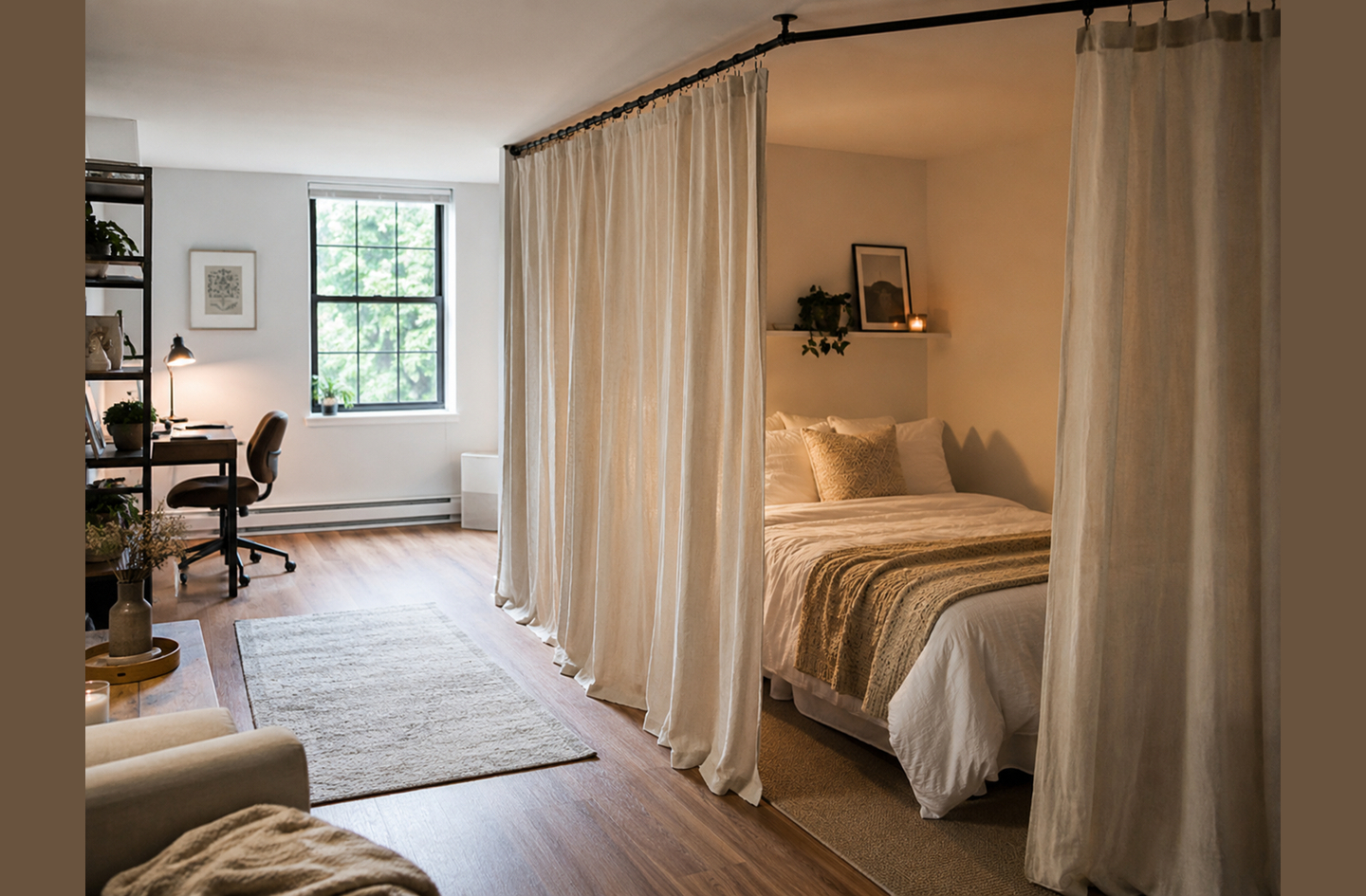
Fabric curtains and folding screens
Fabric is the most common choice and the weakest acoustic one. In impedance-tube tests, single woven fabrics barely absorbed sound, and the best one peaked at a coefficient of 0.13243. The same study treats any result with an NRC below 0.2 as not an absorber at all3.
Layering changes the picture. A triple layer of woven fabric backed by a nonwoven polyester layer reached an NRC of 0.6 in that research3. So a heavy, lined, multi-layer curtain can calm a hard room. It still will not stop a conversation on the other side.
Sound absorbing room divider panels
Freestanding acoustic panels, usually felt, compressed fiber, or a fabric-wrapped core, are the products that do absorb. Their value is highest close to the noise source, such as beside a desk where someone takes calls. Height matters as much as material.
“To have any impact at all the screening needs to be at least 5 feet high and one needs solid mass in this screening to block sound energy.”
Cornell University, Department of Design and Environmental Analysis course notes on acoustics and speech privacy4
Most decorative folding screens fall short of that height or that mass. An acoustic privacy screen that clears head height for a seated person, with absorbing faces on both sides, is a reasonable buy for a home office corner.
Bookshelf and storage dividers
A filled shelf brings two things fabric lacks: real mass and an uneven surface that scatters sound. A unit packed with books, closed baskets, and boxes weighs far more than a screen, and the mass law rewards that. Open cubbies and a gap above the top shelf still leak, so treat it as damping, not isolation.
If storage is part of the plan anyway, a bookshelf room divider gives you zoning, storage, and some acoustic benefit in one footprint. The same logic applies to cabinets and wardrobes, covered in room divider storage. Tall units must be anchored against tipping.
Full-height track and panel dividers
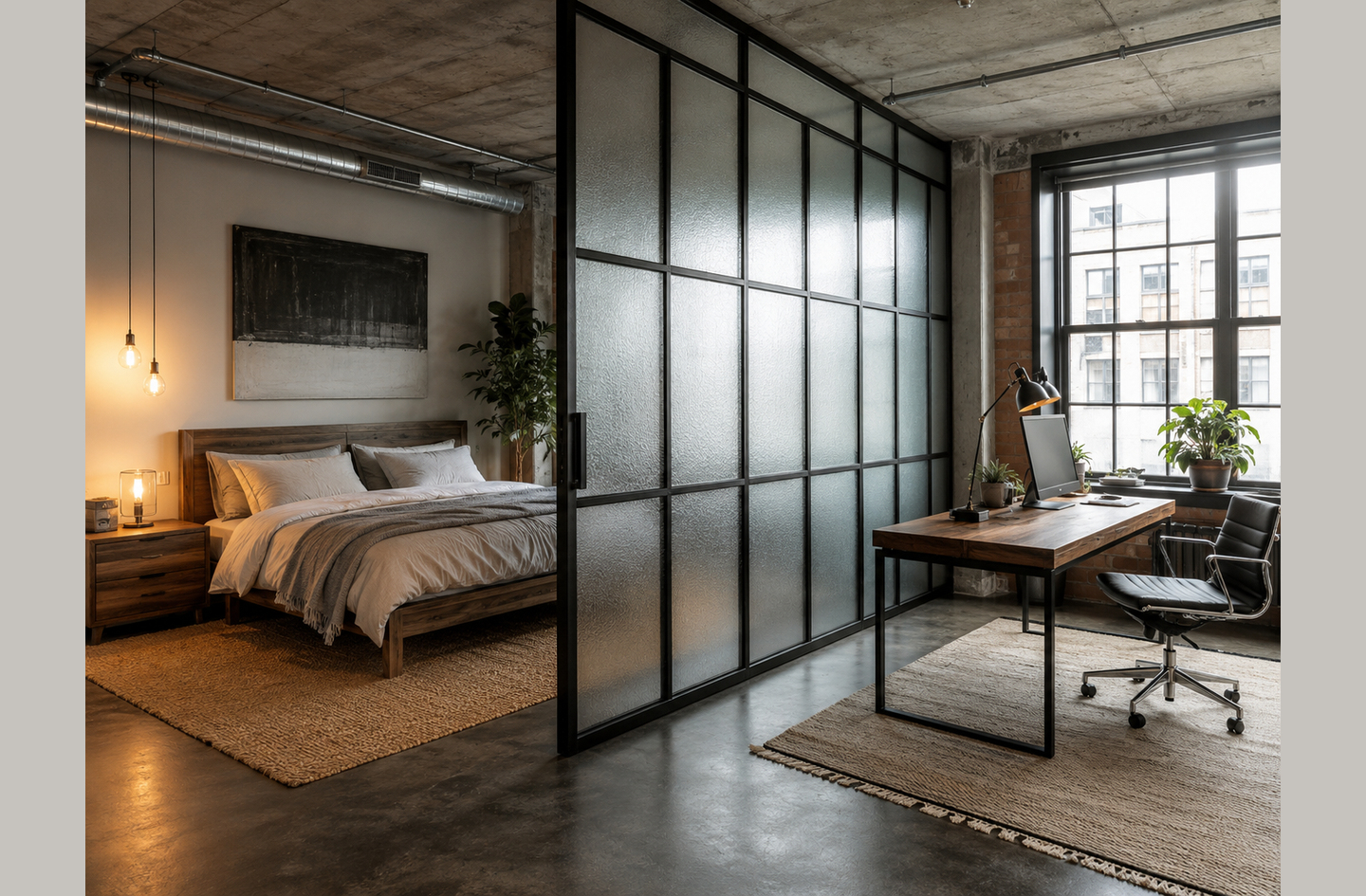
Full-height dividers come closest to a wall because they close the biggest gap: the open top. A tension-mounted or ceiling-track panel that meets the floor and ceiling, with soft seals at the edges, removes most of the direct air path. Glass or solid panels add mass, though they also reflect sound back into the room.
This is the option to consider when one zone is for sleep. The trade-offs in light, airflow, and installation are covered in depth in floor to ceiling room dividers. Even sealed, a panel system stays well short of the STC 50 that the building code requires between apartments6.
Slatted and open dividers
Slatted and open-frame dividers are close to acoustically transparent. Sound passes between the slats almost as freely as light does. Their job is structure and sight-line control, which wood slat room dividers do well, not noise control.
For noise, rank options by how completely they close the gaps first and by mass second. A divider that leaves the top open belongs in the “soften” category, however heavy it looks.
Choosing a Noise Reducing Room Divider by the Problem You Have
The right noise reducing room divider depends on where the sound starts and which job you need done. Survey data from 600 office buildings found acoustics was the most common complaint, named by 54% of respondents8. A shared studio packs the same conflicts into less space. A four-question diagnosis sorts most cases before anything is bought.
Is the noise inside the room or coming through the walls?
Sound from a neighbor, a hallway, or the street arrives through the building, not across your room. A divider inside your unit does nothing for it, because the noise has already entered both zones. That problem belongs to the walls, windows, and doors, and to a landlord or a contractor if construction is involved.
Is the problem echo, conversation, or sleep?
Echo is an absorption problem, and soft dividers, rugs, and curtains help. Conversation is a speech-privacy problem, which needs distance, absorption near the talker, and some masking sound. Sleep next to an active zone is an isolation problem, and only a sealed full-height barrier with a door-like closure gets close.
Can you move the noise source instead of blocking it?
Distance is free, and it beats most screens. Putting the desk and the bed at opposite ends of a studio, with storage or a sofa between them, often does more than a divider placed between two zones that touch. Open layouts show the cost of skipping this step. Occupants of open-plan offices with low or no partitions were almost twice as likely to complain as people in enclosed offices8.
What does a realistic target look like?
Set the goal in plain terms: less echo, softer voices, or a calmer sleep zone. A soft screen can deliver the first, a well-placed acoustic panel can help with the second, and a sealed full-height panel can help with the third. None of them delivers the silence of a closed door in a full wall.
This sequence is the Small Space Logic diagnosis applied to sound: find the source, name the job, move the source if you can, and only then choose a divider. It follows the same order as every layout decision on the site. Engineer the layout first, decorate second.
Most noise complaints in a studio are solved, or ruled out, by the first and third questions, which cost nothing; the divider is the last step, not the first.
How to Get More From an Acoustic Privacy Screen Without Construction
An acoustic privacy screen works best when it is tall, close to the source, and backed up by soft surfaces in the rest of the room. Cornell University guidance sets 5 feet as the minimum height for a screen to affect speech4. Every step here is renter-friendly and reversible.
Go tall and place it close to the noise
A screen near the talker blocks more of the direct sound than one placed mid-room. Choose panels at least as tall as a standing person’s head when the goal is speech, and angle a folding screen into a shallow “C” around a desk. Leave enough clearance to walk past without shifting it.
Close the gaps you can reach
Lower the bottom edge until it nearly touches the floor, and push the ends tight to a wall or a tall piece of furniture. On a ceiling-track curtain, choose a track mounted flush to the ceiling and a fabric long enough to puddle slightly. Each gap you close removes part of the direct path.
Soften the hard surfaces around it
Absorption works across the whole room, not just on the divider. A large rug, upholstered seating, and full curtains on the windows all reduce echo. Carpet alone tops out around an NRC of 0.34, so combine several soft surfaces rather than relying on one.
Add steady background sound
Masking sound, such as a fan or a white-noise machine, makes speech from the other zone harder to follow. It does not lower the noise. It lowers how much the noise intrudes. For sleep, it is worth trying before buying a heavier divider.
If the only answer left is a real wall, that is a construction project. Bring in a licensed contractor, check the lease or building rules, and expect permits in many places. This article is engineering-informed education, not a substitute for a professional assessing a specific home.
The cheapest gains come from height, placement, and gap control, which turn an average screen into a useful one before any money goes to a heavier product.
Common Mistakes When Buying a Room Divider for Noise
Most poor results trace back to buying for the label instead of the job. A screen sold as “soundproof” usually absorbs a little and isolates very little, because a leak of 0.1% of its area already caps performance near STC 302. These are the errors that cost the most.
- Trusting the word “soundproof.” Look for an NRC figure on absorbing panels. If a seller quotes an STC for a freestanding screen, ask how it was tested and whether the edges were sealed.
- Buying thin fabric for a noise problem. A single decorative layer is a visual divider. It belongs in the privacy category.
- Leaving a gap at the floor and ceiling. The open top is the largest leak in most setups.
- Expecting a divider to stop bass or footsteps. Low frequencies and impact noise travel through the structure.
- Choosing the divider before the layout. Moving the desk or the bed may solve what no screen can.
Frequently Asked Questions
Do soundproof room dividers actually exist?
Not in the strict sense. A freestanding divider cannot be sealed at the ceiling, floor, and walls, so it cannot isolate sound the way construction does. Walls between apartments must reach STC 50 under the building code6, and no portable screen comes close. Products sold under that label are absorbing screens that soften sound.
How tall should an acoustic room divider be?
At least 5 feet to have any effect on speech, according to Cornell University acoustics course notes4. Taller is better, and a panel that reaches the ceiling removes the largest gap. For a seated desk zone, choose a screen that clears head height and has absorbing material on both faces.
Will a heavy curtain block sound between a bed and a living area?
It will soften sound but not block it. Woven fabric tested on its own stayed below NRC 0.2, too low to count as an absorber, while a triple layer on a nonwoven backing reached 0.63. A lined, multi-layer curtain on a ceiling track helps with echo. It will not stop a TV or a conversation.
Does a bookshelf divider reduce noise better than a screen?
Somewhat, if it is packed solid and pushed tight to the walls. A filled shelf carries far more mass than a fabric screen, and books scatter sound. Gaps above the top shelf and through open cubbies still leak, so expect damping rather than isolation, and anchor any tall unit to the wall.
What is the cheapest way to reduce noise in a studio without building a wall?
Rearrange first. Put the noisy zone and the quiet zone at opposite ends, then add soft surfaces and steady background sound. A rug helps, though carpet tops out around an NRC of 0.34, so pair it with curtains and upholstered furniture. A divider comes after those steps, not before.
Limitations and Edge Cases
- Independent test data on freestanding indoor dividers is scarce. The divider estimates here are reasoned from building research, a building code, lab fabric tests, and outdoor barrier guidance, not measured on specific products.
- Impact noise, such as footsteps or furniture dragged on the floor above, travels through the building structure. No in-room divider addresses it.
- Ratings use the North American STC scale and the 2021 International Building Code. Other countries use different ratings and limits, and local codes and leases govern any permanent partition.
References
Methodology: every figure in this article comes from an independent published source (building research digests, a model building code, federal noise guidance, university course material, and peer-reviewed studies) and links to the page that carries it; the article is written by Small Space Logic’s founder and updated when a source or recommendation materially changes.
- National Research Council Canada – Canadian Building Digest CBD-239, Factors Affecting Sound Transmission Loss, A.C.C. Warnock, July 1985 (archived copy hosted by MIT).
- National Research Council Canada – Canadian Building Digest CBD-186, Office Partitions: Acoustical Requirements for Design and Construction, A.C.C. Warnock, May 1977 (archived copy hosted by MIT).
- Materials journal (PubMed Central) – The Influence of Physical Properties and Increasing Woven Fabric Layers on the Noise Absorption Capacity, peer-reviewed impedance-tube study, 2021.
- Cornell University – DEA 3500 course notes, Ambient Environment: Acoustics and Speech Privacy, Acoustics lecture 5 (undated).
- National Research Council Canada – Canadian Building Digest CBD-236, Introduction to Building Acoustics, A.C.C. Warnock, February 1985 (archived copy hosted by MIT).
- UpCodes – International Building Code 2021, Section 1206.2 Airborne Sound, as adopted in the Illinois Building Code 2021.
- U.S. Federal Highway Administration – Highway Traffic Noise Barriers at a Glance, page updated October 6, 2021.
- Buildings and Cities – Parkinson, Schiavon, Kim and Betti, Common sources of occupant dissatisfaction with workspace environments in 600 office buildings, Vol. 4, Issue 1, January 2023.
Conclusion
A room divider can give you visual privacy and, with the right materials, useful sound absorption. It cannot give you the isolation of a sealed wall, because its open edges limit it more than any panel material can fix. Map where the noise starts, move what you can, close the gaps, and choose the divider last. Square footage is fixed. Flow is a choice.
See the room dividers overview for how noise fits into the wider decision of zoning one space into two.