
A small kitchen counter fills up because nothing on it has to earn its place. The small kitchen storage overview covers the wider topic; this guide works on one surface. These small kitchen counter organization ideas apply one test to every item: daily use stays on the counter, and everything else moves up the wall or into a drawer. The test matters because counters attract appliances, and a coffee maker alone is used every week in 73% of U.S. homes1. The result is a counter that holds the few things you reach for daily and leaves a clear run for prep.
Quick Answer
What should stay on a small kitchen counter, and what should move?
Keep only items used every day on the counter: usually one or two appliances, a short utensil crock, and the sink kit. Move weekly appliances into the nearest base cabinet, knives and tools onto the wall, and spices and oils into a drawer away from the range. Even the second most common weekly appliance, the toaster, is used weekly in only 58% of U.S. homes1.
Key Takeaways
- Apartment households in larger buildings use about 2.7 types of small appliance each week, based on 2024 federal survey counts1. The counter needs a rule, not more space.
- A prep run of at least 36 inches is the planning minimum for mixing work2, and it is the first thing clutter takes.
- The stove-side counter is the worst place for paper towels, wooden tools, oils and spices, for both fire and food-quality reasons46.
- The common mistake is buying counter organizers. A turntable or tiered riser keeps an item on the counter instead of asking whether it belongs there.
Small Kitchen Counter Organization Ideas Start With a Residency Test
Small kitchen counter organization works when every item on the counter passes a frequency test, not a style test. In 2024, U.S. homes used about 2.96 types of small kitchen appliance every week on average, before counting the microwave1. Each one wants a spot near an outlet, and in a small kitchen that spot is the counter.
Counter residency is the right of an item to live on the counter full time, earned by daily use and nothing else. An item that earns residency stays where it is used. An item that does not earn it gets a home off the counter, ranked by how often it comes out.
The test has four outcomes, and each one maps to a place in the kitchen:
- Used daily: stays on the counter, at the spot where it is used.
- Used several times a week: moves to the wall or the first drawer, still within one step.
- Used weekly or less: moves into a base or upper cabinet near its outlet or task.
- Used a few times a year: moves to high shelves, deep corners or another room.
The residency test matters more than any organizer you can buy, because a clear counter is a sorting result, not a product.
Is a clear counter the same as a minimal kitchen?
A clear counter is not the same as owning less. The residency test asks where a slow cooker or stand mixer should live between uses, not whether to own one. A kitchen full of tools can still keep a clear counter when every tool has a home that matches how often it comes out. That is the engineering view of compact living: square footage is fixed, flow is a choice.
1. Sort Every Counter Item by How Often You Use It – Best for Counters That Refill Themselves
Sorting by use frequency is the first idea because every later idea depends on it. Clear the counter completely, then put back only what you used today. Leave everything else in a box on the table for one week. Each item you take out of the box during the week goes back to a place chosen by the residency test. Whatever is still in the box at the end of the week did not need counter space at all.
The week-long box works because memory is a poor guide to frequency, and a week of real use replaces guesses with a record. It also shows the true daily kit, which is usually small: one appliance, one crock of tools, the cutting board and the sink supplies.
If the counter refills within days of a clear-out, the cause is almost always items with no assigned home, not a lack of discipline.
What counts as daily use?
Daily use means the item comes out on most days of a normal week, not on the best day. A kettle used every morning qualifies. A stand mixer used for weekend baking does not, even if it is the most valuable appliance in the kitchen. Only frequency earns counter space.
2. Keep One Appliance Per Daily Habit – Best for Kitchens With a Coffee Maker, Toaster and Air Fryer
Only the coffee maker and the toaster are used weekly by about half or more of apartment households, so most other small appliances are candidates to leave the counter. In apartment buildings with five or more units, 59% of households use a coffee maker weekly and 48% a toaster. Only 42% use an air fryer and 36% a blender or juicer1. Weekly use is a lower bar than daily use, so the share using each one every day is smaller still.
The rule that follows is one appliance per daily habit. If the morning habit is coffee, the coffee maker earns residency. The toaster earns it only if toast is also a daily habit. A toaster used twice a week moves into the base cabinet nearest an outlet. A nightly air fryer stays; a weekend air fryer moves.
The numbers also show that apartment kitchens are not appliance-light. The average apartment household in a larger building uses about 2.7 types of small appliance each week, close to the 2.96 average across all homes1. Smaller kitchens carry nearly the same appliance load, so the residency rule matters most there.
The appliance you use every day deserves the best spot on the counter; the appliance you value most may deserve a cabinet.
Where should the resident appliance sit?
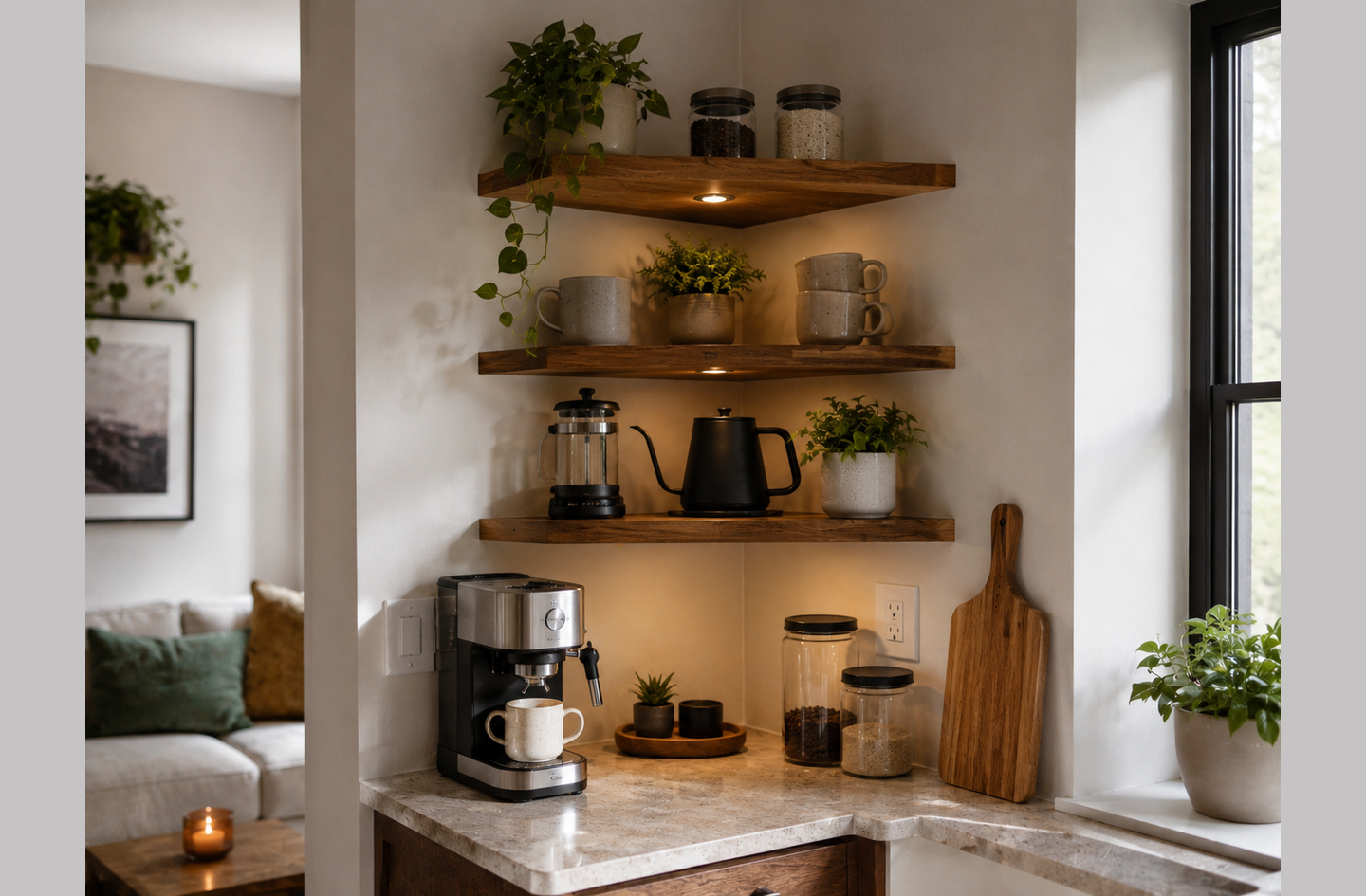
The resident appliance sits at the end of a counter run, not in the middle of it. An appliance placed mid-run splits the counter into two short pieces, and neither may be long enough to prep on. Pushed to a corner or the end of the run, the same appliance leaves one continuous surface. Corners suit coffee stations, because the deep back corner is hard to prep on anyway.
Does the microwave count?
The microwave is a special case because nearly every home uses one and its footprint is large. In apartments in larger buildings, 91% of households use a microwave1. If it sits on the counter, it is usually the single biggest claim on counter length. A shelf or a cart frees that length. An over-the-range mount is an electrical and installation job for a qualified installer, and renters need the landlord’s approval.
3. Protect One Clear Prep Run – Best for People Who Cook Most Days
The prep run is the counter’s most valuable surface, and university kitchen-planning guidance sets its minimum length for mixing work at 36 inches2. Clutter takes this space first, because it is the longest open stretch. Treat it as a no-residency zone: nothing lives there, and anything set down leaves when the task ends.
The same guidance sets at least 15 inches on either side of the range and an 18-inch counter beside the refrigerator door handle2. These shorter stretches are landing spots for hot pans and grocery bags. They are not storage. A canister set or a fruit bowl parked beside the range removes the one safe place to set a hot pan.
If the kitchen cannot give the prep run its full length, choose the longest run you have and keep it empty; a shorter clear run beats a longer cluttered one.
What if no run in the kitchen is that long?
Many studio and galley kitchens have no single run of that length between the sink and the range. There the prep surface has to be added rather than freed. A cutting board that bridges the sink, a fold-down wall shelf or a rolling cart can supply the missing length. The counter space and reach guide covers layout options for kitchens that lack a full prep run.
4. Clear the Stove Side of Anything That Can Burn – Best for Ranges With Counter on Both Sides
The counter beside the range should hold nothing that burns, because cooking is the leading cause of home fires and U.S. fire departments responded to an estimated 170,000 home cooking fires in 20215. Unattended equipment was the leading factor in 37% of the nonconfined cooking fires in that data5. Paper towels, oven mitts and wooden spoons collect there by habit, right next to the heat.
“Keep anything that can catch fire – paper towels, oven mitts, wooden utensils, food packaging, towels and curtains – away from your stove top.”
U.S. Fire Administration, FEMA, home cooking fire safety guidance4
That list maps directly onto common counter clutter. The paper towel holder moves to the far side of the sink or onto the wall beside it. Oven mitts go in the drawer nearest the range. Wooden spoons move to a drawer or a crock well away from the burners.
The stove-side counter is a landing zone for hot pans, so the best thing to store there is nothing.
Which tools can stay near the range?
Tools used during cooking can stay within reach of the range when they do not burn easily: a short crock of metal spatulas, tongs and silicone spoons. Fire-safety guidance also recommends keeping a pan lid or baking sheet nearby5. Give the lid a slot in the nearest drawer, not a spot on the counter.
5. Move Spices and Oils Into a Drawer Away From the Heat – Best for Cooks Who Keep Bottles Beside the Range
Spices and cooking oils lose quality faster in the warm, bright spot beside the range, so the counter there is the wrong home for them. Penn State Extension gives opened vegetable oil a shelf life of 1 to 6 months when it is stored in a cool, dark place6. The same guidance says to evaluate the freshness of ground spices and all herbs after six months6.
“Spices and herbs should be stored in airtight containers in dry places away from sunlight and heat.”
Martha Zepp, former program assistant, Penn State Extension6
A drawer insert that holds jars on their sides solves both problems at once. It keeps the spices dark and away from steam, and it frees the counter strip behind the range. Choose a drawer one cabinet away from the range, not directly under the cooktop. If no drawer is free, a shelf inside the nearest upper cabinet works; a rack above the burners does not.
Oils follow the same rule with one exception: the single oil used at almost every meal can sit in a small tray at the far end of the counter. Backup and specialty bottles move to a cabinet.
The spot beside the range looks like the logical home for spices, but it is the one place in the kitchen most likely to shorten their useful life.
6. Put Knives and Tools on the Wall – Best for Counters Taken Up by a Knife Block
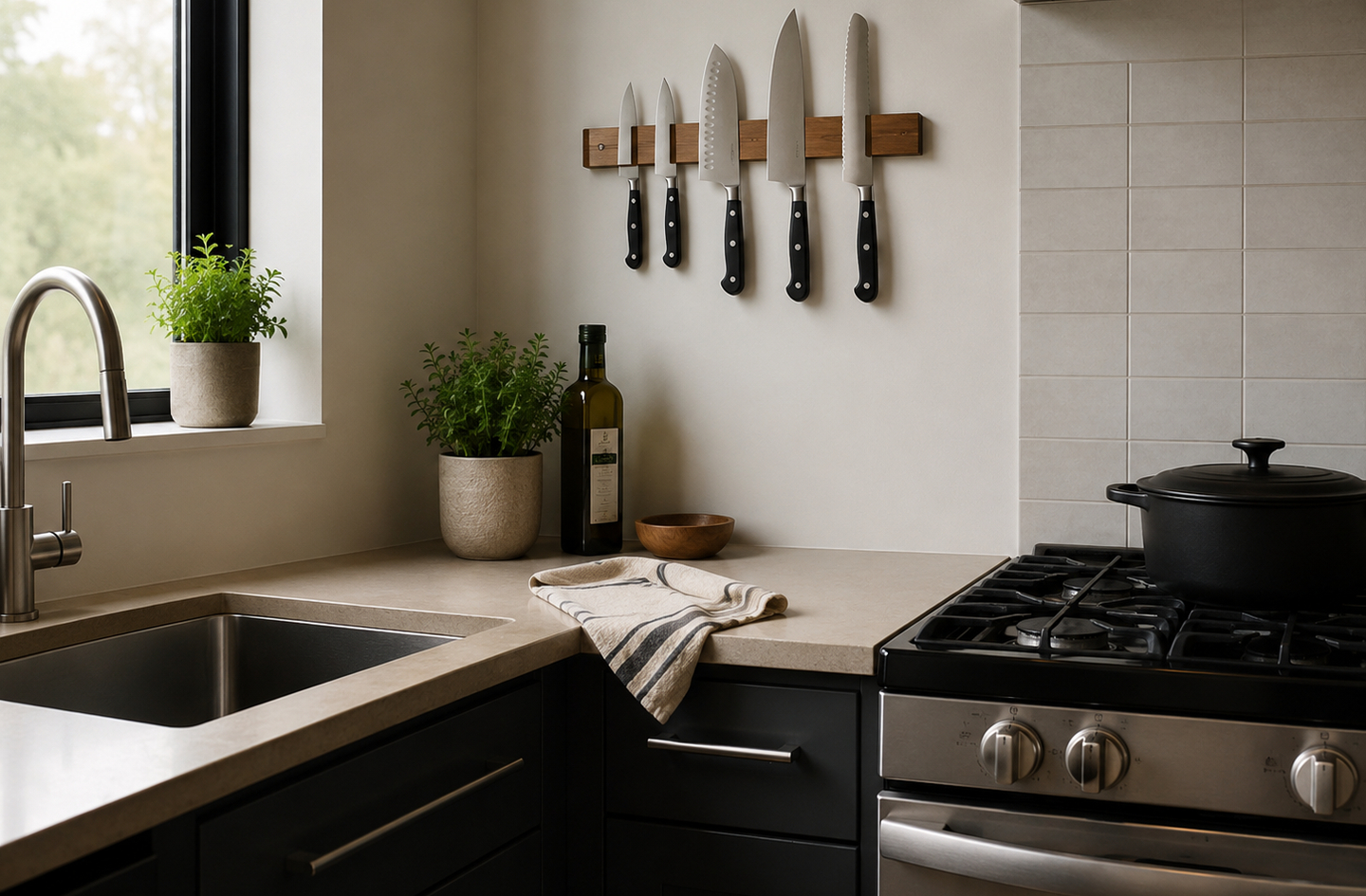
A wall-mounted knife strip or rail moves the knife block’s footprint off the counter and keeps every blade in sight. The wall between the counter and the upper cabinets sits close to the prep run, and little else competes for it.
The reach band is the height range where items can be reached without a stool or a deep lean. Federal accessibility standards set an unobstructed forward reach of 15 inches minimum to 48 inches maximum above the floor3. Where the reach crosses an obstruction deeper than 20 inches, such as a standard counter, the high reach drops to 44 inches maximum3. These limits are drawn for a person using a wheelchair, so they form a conservative band. Standing adults can reach higher, but tools placed inside the band work for everyone in a shared home.
For the wall above a counter, that means the most-used tools hang low on the backsplash, close to the counter surface. A knife strip, a short rail with hooks or a slim shelf for salt and pepper all fit the band. Items used less often go higher.
If a tool is used every day and hangs on the wall within easy reach, it costs no counter space at all.
Is a wall rail renter-friendly?
A wall rail can be renter-friendly when it uses removable adhesive mounts or a tension pole instead of screws. Adhesive strips are rated by weight, so they suit utensils and small shelves better than a full set of knives. A knife strip holds heavy steel and usually needs screws, so ask the landlord first.
7. Give the Sink Kit One Tray – Best for Counters Covered in Soap, Sponges and Brushes
The sink kit (dish soap, a sponge, a brush and a cloth) earns counter residency because it is used several times a day. It earns one tray, not the whole edge of the sink. University kitchen-planning guidance names the sink center as the most-used area in the kitchen. For a right-handed cook, it suggests at least 24 inches of counter to the right of the sink and 18 inches to the left2. A tray holds the kit to a fixed footprint and catches drips.
Everything else that drifts to the sink moves below it. Backup soap, scrub pads and sprays go in the cabinet under the sink, ideally in a pull-out bin. The same guidance places dishwashing supplies, cutting boards and the wastebasket at the sink center2: close to the sink, but not on top.
A sink kit with a fixed tray is a container with a limit; a sink kit without one grows until it reaches the next appliance.
Should the dish rack stay out?
A full-size dish rack is one of the largest counter claims in a small kitchen, and it is used for only part of the day. A roll-up rack across the sink, or a folding rack stored under it, gives the same drying space without permanent residency.
8. Give Weekly Appliances a Cabinet Shelf or a Garage – Best for Bakers, Blenders and Air Fryer Owners
Weekly appliances leave the counter but stay within one step of an outlet. The base cabinet nearest the counter outlet is the best home for them. Lifting a heavy appliance from a low shelf is easier than lowering it from a high one. Without a spare cabinet, a lower shelf on a rolling cart at the end of the counter works.
An appliance garage is a cabinet that sits on the counter, usually in a corner, with a door that closes over one or two plugged-in appliances. In a rental, a freestanding hutch or a closed cart does the same job without installation.
A rolling cart or compact island can hold weekly appliances below and add prep surface on top. The guide to small kitchen islands covers how to size one so it does not block the walkway. In kitchens that came with almost no cabinets, storage without cabinets explains open shelving and rail systems that give these appliances a home.
Moving one weekly appliance into a cabinet often frees more counter than any organizer, because appliances have the largest footprints on the counter.
Do canisters and bread boxes earn counter space?
Canisters and bread boxes rarely pass the residency test. Flour and sugar belong in airtight containers in a cabinet or pantry. Penn State Extension notes that whole wheat flour can turn rancid quickly at room temperature. All-purpose and bread flour keep up to two years at 40 degrees F in the refrigerator6. Decanting means moving dry goods from their packaging into uniform, labeled containers. It pays off only when the containers go into a pantry or cabinet.
9. Send Non-Kitchen Items Somewhere Else – Best for Counters That Double as a Drop Zone
Mail, keys, chargers, bags and school papers fail the residency test by definition, because they are not kitchen tools. They land on the kitchen counter because it is the first flat surface inside the door. The fix is a dedicated drop spot near the entry: a wall shelf, a tray on a narrow console or a set of hooks. Once that spot exists, the counter stops working as the household’s inbox.
Chargers also tie up outlets the kitchen needs for appliances, so a charging spot in another room returns those outlets to the counter.
When the counter doubles as the dining table, a separate eating spot removes plates and condiments from it. The kitchen nook and banquette guide covers how to add a small table or bench seating without crowding the walkway.
A counter that holds the day’s mail is a sign that the home is missing a drop zone, not that the kitchen is too small.
What Stays and What Moves: Small Kitchen Countertop Organization Compared
The table below applies the residency test to the items that most often crowd a small kitchen counter. Each row names the item, its usual home after the test, a renter-friendly way to get it there, and the reason. Adjust each row to your household’s actual use.
| Item | Counter residency? | Home after the test | Renter-friendly option | Reason |
|---|---|---|---|---|
| Daily coffee maker or kettle | Yes | End of a counter run or a corner | Shelf above for mugs and supplies | Used daily; 73% of homes use a coffee maker weekly1 |
| Toaster used a few times a week | No | Base cabinet nearest an outlet | Lower shelf of a rolling cart | 48% of apartment homes use one weekly1 |
| Air fryer, blender, slow cooker | Only if used daily | Base cabinet or appliance garage | Closed cart or freestanding hutch | Each is used weekly by under half of apartment homes |
| Microwave | Depends on the layout | Shelf, cart or built-in position | Microwave cart at the end of the run | Largest single counter claim |
| Knife block | No | Knife strip on the backsplash | In-drawer knife tray | Wall space costs no counter |
| Spices and backup oils | No | Drawer insert one cabinet from the range | Shelf inside an upper cabinet | Heat and light shorten shelf life |
| Paper towels, oven mitts | Not beside the range | Far side of the sink, or a drawer | Adhesive hook inside a cabinet door | Combustibles stay away from the stovetop |
| Canisters and bread box | Rarely | Pantry or cabinet, airtight | Pull-out bins in a base cabinet | Contents used less often than the space they hold |
Read down the residency column: in most kitchens, only three or four rows say yes, and that short list is the whole counter plan.
How We Selected These Ideas
The nine ideas were selected from the decisions that most affect usable counter length in a compact kitchen. Each was checked against an independent public source: federal survey counts, university kitchen and food-storage guidance, federal fire-safety guidance or the federal accessibility standards.
Each idea was then ranked by how much counter it frees for the effort involved, and by whether a renter can do it without permanent changes. Ideas that need wiring, plumbing or new cabinetry were left out or marked as work for a professional. This is a research-based comparison, not a hands-on product test, and no product or retailer is named or paid for placement.
The ranking favors ideas that cost little and change the most, because a counter plan that needs a renovation is not a counter plan most renters can use.
Frequently Asked Questions
What should you keep on a small kitchen counter?
Keep only what you use every day: usually one appliance, a small utensil crock, a cutting board and the sink kit in a tray. Everything else gets a home off the counter. Even the coffee maker, the most common weekly appliance, is used weekly in 73% of homes1, not all of them.
How do you organize a small kitchen counter without drilling?
Use trays, in-drawer inserts, adhesive hooks rated for the load and a rolling cart. Start by freeing one clear prep run, which planning guidance sets at a minimum of 36 inches for mixing work2. Then move weekly appliances to a cabinet or cart, and ask the landlord before mounting anything heavy.
Where should spices go in a small kitchen?
Spices belong in a drawer or cabinet one step away from the range, in airtight containers, out of light and steam. A rack above the burners shortens their useful life. Penn State Extension advises checking the freshness of ground spices and all herbs after six months6.
How much counter should stay clear next to the stove?
Kitchen-planning guidance treats 15 inches of counter on either side of the range as the minimum2. That space is a landing zone for hot pans and lids. It should hold no stored items, and nothing that can burn, such as paper towels or wooden spoons.
Should the microwave stay on the counter in a small kitchen?
Only if no other spot works. In apartments in larger buildings, 91% of households use a microwave1, and on the counter it is usually the largest single footprint. A shelf, a microwave cart or a built-in position frees more counter than any other single move.
Limitations and Edge Cases
- The appliance figures measure weekly use in 2024 U.S. homes, not daily use. The share using each appliance every day is lower, and the survey does not publish it.
- The reach heights come from accessibility standards drawn for a person using a wheelchair. They are a conservative planning band, not a ruling on what a specific home requires.
- Moving a microwave over the range, adding counter outlets or wiring an appliance garage is electrical work. It needs a licensed electrician or contractor, and renters need written landlord approval first.
References
Methodology: every sourced figure in this article comes from an independent published source and links to the page that carries it; the appliance shares and averages are Small Space Logic calculations from the federal survey counts. The article is written by Small Space Logic’s founder and updated when a source or a recommendation materially changes.
- U.S. Energy Information Administration – Residential Energy Consumption Survey 2024, Table HC3.1, Appliances in U.S. homes, by housing unit type (preliminary release, March 2026).
- University of Missouri Extension – Kitchen Planning: Work Centers (GH5669), Marilyn W. Caselman and Lelland L. Gallup, updated September 2017.
- U.S. Access Board – Guide to the ADA Standards, Chapter 3: Building Blocks, section 308 Reach Ranges, 2010 ADA Standards for Accessible Design.
- U.S. Fire Administration – Cooking safety pictograph, keep anything that can catch fire away from your stove top, FEMA (undated).
- U.S. Fire Administration – Cooking fire safety, home fire prevention guidance, FEMA (undated).
- Penn State Extension – Storing Staple Ingredients in the Kitchen, Martha Zepp, August 9, 2024.
Conclusion
A small kitchen counter stays clear when every item on it passes one test: daily use. Keep the daily appliance at the end of a run, protect one prep run and keep the stove side free of anything that burns. Then move knives, spices, weekly appliances and mail to homes that match how often they are used. Engineer the layout first, decorate second.
For how counter decisions fit the wider topic of compact kitchen storage, see the small kitchen storage overview.