
Studio apartments average 460 square feet in the U.S.1, and a full-size desk earns its place only if you are willing to live beside it all day. With roughly 25% of paid workdays now done from home2, choosing the right folding desk for small spaces is a layout decision as much as a product one. The Small Home Office planning overview covers the full set of decisions. This article compares three desk types that fold: wall-mounted fold-down desks, cabinet fold-down units, and freestanding foldable desks, measured on working depth, stability, folded footprint, mounting demands, and daily reset.
Quick Answer
Which folding desk type works best in a small space?
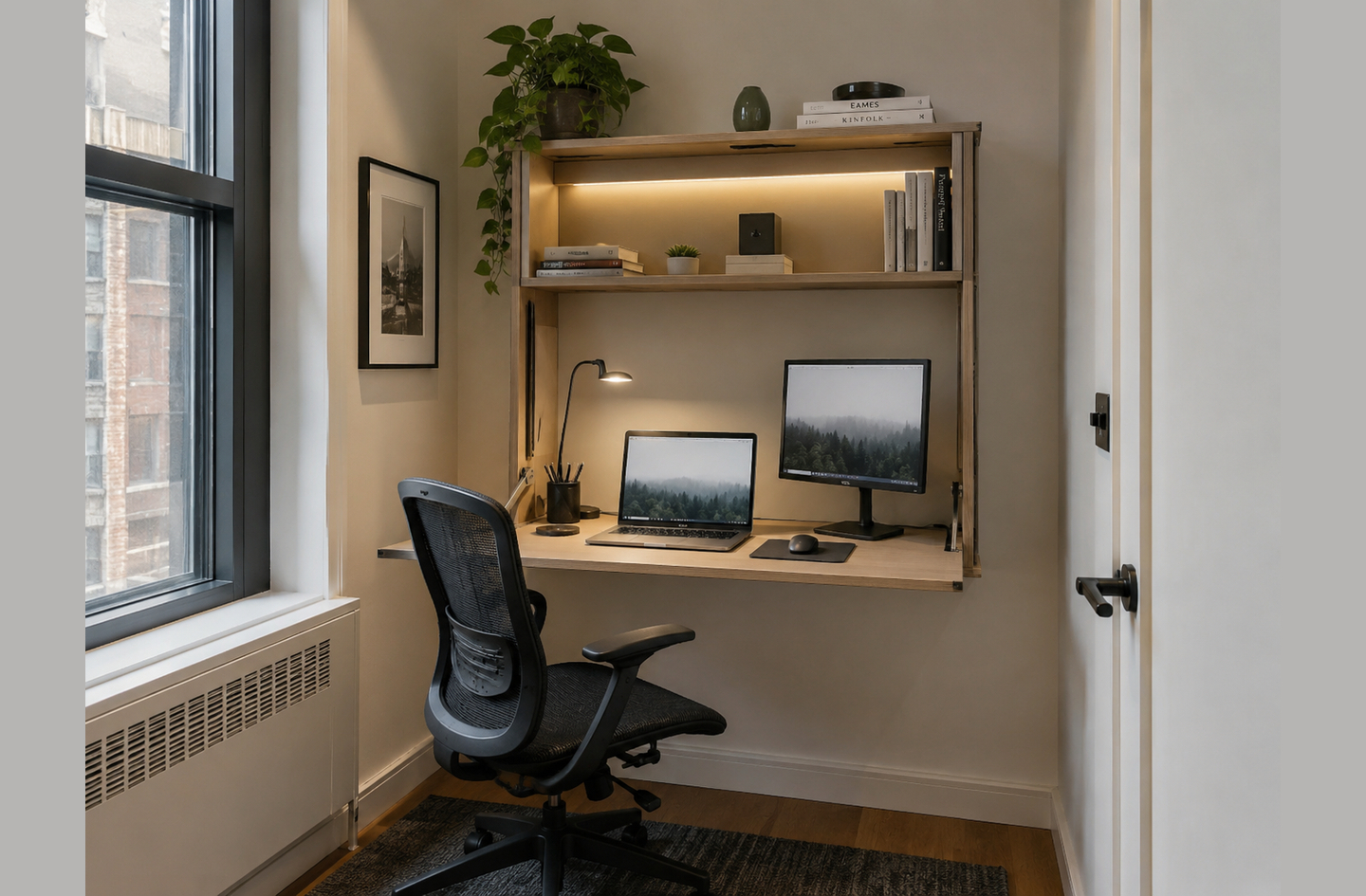
The right type depends on three factors: required working depth, renter status, and how quickly the room needs to reset. Freestanding foldable desks (20-30 in deep) suit renters who cannot patch walls. Wall-mounted fold-down desks (13-17 in deep) give the fastest room recovery in under 10 seconds but need wall anchoring. Cabinet fold-down units (18-24 in deep) offer the most working depth and close back into furniture. Laptop-only work fits all three types. A dual-monitor setup needs a cabinet or freestanding desk.
Key Takeaways
- Wall-mounted fold-down desks (13-17 in typical depth) reset in under 10 seconds but fall below the ANSI/HFES 100-2007 ergonomic minimum of 24 inches for most monitor setups.5
- Cabinet fold-down units offer the deepest working surface (18-24 in) and close back into furniture, but add 12-18 inches of permanent depth to the wall even when shut.
- Freestanding foldable desks are the only type requiring no wall work, making them the default for renters, though they take 60-120 seconds to stow versus under 10 seconds for a wall-mounted latch.
How a Folding Desk for Small Spaces Compares: Three Types at a Glance
The three desk types solve the same problem from different starting points. A wall-mounted fold-down desk trades working depth for the smallest closed profile. A cabinet fold-down desk (also called a murphy desk or fold-away desk) trades permanent wall depth for the largest open workspace. A freestanding foldable desk trades instant room recovery for portability and renter suitability. The table below maps all five decision dimensions side by side.
| Category | Wall-Mounted Fold-Down | Cabinet Fold-Down | Freestanding Foldable |
|---|---|---|---|
| Best for | Laptop-only work, tight rooms needing full daily reset | Daily remote work, full monitor setups | Renters, portable or multi-room use |
| Typical working depth | 13-17 in (below ANSI min.) | 18-24 in (near ANSI min.) | 20-30 in (meets ANSI min.) |
| Stability | Solid when stud-anchored | Solid, cabinet-supported | Moderate (some leg flex under load) |
| Folded depth from wall | 2-4 in (panel only) | 12-18 in (full cabinet remains) | 1-2 in flat (requires floor storage) |
| Mounting required | Yes (wall studs or rated anchors) | Yes (typically wall-anchored) | No |
| Reset speed | Under 10 seconds | 15-30 seconds | 60-120 seconds |
| Renter suitability | Low (wall holes required) | Low (larger wall footprint) | High (no wall work) |
| Typical price range | $80-$350 | $200-$800+ | $60-$250 |
Working Depth: Which Type Gives You Enough Room?
Working depth is the measurement from the front edge of the desk surface to the back wall or back edge. It determines how far from your eyes the monitor screen sits when you are seated. For a laptop alone, a depth of 14-16 inches works. Add an external monitor or docking station, and depth becomes the deciding factor in whether the workspace functions well over a full day.
ANSI/HFES 100-2007 (Human Factors Engineering of Computer Workstations) recommends a minimum work surface depth of 24 inches when equipment sits directly on the desktop, and 29 inches for the preferred configuration. Using a keyboard tray lowers that minimum to 24 inches by moving the keyboard off the surface itself.5 The standard exists because monitor distance governs neck and eye load. OSHA states the threshold clearly:
“The preferred viewing distance is between 20 and 40 inches (50 and 100 cm) from the eye to the front surface of the computer screen.”4
U.S. Occupational Safety and Health Administration, Computer Workstations eTool
If your monitor sits 8 inches from the desk’s back edge and the desk is only 15 inches deep, the screen ends up at roughly 7 inches from the front edge. That forces either a dangerously close viewing distance or the need to push the chair back so far that the user hunches forward to reach the keyboard. One study of 41 home workstations found that 75% of participants who used laptop computers had their screens positioned too low for comfortable sustained viewing,6 which compounds the depth problem: a shallow desk brings the monitor too close, and a too-low laptop screen doubles the load on the neck simultaneously.
Wall-Mounted Desks and the Depth Trade-off
Wall-mounted fold-down desks typically range from 13 to 17 inches deep. That number is set by the panel thickness and the length of the support legs or chains that hold the surface level when open. Some models reach 18 inches, but most compact versions designed for small rooms stay at 13-15 inches. This depth suits a laptop without peripherals and is manageable with a compact external monitor positioned close to the wall. It is almost always below the ANSI/HFES minimum for a desktop computer setup where a monitor, keyboard, and mouse share the same surface.
Cabinet and Freestanding Desks Reach the Standard
Cabinet fold-down desks (murphy desks or fold-away secretary desks) are deeper because the panel folds out from a cabinet box, and the cabinet’s own depth determines the desk’s working surface. Typical cabinet fold-down desks offer 18-24 inches, putting them near or at the ANSI/HFES minimum. Freestanding foldable desks have the most flexibility in this dimension: they span 20-30 inches depending on the product frame. Heavier-framed freestanding models exceed the 29-inch preferred standard, making them the strongest match for a full desktop computer setup with a monitor, keyboard, and mouse on the same surface without a keyboard tray.
Verdict: For a dual-monitor or desktop computer setup, freestanding desks meet the ANSI depth standard most reliably. Cabinet desks are the second choice. Wall-mounted desks work well for laptop-only use, but the depth limitation is a genuine constraint for any external-monitor configuration.
Stability: Which Type Holds Firm Through a Full Workday?
Stability in a fold-down desk depends on two things: how the surface is supported when open, and how securely it is anchored to the wall.
Wall-Mounted Desks: Anchoring Is Everything
Wall-mounted fold-down desks anchor at the hinge plate, which connects to wall studs (typically spaced 16 inches apart in North American wood-frame construction). The desk surface is supported by folding legs, cables, or bracket chains that extend from below the panel. When properly anchored to studs with structural screws, this system is rigid under typical desk loads: a laptop, a monitor, and the downward force of arms resting while typing. The wobble problem emerges when the desk is installed with drywall-only anchors instead of studs, or when the bracket hardware is thin-gauge steel that flexes under lateral force. A rocking sensation during typing usually signals one of these two failure points rather than a fundamental design problem.
Cabinet Desks: The Structural Advantage
Cabinet fold-down desks carry a structural advantage: the desk panel rests on the cabinet’s own body, often with additional folding legs at the front corners. This distributes load across a wider contact area than a simple hinge plate. When the cabinet is anchored to the wall studs (which most large units require), the whole system behaves like a wall-mounted shelf with front support. The result is a noticeably stiffer surface under typing pressure. If the unit also makes floor contact at its base, stability improves further, putting the best-anchored cabinet desks close to the feel of a fixed desk. A broader review of home workstation setups found that more than 90% of evaluated home workstations had a hard, sharp front edge on the work surface,6 suggesting that most home office furniture is built from available pieces rather than purpose-made ergonomic equipment, which makes the relative stability of cabinet desks a meaningful advantage over improvised alternatives.
Freestanding Desks and Leg Flex
Freestanding foldable desks rely entirely on their own leg structure. Folding metal-frame desks with round or square tube legs develop lateral flex when the leg locks wear or when the leg stance is narrow relative to the tabletop width. A 48-inch-wide freestanding desk with an 18-inch-wide leg stance wobbles more than a 36-inch-wide desk with a proportionally wider leg spread. Better-quality freestanding frames use locking cross-braces that span the leg diagonals and stiffen the whole structure under load. The stability of freestanding desks rarely matches a well-anchored wall-mounted unit for sustained typing, but the gap narrows substantially for heavier-framed models with diagonal bracing.
Verdict: Cabinet fold-down desks win on stability when properly anchored. Wall-mounted desks are a strong second with quality brackets and full stud anchoring. Freestanding desks are adequate for light to moderate use but show more flex under heavy or prolonged typing loads.
Folded Footprint: How Much Space Does Each Type Keep?
The folded footprint is what the desk looks like when you are not working. This is often the deciding dimension for small-space buyers: they want the desk surface to disappear, but the three types differ sharply in how completely they achieve that goal.
Wall-Mounted Desks: As Close to Gone as a Desk Gets
Wall-mounted fold-down desks come closest to disappearing. When closed, the panel rests flat against the wall at 2-4 inches of depth. That thin profile means the desk occupies almost no room depth. The panel itself ranges from 24 to 48 inches wide and 18 to 36 inches tall when closed. Those dimensions sit flush enough that some units read as a decorative wall panel from across the room rather than a dormant workspace. The room reads as desk-free. This is the core promise of the wall-mounted design: the visual and spatial reset is nearly complete, which matters most in a studio or bedroom where the same 150 square feet has to function as both office and living space within the same day.
Cabinet Desks: Furniture That Stays
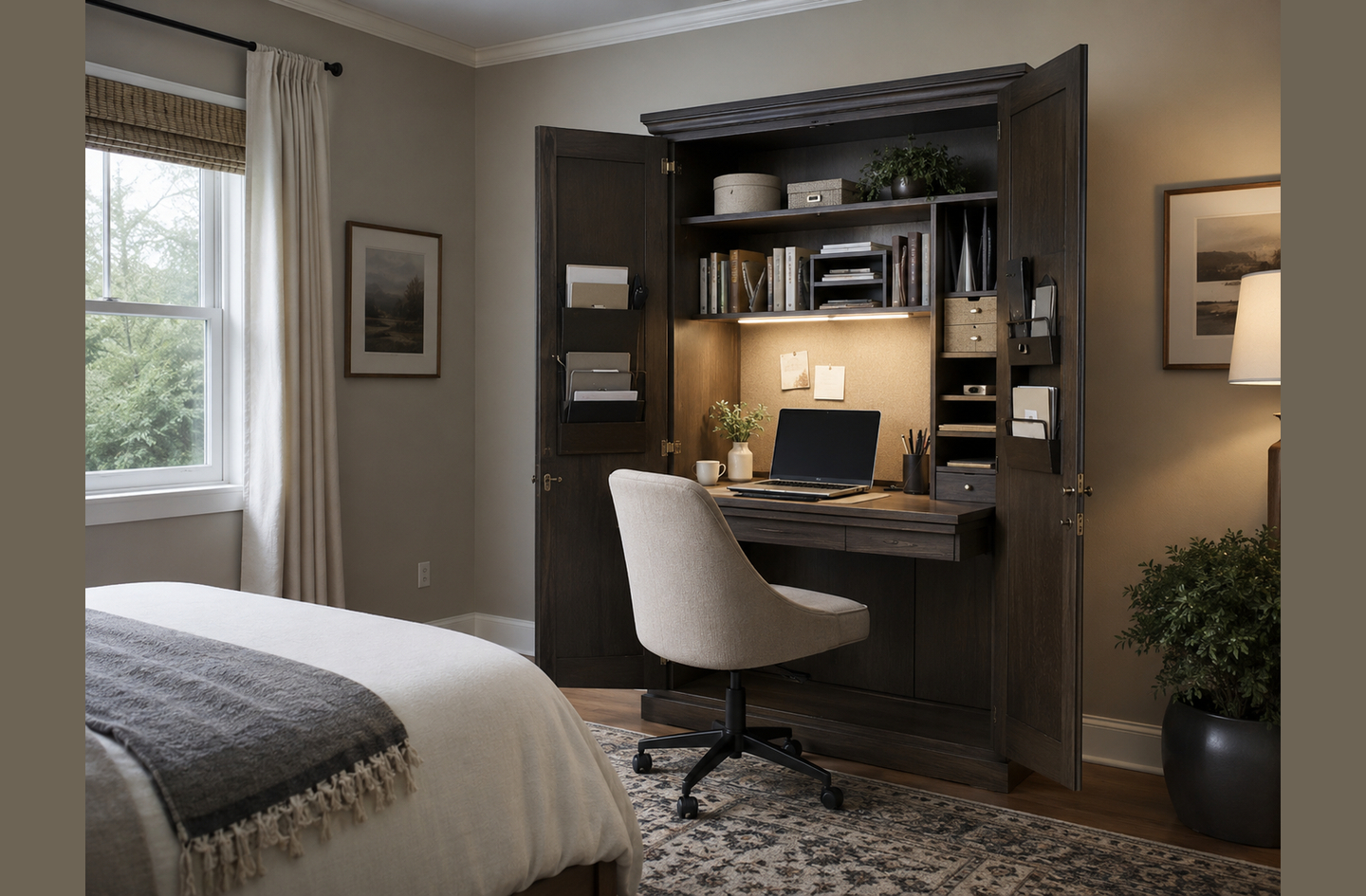
A cabinet fold-down desk does not disappear when it closes; it becomes furniture. The cabinet body remains at its full depth (typically 12-18 inches from the wall) whether the desk is open or shut. That permanent depth occupies floor space comparable to a bookshelf or wardrobe. For rooms that need a total visual reset after work hours, this is a meaningful limitation. For rooms where a piece of furniture in that location already makes sense (a bedroom wall lined with wardrobes, a living room with media units, a hallway with built-in storage), the closed cabinet reads as intentional rather than residual. Some units are designed specifically to look like an armoire or credenza when closed, which converts the footprint trade-off into an aesthetic feature. The distinction matters: if you need the space to read as a living room after 6 pm, a 16-inch-deep closed cabinet along one wall is very different from a 3-inch-deep closed panel.
Freestanding Desks: Folded but Not Gone
A freestanding foldable desk folds to a flat panel roughly 1-2 inches thick. That sounds like it disappears, but the folded desk has to go somewhere. Leaning it against a wall in the same room adds a flat rectangle to the visual field. Storing it in a closet or hallway solves the visual problem but adds 30-60 seconds to both setup and teardown, and requires a clear path. The difference between a wall-mounted desk and a freestanding desk on this dimension is not just size but automation: the wall-mounted desk is already where it needs to be, folded or open, with no carry step required. The freestanding desk introduces a storage decision that the room must accommodate before the product choice is finalized.
Verdict: Wall-mounted desks win on folded footprint for visual reset. Cabinet desks become permanent furniture but with the largest working surface. Freestanding desks fold flat but require a storage step that adds friction to the daily routine.
Mounting Requirements: What Each Type Asks of Your Walls
Mounting requirements determine whether a given desk type works in your current home and what you leave behind when you move or change plans. For renters, this dimension alone eliminates two of the three options.
Wall-Mounted Desks: Stud Anchoring and the Renter Trade-off
Wall-mounted fold-down desks anchor to wall framing. In standard North American wood-frame construction, studs run vertically at 16 inches on center (occasionally 24 inches). A desk bracket typically spans two to four studs. The mounting process involves locating studs with a stud finder, drilling pilot holes, and securing with lag screws or structural screws long enough to penetrate at least 1.5-2 inches into the stud itself. This produces a secure attachment rated for 150-300 lbs depending on the hardware and bracket design. For renters, the wall work leaves behind four to eight screw holes in a concentrated area (roughly 12 by 6 inches for a standard bracket), which need spackling and touch-up paint before move-out. Whether this counts as normal wear and tear depends on the lease and the landlord, and it is worth confirming before drilling.
Cabinet Desks: Large Footprint, Some Freestanding Options
Cabinet fold-down desks typically anchor to the wall at the cabinet back, which is a narrower connection point than a full bracket but still requires locating studs for heavier units. Some smaller cabinet-style desks stand fully on the floor and require only an anti-tip anchor (a short strap from the cabinet top to a wall stud), which is a lighter intervention than full mounting. Those freestanding-cabinet models are more manageable for renters than a direct wall-mounted bracket, though they still leave behind a baseboard anchor hole and occupy permanent floor depth. Larger murphy-style units that span floor to ceiling or wall to wall require professional installation and are a permanent improvement to the home rather than a piece of furniture.
Freestanding Desks: Zero Wall Contact
Freestanding foldable desks require no wall contact. They set up on any floor space and leave nothing behind. For renters who move every one to three years, the zero-installation requirement makes a freestanding desk the only type that travels without leaving evidence. About 35% of workers with jobs that are possible to do remotely work from home all the time, according to a 2023 Pew Research Center survey of 5,775 U.S. adults.3 A large share of that group rents, and for renters who cannot or prefer not to patch walls, the freestanding desk is often the only viable fold-away option.
Verdict: Freestanding desks win on mounting requirements for renters. Wall-mounted desks require the most wall work but leave a small, repairable footprint. Cabinet desks range from moderate wall anchoring to full installation depending on size and type.
Daily Reset: Which Type Is Fastest to Fold Away?
The reset is the daily behavior that determines whether a fold-down desk actually gets folded. A 10-second reset happens every night. A 5-minute reset often does not, which means the room never recovers its non-office character after work hours.
Wall-Mounted Desks: The 10-Second Close
A wall-mounted fold-down desk closes in one motion. Clear the surface, lift the panel, fold the support legs (or let the cable supports retract), latch the panel flush to the wall. The total action with a clear surface is 5-10 seconds. This is the fastest reset of any desk type by a wide margin. The folding action itself is trivial enough that it does not require a conscious decision each evening. A desk that closes in 10 seconds gets closed every night, and a desk that gets closed every night allows the room to function as something other than an office for the rest of the evening.
Cabinet Desks: Close and Conceal
A cabinet fold-down desk closes in roughly 15-30 seconds, including folding up the front leg supports and shutting the cabinet door. The slightly longer reset time reflects the cabinet’s larger working surface: more working area means more items to clear before closing. The payoff is that a closed cabinet desk looks like furniture rather than a dormant office, which is a different kind of reset from the wall-mounted option. For rooms where the desk surface disappearing is less important than the room reading as non-office, the 15-30-second cabinet close achieves a more complete visual transformation than a wall-mounted panel that is still clearly a desk shape even when shut.
Freestanding Desks: The Storage Penalty
A freestanding foldable desk takes 60-120 seconds to fold and move to its storage position. This assumes a clear surface, a functioning latch, and a clear path to wherever the desk is stored. In a bedroom, that usually means leaning it against a wall, sliding it into a closet, or moving it to a hallway. Each step adds friction, and friction is what turns a desk that should fold every night into one that folds every weekend. The global folding furniture market is projected to grow from $4.87 billion in 2026 to $9.37 billion by 2033 at a compound annual growth rate of 9.8%,7 which reflects genuine demand for fold-away solutions. But that demand does not eliminate the reset gap: a freestanding desk with a 90-second storage routine imposes a behavioral cost that a wall-mounted desk with a 10-second latch does not.
Verdict: Wall-mounted desks win on reset speed for daily home office use. Cabinet desks are a strong second for rooms where the visual transformation (looking like furniture) matters more than time. Freestanding desks carry a storage penalty that grows the smaller the room gets.
Which Desk Type Fits Your Setup?
Each type serves a distinct situation. None is universally the right answer, and the wrong choice on one dimension will undermine the desk regardless of how well it performs on the others.
The Renter Who Moves Every Few Years
If you rent and your lease restricts wall installation, the freestanding foldable desk is the starting point. It travels with you, leaves no holes, and gives the most working depth of the three types. The trade-off is the daily setup time and the need to plan where the folded desk goes when it is not in use. Plan the storage position before buying the desk. If the only option is leaning it against the same room’s wall, you have traded a desk for a folded rectangle that occupies most of the same visual field. A freestanding desk works best when a true storage position exists: a closet, an entry hallway, or a dedicated corner behind a door where the folded desk disappears from the living area entirely.
The Bedroom Office That Needs to Reset Nightly
Wall-mounted fold-down desks are the clearest choice when the desk must completely disappear every evening. A studio or bedroom where the desk and the sleeping area share 150-200 square feet needs the desk surface to vanish, not just close. The 2-4-inch closed profile of a wall-mounted desk achieves that. The depth limitation (typically 13-17 in) means this setup works best with a laptop and no external monitor, or with a wall-mounted monitor arm that folds flat when the desk closes. Without a monitor arm, a dual-screen setup is difficult on a 15-inch-deep surface.
The Daily Remote Worker With a Full Setup
A cabinet fold-down desk is the closest available option to a fixed desk that also folds. If you work six to eight hours daily from home, need a dual-monitor setup, and want the desk to close back into a piece of furniture rather than disappear into the wall, the cabinet type is the right structure. The 18-24-inch working depth meets or approaches the ANSI/HFES ergonomic minimum5. The closed cabinet reads as furniture. The trade-offs are cost, the permanent 12-18-inch wall depth even when closed, and the installation requirement that makes this a poor fit for renters. For homeowners who work from home daily and need a real workstation in a small room, the cabinet fold-down desk is the only type that delivers full-desk function alongside an after-hours room identity.
Square footage is fixed. Flow is a choice. The fold-away desk decision is fundamentally about which friction you prefer: the friction of a shallow desk depth, the friction of a permanent cabinet depth, or the friction of a 90-second carry-and-store routine.
Frequently Asked Questions
What working depth do I need for a home office folding desk?
For laptop-only work, 14-16 inches often functions. The ANSI/HFES 100-2007 standard recommends at least 24 inches when equipment sits directly on the surface,5 ensuring a comfortable monitor viewing distance. Wall-mounted fold-down desks (13-17 in typical) fall short of that threshold. Cabinet and freestanding desks (18-30 in) approach or exceed it, making them the better fit for any setup involving an external monitor.
Can I mount a wall-mounted folding desk without finding wall studs?
Drywall-only anchors are not recommended for a daily-use desk. Heavy-duty toggle anchors hold 30-100 lbs, but a desk with a laptop, a monitor arm, and arm pressure from typing approaches that limit easily. Stud anchoring is the safe default. If studs do not align with the desired position, a horizontal steel mounting rail bridging two studs lets you place the bracket anywhere along that span.
What is a murphy desk, and is it the same as a fold-down desk?
A murphy desk is a fold-down desk built into a wall-mounted cabinet unit. The front panel hinges down to become the work surface, and when closed the unit looks like an armoire or credenza. Murphy desks typically offer 18-24 inches of working depth and a 12-18-inch closed profile, making them the deepest and most furniture-like of the three folding desk types. All murphy desks are fold-down desks, but not all fold-down desks are murphy desks.
Which type of folding desk is best for renters?
Freestanding foldable desks require no wall installation and leave no marks, making them the default for renters who cannot patch walls. Cabinet and wall-mounted desks both require anchoring and leave holes that need repair. For renters who need depth, a freestanding desk (20-30 in) is both renter-safe and ergonomically closer to the ANSI/HFES minimum than most wall-mounted options.5
How stable is a wall-mounted folding desk compared to a fixed desk?
A properly stud-anchored wall-mounted fold-down desk is stable for laptop and light monitor use. Some flex under sustained typing load is typical with a two-stud installation. Four-stud anchoring with rigid brackets closes most of that gap. Drywall-only installations show more lateral movement under pressure and are not recommended as the sole attachment for daily use.
Limitations and Edge Cases
- Coverage here addresses the three main product categories. Built-in carpentry (a fold-down desk integrated into a custom bookcase wall or a Murphy wall-bed unit with a dedicated desk surface) involves structural modifications that require a licensed contractor, not product selection alone.
- The depth ranges cited (13-17 in for wall-mounted, 18-24 in for cabinet, 20-30 in for freestanding) reflect standard product categories. Specialty or custom-manufactured units may fall outside these ranges.
- Floor plans with no suitable wall for mounting (rooms with windows, radiators, or doors on every wall) default to freestanding desks regardless of preference on the other dimensions.
References
- RentCafe – U.S. Apartment Sizes Are Growing, Yardi Matrix data, August 2026. Average studio apartment: 460 sq ft in 2025.
- WFH Research – Survey of Working Arrangements and Attitudes (SWAA), Bloom, Barrero, Davis, Stanford University, June 2026. Work from home has settled at roughly 25% of full paid days in the U.S.
- Pew Research Center – About a Third of U.S. Workers Who Can Work From Home Do So All the Time, March 30, 2023. Survey of 5,775 U.S. adults.
- U.S. Occupational Safety and Health Administration – Computer Workstations eTool: Monitors. Federal agency guidance on monitor viewing distance.
- UC Berkeley University Health Services – Ergonomics Guidelines for Computer Workstations, 2016. Cites ANSI/HFES 100-2007: work surface depth minimum 24 inches (with keyboard tray) or 29 inches (equipment on surface).
- PMC / National Library of Medicine – Davis, Kotowski et al., Ergonomics in Design, 28(4):4-10, DOI: 10.1177/1064804620937907, 2020. Home workstation assessment of 41 setups.
- Coherent Market Insights – Folding Furniture Market report, April 2026. Market projected to grow from $4.87 billion (2026) to $9.37 billion by 2033 at 9.8% CAGR.
Conclusion
The three folding desk types answer three distinct problems. Wall-mounted fold-down desks solve the reset problem: the room recovers in under 10 seconds, and the 2-4-inch closed profile is as close to gone as a desk gets. Cabinet fold-down desks solve the depth problem: 18-24 inches of working surface is enough for a real monitor-and-keyboard setup, and the closed cabinet reads as furniture. Freestanding foldable desks solve the renter problem: no wall anchoring, no patching, and the desk travels with you.
The trade-offs are real and do not disappear with a better product in any category. Choose the type that solves the constraint you cannot work around first, then accept its trade-offs on the other dimensions. For the broader home office layout questions that affect which wall gets the desk and how the rest of the room flows around it, see the Small Home Office planning overview.