
An over the door organizer turns a door panel into storage without drilling, anchoring, or claiming floor space. Median new single-family home size dropped to 2,191 square feet in Q2 2023, the lowest reading in over a decade,5 and door surfaces remain one of the most overlooked opportunities in vertical storage planning. A standard 32 x 80-inch interior door gives you roughly 18 square feet of usable panel.
This guide compares pocket organizers, basket racks, and hook systems on the questions most buyers get wrong: door thickness compatibility, weight limits, handle clearance, whether the door closes cleanly after mounting, noise, and surface protection by room.
Quick Answer
Which type of over the door organizer works best for a small space?
The right choice depends on what you store and where. Fabric pocket organizers suit small items (shoes, toiletries, cleaning supplies) and are the most renter-friendly option. Wire basket racks handle heavier loads: the VEVOR 9-tier is rated to 29.8 lbs total.6 Hook bars work well in entries and on closet doors for coats and bags. All three types require a standard 1-3/8 inch door thickness or thinner, plus a small gap between the door top and the frame above.3
Key Takeaways
- Standard US interior doors measure 1-3/8 inches thick; most over-door organizers fit this size, and wire racks with deeper hooks fit doors up to 2 inches thick.3
- Three standard residential hinges support 45 to 60 pounds of door weight combined; keep the organizer and its contents under that limit so the door swings freely.4
- Fabric pocket organizers dampen noise and protect door finishes better than bare metal hardware; add rubber or felt pads to any metal hook contact points to prevent scratches.
- The US home storage market is projected at $12.05 billion in 2025, growing as homes shrink and renters favor non-permanent storage solutions.1
Quick Comparison: 4 Over the Door Organizer Types
An over the door organizer is a storage unit that hooks over the top edge of a door panel, using the door’s thickness as its only anchor point, with no wall attachment required. Four main types exist, and each fits a different weight range, item size, and room.
“As interest rates increased in 2022 and housing affordability worsened, the demand for home size has trended lower.”
Robert Dietz, Chief Economist, National Association of Home Builders5
Smaller homes drive this category’s growth. The global over-door organizer market is projected to grow at 3.8% annually through 2035, pushed by urbanization and renters seeking storage without permanent hardware.2
| Feature | Fabric Pocket | Wire Basket Rack | Multi-Hook Bar | Single Hook |
|---|---|---|---|---|
| Best for | Shoes, toiletries, small cleaning supplies | Pantry items, boxed goods, produce bags | Coats, bags, hats, scarves | One bag, towel, or light jacket |
| Max door thickness | ~1.75 in (typical) | Up to 2.0 in (VEVOR)6 | ~1.75 in (typical) | 1.375-1.75 in (OXO)7 |
| Typical weight capacity | 30-50 lbs total | 29.8 lbs total (VEVOR 9-tier)6 | 10-25 lbs total | 5-15 lbs per hook |
| Noise level | Low (fabric absorbs movement) | Medium (metal baskets rattle slightly) | Low to medium | Low |
| Surface protection | Fabric backing protects door finish | Metal contact; requires felt pads | Rubber or plastic cap tips needed | Built-in rubber grip on most models |
| Renter-friendly | Yes, no tools | Yes, no drilling | Yes, fully removable | Yes, no marks |
| Best rooms | Bedroom, bathroom, closet | Pantry, utility room, kitchen | Entryway, bedroom, closet door | Entryway, bathroom, closet |
Pocket Organizers
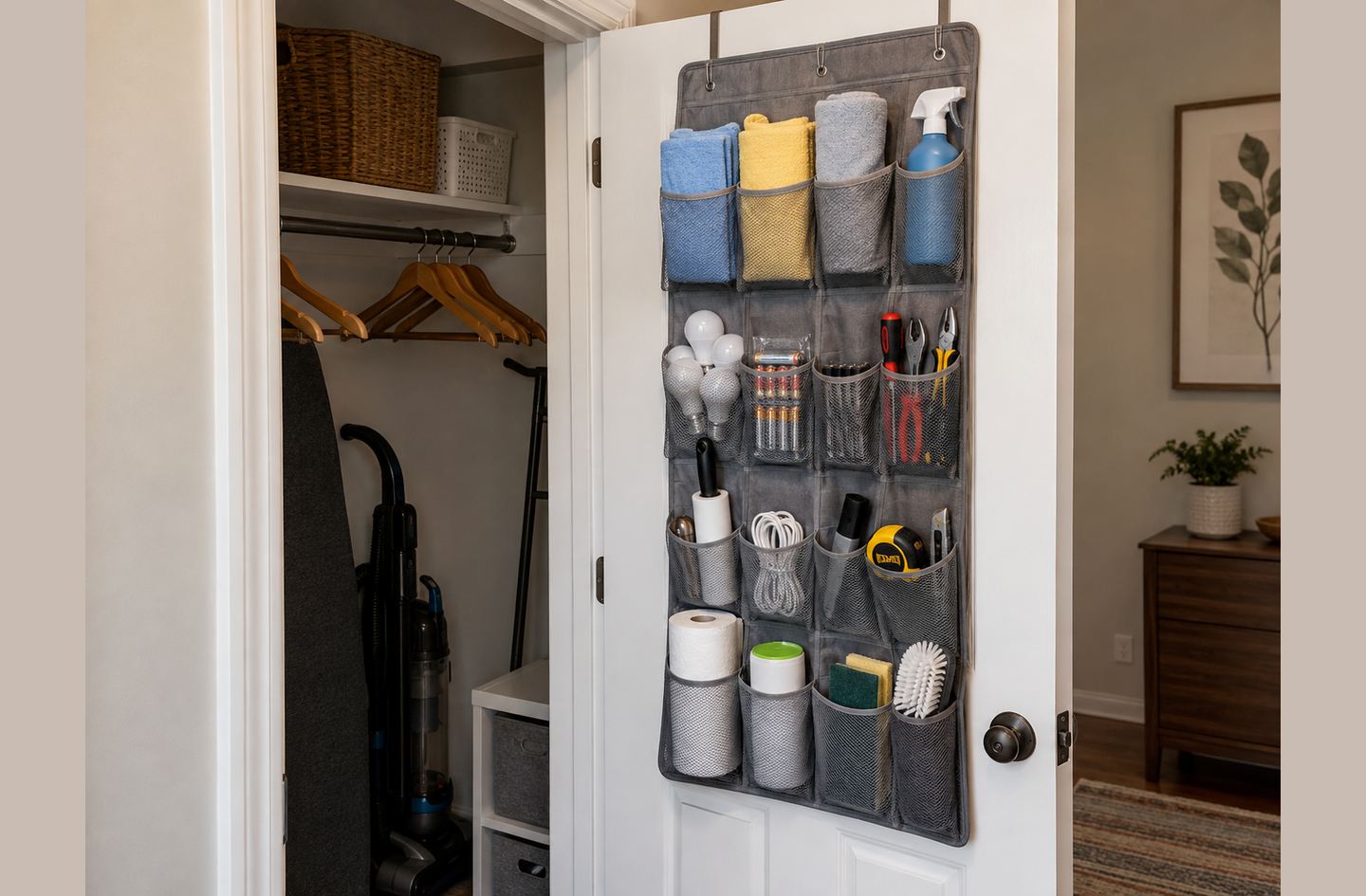
Fabric pocket organizers are the most versatile over-door type for compact bedrooms and bathrooms. A single 5-tier unit adds 24 to 36 individual storage cells without occupying any floor or wall space. The fabric construction does two things a metal hook system does not: it protects the door finish on contact, and it absorbs the small vibrations that cause metal hardware to rattle against the door when opened or closed.
Pocket count and cell size
Most fabric pocket organizers offer 24 to 48 pockets arranged in rows of 4 to 6 across. Pocket depth ranges from about 4 inches (suitable for toiletry bottles and cleaning sprays) to 7 inches (suitable for folded shoes or rolled kitchen towels). Shoes are the most common use case, but the same unit works equally well for cleaning supplies, craft supplies, or bathroom toiletries.
Choose a wider unit (18 to 22 inches across) if the door is wide enough to accommodate it without blocking the handle on a lever-style latch. Standard door widths run 28 to 36 inches, so most pocket organizers clear the handle with room to spare.
Weight distribution and hook stability
Fabric pocket organizers distribute weight vertically across multiple pockets, which reduces the stress on the hook point at the top. A fully loaded 5-tier unit with shoes in every pocket weighs roughly 15 to 25 lbs, well within the range of a standard door’s hinge set. The main failure mode is overloading a single pocket: a heavy item in one cell pulls the fabric sideways and causes the organizer to tilt. Spread weight across multiple pockets and avoid placing the heaviest items in the top row.
Clear vs. opaque pockets
Clear-front pocket organizers make every item visible from outside the door, which works well for shoes, craft supplies, or bathroom products where you need to find things quickly. Opaque fabric pockets look cleaner from across the room but require a moment to find a specific item. In a studio or multipurpose room where the door faces a living area, opaque is the better visual choice. In a bedroom closet or bathroom, clear front pockets reduce time spent searching.
For renters in compact bedrooms or bathrooms, a fabric pocket organizer is almost always the first over-door investment worth making: low cost, no tools, no surface damage, and more usable cells per inch of door height than any other type.
Wire Basket Racks
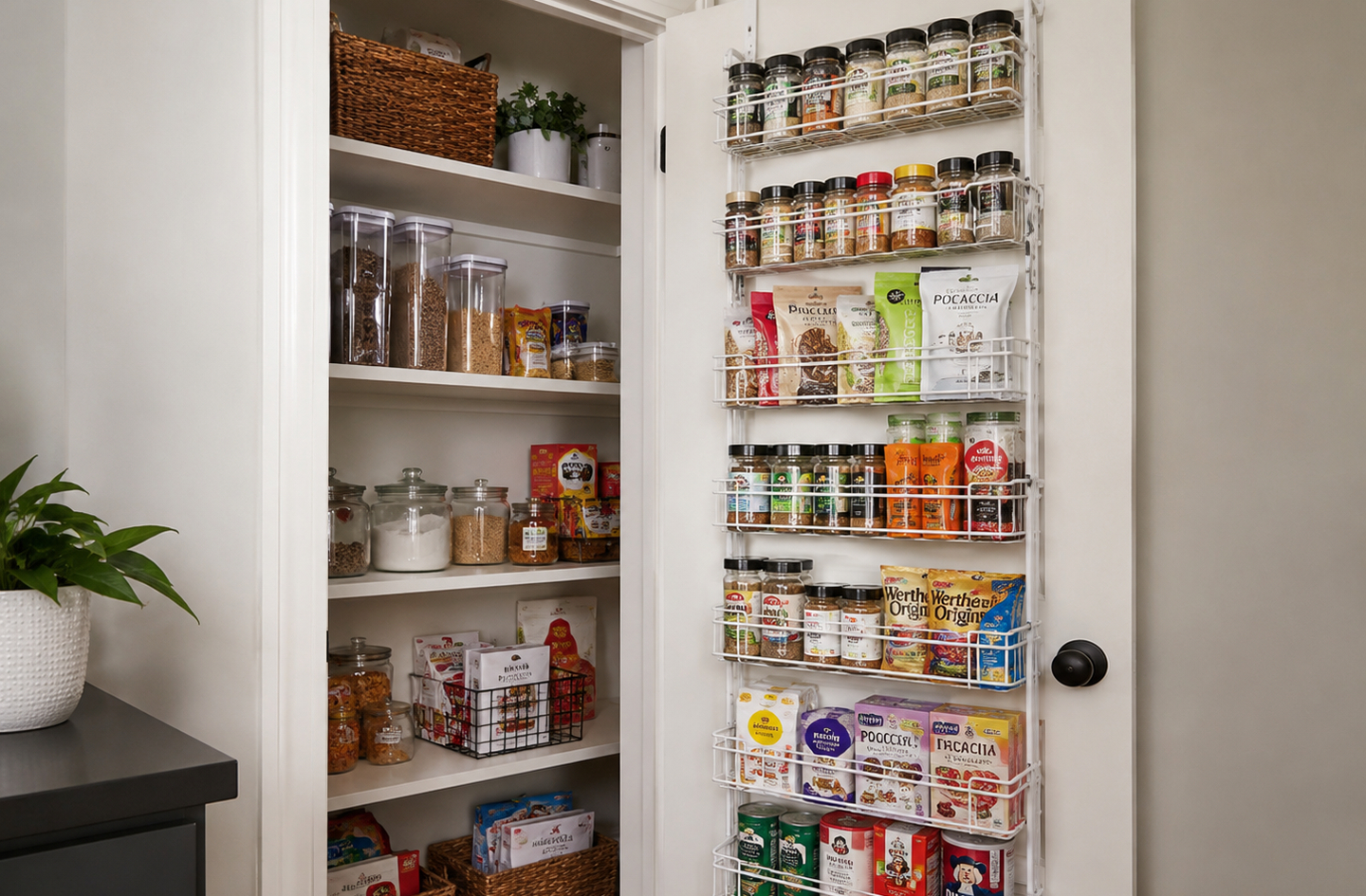
Wire basket racks suit heavier items and pantry-style storage. Each basket sits open on a metal frame that hooks over the door, making contents visible from above and easy to grab without opening a pocket or unzipping a flap. The VEVOR 9-tier model carries up to 29.8 lbs total across 9 baskets, with each basket rated to 3.31 lbs.6
What wire baskets hold well
Wire basket racks store items that do not fit neatly into a fabric pocket: onion bags, canned goods, boxed snacks, spice jars, cleaning spray bottles, rolled dish towels, and small kitchen appliance parts. The open wire floor lets air circulate, which matters for produce and fresh herbs. Baskets on a pantry door or kitchen cabinet door recover dead-corner space that would otherwise store nothing.
The key limitation: wire baskets are not suitable for loose small items. A single spice packet or pill bottle falls through the gaps. Line the basket floor with a thin rubber mat or use a small container inside the basket to solve this.
Frame depth and door clearance
Wire basket racks project further from the door than fabric organizers, typically 5 to 8 inches. In a narrow pantry where the shelving unit opposite the door sits close, measure the clearance before installing. The door needs to open fully without the rack hitting the opposite shelf. In most standard pantries (24 to 30 inches deep), this is not a problem. In a very compact closet under 20 inches deep, check the swing clearance first.
Adjustable vs. fixed baskets
Some wire racks allow individual baskets to slide up or down on the frame, which lets you adjust row spacing for taller items like wine bottles or spray bottles. Fixed-basket racks cost less and are more rigid, but the basket spacing is set at the factory. If you plan to store items of varying heights, an adjustable rack saves frustration.
Wire basket racks are the right choice for a pantry or utility door where items are heavier or bulkier than a fabric pocket fits. The trade-off is projection depth and a slightly higher noise profile: the metal baskets rattle briefly when the door closes hard.
Hook Systems
Hook systems include two distinct products: single hooks and multi-hook bars. Both mount over the door the same way, but they serve different storage jobs. A single hook holds one bag, a towel, or a light jacket. A multi-hook bar, which spans the width of the door with 4 to 8 individual hooks, stores an entire entry’s worth of coats, bags, hats, and scarves in a single mounted unit.
Single hooks
Single hooks are the simplest over-door product. The OXO auto-adjust hook fits doors from 1-3/8 inches to 1-3/4 inches thick and requires a 3/16-inch gap between the door top and the frame to seat properly.7 The rubber or plastic grip surface protects the door finish. Use a single hook for one high-rotation item: the bag you grab every morning, a dog leash near the front door, or a bathrobe on the back of a bedroom door.
The load limit on a single hook depends on the hook’s design and mounting point, but most over-door single hooks are rated for 5 to 15 lbs. Avoid hanging multiple items by looping handles together on one hook: the combined weight shifts unevenly and stresses the door edge.
Multi-hook bars
A multi-hook bar mounts the same way as a single hook but extends across much of the door width. Most bars offer 4 to 8 hooks spaced 3 to 5 inches apart, enough to hold a household’s daily coats and bags with individual hooks per person. The projection from the door is 2 to 4 inches, shallow enough to close most entry doors without the bar hitting the door jamb.
Check the hook tip material before buying. Bare metal tips scratch door finish over time, especially on hollow-core doors with thin paint. Look for rubber-tipped or plastic-capped hooks, or plan to add silicone adhesive bumpers to any bare metal contact points. For more about protecting door finishes, see the surface protection section below.
Over-door vs. adhesive hooks for light loads
For loads under 3 lbs, adhesive hooks on the door face compete with over-door hooks on convenience. Adhesive hooks leave no gap requirement and work on frameless sliding doors where an over-door hook cannot seat. The trade-off: adhesive hooks damage paint on removal, which matters in rentals. Over-door hooks leave no marks at all, making them the better renter choice for any load above a few ounces. For lightweight items in rentals, tall narrow shelving handles non-door vertical storage without wall damage.
Hook systems earn their place at entry doors and behind bedroom doors where quick-access hanging beats any other storage type. The multi-hook bar is almost always more useful than a set of single hooks in the same space, because it handles multiple items while using the same one mounting point.
Door Compatibility: Thickness, Gap, and Hinge Load
The most common reason an over-door organizer fails to seat properly is a mismatch between the hook design and the door’s dimensions. Three measurements decide compatibility: door thickness, the gap between the door top and the frame, and the total weight the hinges support.
Door thickness
The standard US interior door is 1-3/8 inches (1.375 inches) thick.3 This is the dimension the hook wraps around. A hook designed for 1.375-inch doors will not seat on a 2-inch solid-core door: the hook channel is too narrow, and forcing it damages the door edge. The chart below shows maximum door thickness each organizer type accepts, compiled from manufacturer specifications.
Gap clearance
Door gap is the clearance between the top edge of the door panel and the door frame above it, measured when the door is closed or nearly closed. The hook of an over-door organizer needs to fit through this gap, rest on top of the door, and close without the hook scraping the frame. The OXO auto-adjust hook requires a 3/16-inch (0.19 in) gap; the VEVOR basket rack spec calls for a gap greater than 0.06 inches.67 Most interior doors have a gap of 1/8 to 1/4 inch, so this is rarely a problem on standard doors. Doors fitted with weatherstripping along the top edge are the exception: weatherstripping reduces or eliminates the gap, and in those cases a surface-mount or adhesive hook is the only no-damage option.
Hinge load
Hinge load is the combined weight a door’s hinge set must carry, including the door itself plus any organizer and its contents. A set of three standard residential hinges (without ball bearings) supports a door weighing between 45 and 60 pounds.4 A standard 1-3/8 inch hollow-core interior door weighs about 25 to 35 lbs on its own. A loaded fabric pocket organizer adds 15 to 25 lbs, bringing the total close to the hinge set’s lower limit. A loaded wire basket rack on a heavier solid-core door pushes higher.
The rule: keep the total door-plus-organizer weight below the hinge set’s capacity. A standard 80-inch door uses three hinges, following the rule of one hinge per 30 inches of door height.4 Doors over 90 inches tall need a fourth hinge. For heavy basket racks on solid-core doors, verify the hinge count and consult a qualified contractor if the door shows signs of dragging or misalignment before adding load.
Handle clearance
Over-door organizers mount from the top of the door and hang on the handle face or the back face, depending on the product. On the handle face, wide pocket organizers sometimes overlap with lever-style handles. Measure from the door edge to the handle center, then compare to the organizer’s width. Most standard organizers (16 to 20 inches wide) clear a centered knob or lever on a 30-inch-wide door. A full-width organizer (28 inches or wider) is the one type to measure carefully before ordering.
Surface Protection and Noise
An over-door organizer sits against the door face for months or years. Without adequate padding at every contact point, the hook edge and the back of the organizer wear grooves into the paint or finish. This matters more on hollow-core interior doors (which have a thin painted surface) than on solid wood doors, but no door finish is immune to sustained metal contact.
Protecting the door edge at the hook
The hook wraps over the door top and presses against the edge. Metal hooks with no padding cut into wood over time. Check whether the hook has a rubber, plastic, or silicone sleeve where it contacts the door. Products without sleeves need a strip of self-adhesive felt or a silicone bumper on the hook’s underside before installation. This is a 5-minute step and the most important one for preserving the door in a rental.
Protecting the door face at the back panel
Fabric pocket organizers have a fabric or felt backing, so direct contact with the door face is soft. Wire basket racks and metal hook bars press a metal frame against the door face whenever the door moves. Add self-adhesive foam tape or furniture felt to the frame’s contact points before mounting. Three or four small pieces on the vertical struts of a basket rack are enough to stop scratch marks from forming.
Reducing noise on movement
The noise from an over-door organizer comes from two sources: the hook against the door top, and loose items inside the organizer shifting when the door swings. Felt on the hook contact point reduces the first problem. For wire basket racks, a thin rubber mat lining each basket base stops items from rolling and reduces the rattling sound on opening or closing. On fabric organizers, noise is rarely an issue unless the top rod claps against the door frame when the door swings hard.
A 2024 survey found homeowners have roughly 25 items out of place at any given moment, with half putting off finding permanent homes for them.10 Door-mounted systems reduce that backlog by giving items a fixed location with no installation and no rearranging of existing furniture.
Does the door still close cleanly?
Test this on the first install. Load the organizer to a typical operating weight, close the door, and listen for scraping, watch for a gap at the door frame, and check whether the latch engages fully. An organizer projecting further than the door stop depth will prevent the door from closing flush. Most over-door products project 1.5 to 3 inches from the door face, less than the typical door stop depth of 4 to 6 inches. Wire basket racks project further (up to 8 inches) and are the type most likely to conflict with a shallow door stop on a pocket door or barn door opening.
Which Type Fits Your Room?
The four organizer types do not compete equally in every room. Each works best in a specific storage context, and choosing the wrong type for the space is the fastest way to end up with an organizer you stop using.
Bedroom and closet door
Fabric pocket organizers dominate bedroom and closet doors. Shoes, accessories, small bags, and folded items fit neatly in individual pockets. A single over-door unit stores 24 to 48 pairs of shoes on the back of a bedroom door, recovering the floor area a freestanding shoe rack would occupy. For the closet door interior, a pocket organizer storing folded tops or seasonal accessories extends the closet’s effective capacity without adding a new piece of furniture. For broader closet planning, floating shelves in closets complement over-door storage by handling folded stacks at eye level.
Pantry and kitchen cabinet door
Wire basket racks belong on pantry doors and kitchen cabinet interiors. A pantry door rack stores spices, sauces, snacks, and produce bags in open baskets at eye level, moving them off the main pantry shelves and making them faster to find. Cabinet-door racks do the same for under-sink cleaning supplies or the inside of a cabinet below the kitchen sink. In a compact kitchen, a single rack on the pantry door shifts 20 to 30 items off the main shelves, freeing an entire shelf row for larger items. The floor-to-ceiling shelving guide covers how vertical reach extends pantry and utility storage further.
Entryway and front door back
Multi-hook bars suit entryway doors and front door backs. A 4 to 8 hook bar on the back of the front door stores coats, bags, and hats for every person in the household. The location is right: items go on the hook when you come in and come off when you leave. The hook bar stops the pile-on-the-sofa habit without requiring a separate coat closet. For entry storage without a formal foyer, a hook bar on the door is one of the most space-efficient single investments in this category. For more entry options, corner shelving ideas handle keys, mail, and small accessories that do not belong on a hook.
Bathroom door
Fabric pocket organizers and single hooks both work on bathroom doors. A pocket organizer stores toiletries, cleaning products, and rolled hand towels in a compact column. A single hook holds a bathrobe or spare towel. The choice depends on what the bathroom needs more: small-item organization (fabric pockets) or one high-rotation hanging item (single hook). In very small bathrooms where the door swings inward, confirm the door opens fully before adding a projecting organizer: a basket rack on an inward-swinging bathroom door stops the door at roughly 80 degrees rather than a full 90, which makes the bathroom feel smaller.
Utility room and laundry door
Utility rooms and laundry closets are where wire basket racks or combination organizers with both baskets and hooks perform best. Cleaning supplies, spray bottles, rubber gloves, and roll bags fit in baskets. Reusable shopping bags, dog leashes, and extension cords hang from hooks. The inside of a laundry closet door is particularly valuable: it stores items needed near the laundry area without sitting on the floor or taking up shelf space.
Frequently Asked Questions
How much weight can an over-the-door organizer hold?
Total capacity varies widely by type. Wire basket racks like the VEVOR 9-tier hold up to 29.8 lbs across 9 baskets (about 3.3 lbs per basket).6 Heavy-duty fabric organizers sometimes rate higher, up to 40 to 50 lbs total. The practical ceiling is not the organizer’s rating but the door’s hinge capacity: three standard residential hinges support 45 to 60 lbs of door weight,4 and the organizer load adds to whatever the door itself weighs.
Will an over-the-door organizer damage my door?
Not if the hook and back-panel contact points are padded. Bare metal hooks and frames wear grooves into door paint over time. Fabric pocket organizers have a soft backing and rarely cause damage. For wire racks and metal hook bars, add self-adhesive felt or silicone bumpers to every metal contact point before mounting. In rentals, this step is worth the 5-minute setup cost to avoid paint-touch-up charges at move-out.
What door thickness do over-the-door organizers fit?
Standard US interior doors are 1-3/8 inches thick,3 and most over-door products are designed for this size. Hook-type organizers like the OXO auto-adjust hook fit doors from 1-3/8 to 1-3/4 inches thick.7 Some wire basket racks fit doors up to 2 inches thick. If your door is a thick solid-core or fire door, measure the thickness and check the organizer’s spec before ordering.
Do over-the-door organizers work on sliding or barn doors?
Standard over-door hook organizers require a door with a fixed top edge and a gap between the door and the frame above it. Sliding doors and barn doors do not have this gap, so hook-type organizers will not seat correctly. Adhesive hooks on the door face are the alternative for sliding doors, though these risk paint damage on removal. Wall-mounted storage adjacent to the sliding door is often the better solution for compact spaces with this door type.
Will an over-the-door organizer prevent my door from closing fully?
Most fabric pocket organizers and hook bars project 1.5 to 3 inches from the door face, which is less than the typical door stop depth of 4 to 6 inches, so the door closes fully. Wire basket racks project further (up to 8 inches) and need more clearance. Test the door swing after installation: load the organizer, close the door, and confirm the latch engages fully. Pocket doors and barn doors are not compatible with most over-door organizer types.
Limitations and Edge Cases
- All weight figures and door thickness ranges in this guide come from US product specifications (2025-2026); door dimensions and hinge standards differ in other countries, particularly in Europe where 40 mm doors are common.
- Pocket doors, barn doors, and frameless sliding doors do not work with hook-style over-door organizers; surface-mount adhesive systems are the only no-damage option for those door types.
- Solid-core doors, fire-rated doors, and oversized doors (taller than 80 inches) weigh more than standard hollow-core doors; consult a qualified contractor before adding significant organizer load if the door already shows signs of hinge stress or dragging.
References
Methodology: every figure in this article links to an independent published source; product specifications were drawn from manufacturer pages as of September 2026 and the article follows the Small Space Logic editorial methodology for source verification.
- Mordor Intelligence – United States Home Organizers and Storage Market Size Report, 2025.
- IndexBox – Over-Door Organizer Market Forecast, 2026 update.
- Bob Vila – Standard Door Sizes, Interior and Exterior Dimensions, 2024.
- Engineer Fix – How Much Weight Can a Door Hinge Hold, December 2025.
- NAHB Eye on Housing – Single-Family Home Size Moves Lower to More Than a Decade Low, Robert Dietz, August 2023.
- VEVOR – 9-Tier Over-the-Door Pantry Organizer Specifications, 2025-2026.
- Lowes – OXO Clear Over-the-Door Hook Product Specifications, 2025-2026.
- Study Finds – Container Store / OnePoll survey on clutter and home organization, 2024.
Conclusion
An over the door organizer adds storage on a surface already in your home, with no hardware and no floor footprint. The choice between pocket organizers, wire basket racks, and hook systems comes down to what you store (small items vs. heavier loads vs. hanging gear), which room the door is in, and whether your door’s thickness and gap clearance match the hook design. Measure first, check the manufacturer’s door-thickness spec, and add felt or rubber padding to every metal contact point before mounting.
For the broader picture of how door-mounted storage fits into a whole-room vertical plan, the Vertical Storage overview covers walls, corners, and full-height systems alongside door-mounted options.