
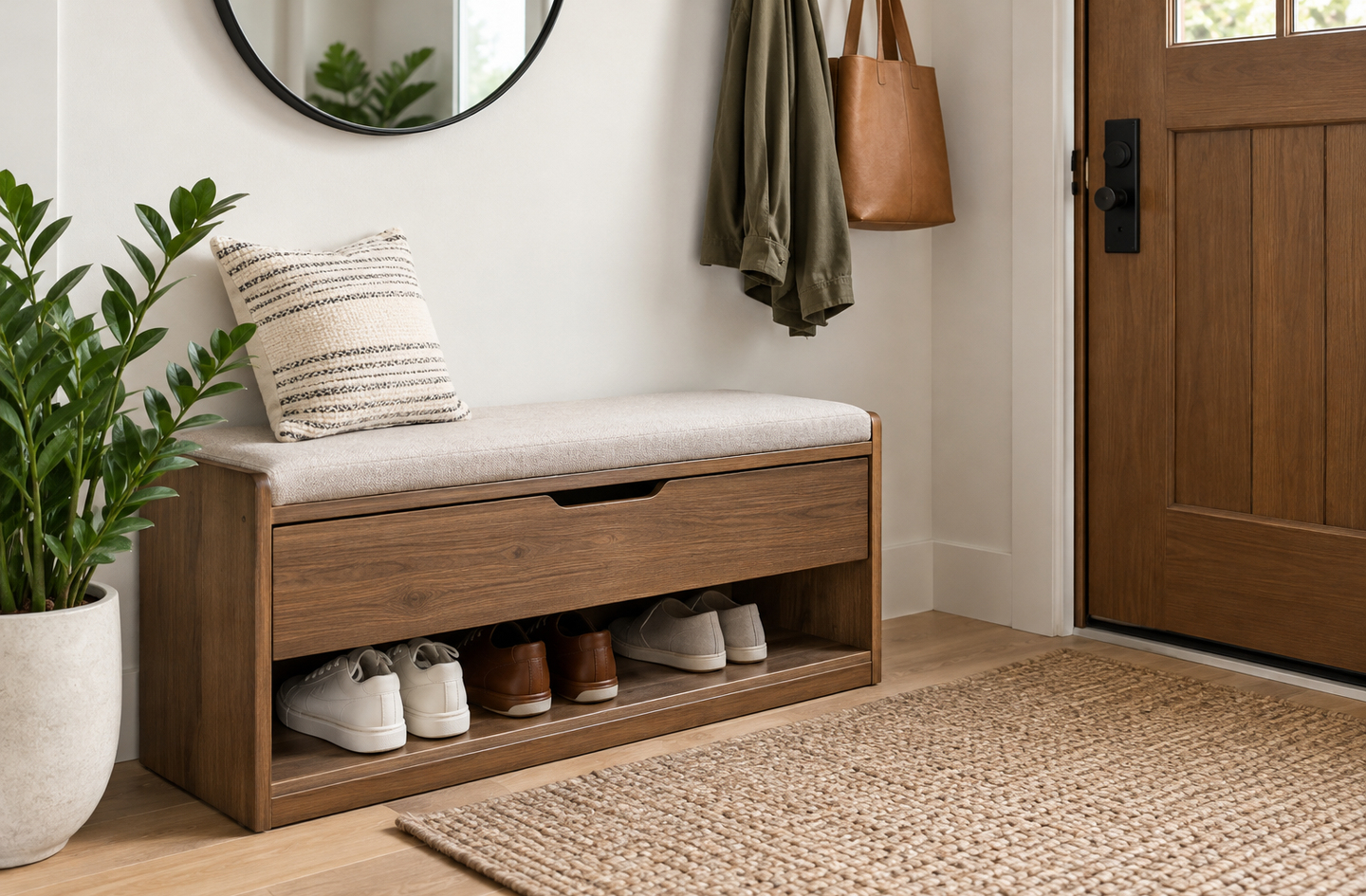
A shoe storage bench combines seating and footwear storage on a single footprint, which makes it a strong choice for compact entries where floor space is limited. Most tight entryways have room for one piece of furniture against the wall. A bench that also stores shoes earns that spot twice over. For context on how a bench fits a complete entry system, see the small entryway storage overview. The average American owns 12 pairs of shoes, per a 2023 KURU Footwear survey of 1,000 adults1. A bench holds the active-rotation pairs that would otherwise pile up by the door. This article covers five decisions that determine whether a shoe storage bench works in a specific compact entryway: seat height, seat depth, storage format, pair capacity, and the walkway clearance left in front.
Quick Answer
What makes a shoe storage bench work in a compact entryway?
A seat height of 17 to 19 inches matches established ergonomic guidelines for benches2. Seat depth should stay under 16 inches in a 42-inch-wide hallway to leave at least 26 inches of walkway clearance. An open-shelf or cubby format gives the fastest daily access. Pair capacity should match household size times 2 to 3 active pairs per person, not total shoe ownership.
Key Takeaways
- Bench seat height between 17 and 19 inches matches ADA ergonomic standards for built-in seating. Benches below 17 inches force users to push up hard to stand, which matters in a daily-use piece.
- A 16-inch-deep bench in a 42-inch-wide hallway leaves 26 inches of walkway, which one person at a time clears comfortably but two people side by side do not.
- Open-shelf benches reset faster than basket or closed-door benches in daily use. The tradeoff is visual: open storage shows whatever is left in it.
The Three Bench Storage Formats Worth Comparing
Shoe storage benches come in three main configurations, and the choice between them drives everything else: how many pairs the bench holds, how fast it resets after a busy morning, and how much depth it adds to the entryway wall.
| Feature | Open-Shelf Bench | Basket Bench | Cubby Bench |
|---|---|---|---|
| Typical seat depth | 12-16 in. | 14-18 in. | 13-17 in. |
| Pairs per 36-in. width | 6-7 pairs (2 levels) | 6-9 pairs (3 baskets) | 8-10 pairs (6 cubbies) |
| Daily access speed | Fastest (direct slide-in) | Moderate (basket lifts) | Fast (open front) |
| Visual order without tidying | Low (shoes show) | High (bins contain) | Moderate (cubbies define) |
| Boot compatibility | Yes (lay flat) | Limited (bin height) | No (height too short) |
| Reset time (daily) | Fastest | Moderate | Fast |
| Best for | High-traffic entries, all shoe types | Households needing visual calm | High pair count, flat shoes |
All three formats work for a compact entryway. The decision comes down to whether your entry needs fast access, contained mess, or the highest pair count per inch of bench width.
Open-shelf benches
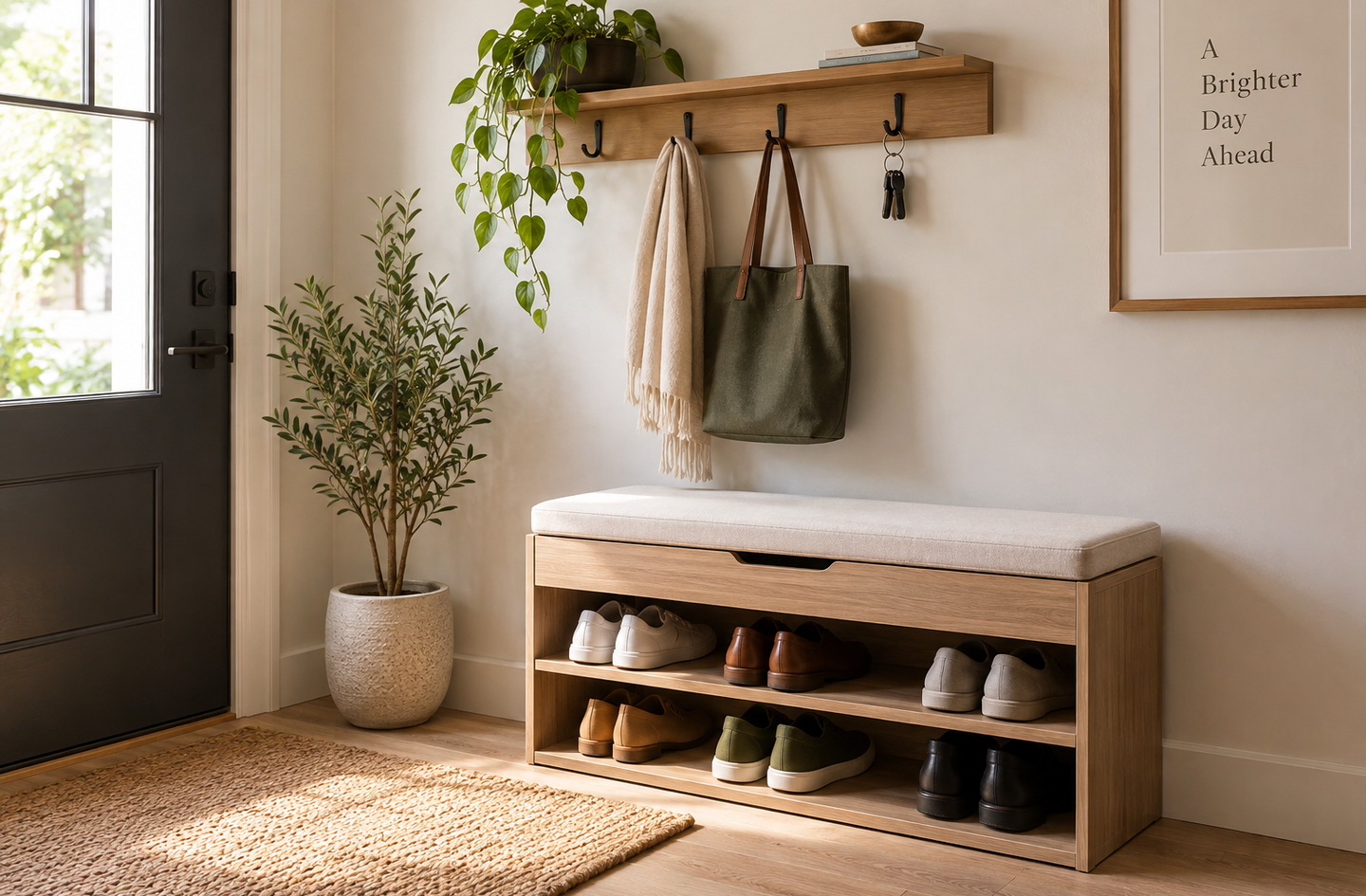
Open-shelf benches have one or two slatted or solid shelves below the seat. Shoes slide in directly, with no drawer to pull, no basket to lift. The open design adds zero door-opening or basket-removal depth. A 14-inch-deep open-shelf bench stays 14 inches from wall to front edge and no more.
Basket and wicker benches
Basket benches place two or three wicker or fabric bins on a frame below the seat. The closed top of the bins keeps shoes hidden. This format adds 1 to 2 inches of operating clearance compared to open shelves because bins need room to slide forward or tilt out. The visual advantage is containment: the bench looks tidy regardless of what is inside the baskets.
Cubby benches
Cubby benches divide the lower section into individual open-fronted compartments, each holding one to two pairs. The cubby walls angle shoes efficiently, which gives this format the highest pair-count-per-inch-of-width among the three. A 36-inch bench with six cubbies holds eight to ten pairs of adult shoes. The limitation is height: standard cubbies are 9 to 10 inches tall, which eliminates tall boots and many over-the-ankle shoes.
Seat Height: Finding the Right Level for Your Entry Users
The right seat height makes the bench genuinely useful. The wrong height turns it into a frustrating low stool or an elevated perch that leaves feet dangling.
“The top of the bench seat surface shall be 17 inches (430 mm) minimum and 19 inches (485 mm) maximum above the finish floor or ground.”
US Access Board, 2010 ADA Standards for Accessible Design, Section 903.52
Standard ergonomic height: 17 to 19 inches
The ADA Standards for Accessible Design, Section 903.5, specify a bench seat height of 17 to 19 inches above the finished floor2. Cornell University’s Ergonomics Web resource identifies an optimal fixed seat height of approximately 17 inches (43 cm) as the anthropometric benchmark for general-population seating3. Both figures point to the same practical conclusion: a bench in this range allows a natural seated-to-standing transition. A person sits, secures a shoe, and stands without an unusual push-up effort from a low surface.
Most shoe storage benches on the retail market land between 17 and 18 inches. A bench labeled “seating height” with no measurement should be verified before buying. Anything below 16 inches forces a deeper squat to stand. Anything above 20 inches leaves shorter adults with feet elevated rather than flat on the floor.
Below-standard heights and when they matter
Benches below 17 inches appear in children’s furniture and some low-profile decorative pieces. For adults, a 14-inch seat means the knees rise above the hips when seated, which makes standing harder. In a daily-use location like an entryway, a seat requiring extra effort to leave gets avoided. Users put shoes on while standing, which eliminates the bench’s ergonomic role.
If the bench serves both children and adults, 17 to 18 inches works for both groups. Children stand from a 17-inch seat more easily than adults stand from a 14-inch seat. A 15-inch bench, common in some decorative pieces, tends to be comfortable for neither group over time.
Seat Depth and the Walkway Clearance Math
Seat depth is the number that determines how much floor remains in front of the bench. Every inch of depth is one inch subtracted from the walkway. In a tight entry, this math deserves a real calculation before buying.
What bench depth standards tell us about floor space
ADA Standards for Accessible Design, Section 903.3, specify a bench seat depth between 20 and 24 inches for accessible built-in seating2. Those figures accommodate full back support when seated. But an accessible bench specification is designed for a changing room or locker facility, not a residential entry. A 24-inch-deep bench against the wall of a 36-inch hallway leaves 12 inches of walkway, which requires turning sideways to pass through.
For compact entryways, the functional target is a seat depth of 12 to 16 inches. A 12-inch seat is shallower than the ADA minimum, but it is adequate for sitting briefly to put on a shoe. A 16-inch seat gives full sit-back comfort while keeping the walkway usable in most residential entries.
The clearance calculation for a 42-inch entryway
A standard residential hallway runs between 36 and 48 inches wide, with 42 inches as a common minimum for newer residential construction. The ADA minimum clear width for an accessible corridor is 36 inches4. A shoe storage bench placed against the wall of a 42-inch entry at 14 inches deep leaves 28 inches of walkway clearance. At 16 inches deep, it leaves 26 inches. At 18 inches deep, 24 inches remain. At 20 inches deep, only 22 inches remain, which is tight for a single person carrying bags.
The chart below shows this relationship across common bench depths. The calculation synthesizes ADA bench depth ranges with ADA corridor width standards to create a planning reference for compact entries that does not exist in a single source.
Open Shelf vs. Basket Storage: Access Speed vs. Visual Order
The storage format below the seat determines two things: how fast a pair of shoes goes in and out, and how the bench looks after a busy week without deliberate tidying.
Open-shelf benches: fast access, visible storage
An open shelf has no container to open, lift, or slide. A shoe goes directly onto the shelf. This is the fastest access format. It also means everything stored there is visible from across the entry. When the shelf holds three organized pairs, it looks intentional. When it holds five pairs piled at different angles after a rushed week, it looks like the floor pile moved slightly upward.
Open-shelf benches work best in households that reset the entry daily as part of a routine. The format rewards consistent behavior and penalizes inconsistency visibly and immediately.
Basket benches: contained, but access takes one more step
A wicker or fabric basket hides the shoes inside. The outside of the bench looks contained regardless of what is inside. This is the visual-order advantage of the basket format. The tradeoff is a reset requiring one extra motion: the shoe goes into the basket, which typically needs a slight forward pull or tilt, rather than a direct slide onto a shelf.
Basket benches also limit the types of shoes they hold. A standard wicker basket 13 inches wide and 9 inches tall holds two to three pairs of adult shoes depending on the shoe type. Boots require a separate location. Thick-soled sneakers consume more basket volume than flat shoes.
Cubby benches: the middle ground between speed and order
Cubby benches separate the lower section into individual open-fronted compartments. Each cubby holds one to two pairs. The open front gives immediate visibility, which is faster than a basket but reads more organized than a flat open shelf because the cubby walls define distinct zones. A 36-inch bench with six cubbies achieves the highest per-width-inch capacity of the three formats.
The limitation is height. Standard cubbies are typically 9 to 10 inches tall and 10 to 12 inches wide. Ankle boots, tall dress shoes, or shoes with thick platforms do not fit. For households with a varied footwear rotation, a cubby bench covers flat daily shoes and sneakers but leaves tall footwear needing a separate home.
Pair Capacity: How Many Pairs Does a Bench Need to Hold?
The goal of a shoe storage bench is not to hold every shoe in the household. It is to hold the active-rotation pairs that would otherwise end up on the floor near the door. Getting the capacity target right means estimating how many pairs actually live at the entry, not how many shoes the household owns.
How many active pairs belong near the door?
Americans own an average of 12 pairs of shoes, per a 2023 KURU Footwear survey of 1,000 adults1. The US footwear market hit $121 billion in annual sales by 20257, reflecting how many pairs cycle through households each year. But not all 12 pairs rotate through the entry daily. For most adults, the active-door rotation is two to four pairs: daily shoes, exercise shoes, and one casual pair or set of slippers. Children typically have a smaller active rotation of one to two pairs.
A two-person household needs capacity for four to eight pairs at the entry. A household with two adults and two children needs six to twelve accessible pairs. A bench holding only four pairs in a six-person household overflows onto the floor within days. Size the bench to the realistic door rotation, not total shoe ownership.
Estimating capacity by bench width and storage format
Standard adult shoes placed in alternating heel-to-toe rows occupy approximately 10 to 11 inches of shelf width per pair. A 36-inch-wide bench with two open shelves holds approximately six to seven pairs of adult shoes. The same width in a six-cubby format holds eight to ten pairs because the cubby walls angle the shoes more efficiently and use the full depth of each compartment.
Basket benches at 36 inches wide typically include three baskets, each holding two to three pairs, for a total of six to nine pairs. Baskets fill to capacity less efficiently than open shelves or cubbies because the curved walls lose space at the corners.
For a household needing more than eight accessible pairs at the entry, a 48-inch bench or a bench paired with a supplementary narrow shoe rack is more practical than trying to overload a 36-inch model. The bench holds the daily rotation. Overflow storage goes elsewhere.
Reset Speed: The One Metric That Decides Whether the System Sticks
A shoe storage bench requiring effort to reset gets abandoned. Shoes drift back to the floor beside it, and the bench starts collecting bags and mail instead of functioning as a shoe system. Reset speed is how long it takes to go from a morning of grabbed-in-a-hurry shoes back to a tidy entry.
What makes a bench easy to reset
An open-shelf bench resets in one motion: pick up a pair, slide it onto the shelf. A basket bench adds one step: move the basket forward slightly, drop in the shoes, slide it back. A closed-door bench adds the most friction: open the door, place the shoes inside, close the door. Each added step sounds minor in isolation. Over a week of daily rushed mornings, the difference compounds into a behavioral pattern.
The basket and closed-door formats offset slower resets with better visual order. If the bench sits in a visible entry where a messy shelf bothers the household, the extra reset step may be worth accepting. In a compact entry where users move quickly and space is tight, the easier the reset, the more reliably the system holds.
Format comparison by reset effort
For households where multiple people use the entry daily, the fastest-reset format tends to sustain the routine most reliably. Open-shelf and cubby benches work better in family entries because the one-motion return happens automatically, even under the pressure of a busy morning. Basket benches and lidded storage benches work better in single-person entries or households with consistent organization habits, where the containment benefit matters more than the seconds saved.
The primary failure mode of a shoe storage bench is not that users stop using it intentionally. It is that the reset becomes a deliberate task rather than a reflex. Once returning a pair of shoes requires opening something, the floor wins as the default landing spot on busy days. Storage where the behavior happens and the reset costs nothing is the goal. That principle determines format as much as any measurement.
Which Shoe Storage Bench Fits Your Entryway?
The right shoe storage bench matches the entryway’s physical constraints and the household’s actual reset behavior, not the most attractive option in a product listing.
If your priority is fast access and the highest pair count
Choose an open-shelf bench or a cubby bench. For most compact entries, a 36-inch-wide open-shelf or cubby bench at 17 to 18 inches tall and 14 to 16 inches deep holds six to ten pairs, leaves functional walkway clearance, and resets in a single motion. If the entry serves multiple people, the cubby format helps assign ownership to specific compartments, which reduces the pile-on problem common to flat open shelves.
If your priority is visual containment with minimal daily effort
Choose a basket bench. The wicker or fabric bins contain the visual disorder without requiring daily straightening of the shoe arrangement inside. The tradeoff is slightly lower pair capacity per inch of bench width and a slower reset for households with boots or large shoes. A basket bench in a visible entry near a living room earns its format premium. A basket bench in a utility back entry may not be worth the added reset friction.
If the entryway is under 36 inches wide
A bench is a high-friction choice at this width. Even a 12-inch-deep bench in a 36-inch hallway leaves only 24 inches of walkway clearance. In a very narrow entry, a wall-mounted shoe cabinet or a slim shoe rack placed at the side of the door path takes up less floor depth than a bench and still provides shoe storage. The seating function is lost, but the walkway stays usable.
Average US apartment size reached 910 square feet in 20255, and new single-family homes declined by 11.6 percent in average size over the past decade6. Entryway width is increasingly a real constraint in newer housing. Measuring before buying is the most important step in this selection process.
The measurement check to run before any bench purchase
Measure the entryway width from the edge of the fully open door swing to the opposite wall. Subtract the intended bench depth. The remainder is your walkway clearance. Below 24 inches, the bench creates daily friction. Between 24 and 28 inches, one person at a time clears it comfortably. At 28 inches or above, the entry functions normally with the bench in place.
Also measure the available wall length. Most shoe storage benches run 24 to 48 inches wide. If your open wall segment is 30 inches, a 36-inch bench overlaps into the door swing or a corner. Width is the constraint most buyers check. Bench depth is the one that most often surprises them after delivery.
Frequently Asked Questions
What is the best seat height for a shoe storage bench?
A seat height of 17 to 19 inches above the finished floor matches the ADA ergonomic range for built-in benches2. Cornell University’s ergonomics research identifies 17 inches (43 cm) as the optimal fixed seat height for general-population use3. Benches below 16 inches make standing harder in daily use. Most shoe storage benches on the market fall between 17 and 18 inches, which works well for most adults and children above age six.
How deep should a shoe storage bench be for a small entryway?
Target a seat depth of 12 to 16 inches for a compact entry. A 12-inch depth provides seating for putting on a shoe and leaves maximum walkway. A 16-inch depth gives full sit-back comfort. ADA accessible bench standards specify 20 to 24 inches2, but those dimensions are designed for locker facilities, not residential entries. In a 42-inch hallway, a 16-inch bench leaves 26 inches of walkway, which is adequate for single-file passage.
How many pairs of shoes should a bench hold?
Size the bench for the active-rotation pairs at the door, not total shoe ownership. Americans own an average of 12 pairs of shoes1, but most adults keep two to four pairs in daily active rotation. For a two-person household, plan for four to eight accessible pairs. For a household with two adults and two children, plan for six to twelve. A 36-inch bench in an open-shelf or cubby format holds six to ten pairs, which covers most two-to-three person households.
What is the difference between an open-shelf bench and a basket bench?
Open-shelf benches store shoes directly on one or two slatted shelves below the seat. Access is immediate and one-motion. Everything on the shelf is visible. Basket benches store shoes inside wicker or fabric bins below the seat. Shoes are hidden, giving the bench a tidier appearance without deliberate arrangement. The basket format adds one reset step and limits boot storage because bin height is usually 9 to 10 inches, too short for tall footwear.
How much walkway should remain in front of a shoe storage bench?
At 28 inches or more, one adult with bags passes without turning sideways. At 24 to 28 inches, single-file passage is comfortable. Below 24 inches, the entry creates friction for daily use. The ADA minimum for an accessible corridor is 36 inches4, which a bench in any standard residential hallway will reduce. For a residential entry, 24 to 28 inches of remaining clearance is the practical minimum to target when choosing bench depth.
Limitations and Edge Cases
- Pair capacity figures in this article are based on standard adult shoe dimensions (US men’s size 10.5, women’s size 8.5). Households with larger shoe sizes, boots, or many children’s shoes will see different capacity outcomes per bench width.
- Walkway clearance calculations assume flat wall placement with no baseboard projection. Existing baseboards, heating registers, or wall returns can reduce effective bench depth by 1 to 3 inches on the wall side.
- Renter constraints on wall mounting are outside the scope of this article. For wall-mounted shoe storage and hook configurations requiring no permanent drilling, see the small entryway storage overview linked in the Conclusion below.
References
- KURU Footwear – Footwear Survey 2023: How Many Pairs of Shoes Does the Average American Own? Survey of 1,000 US adults aged 16+, August 2023.
- US Access Board – 2010 ADA Standards for Accessible Design, Chapter 9 Built-In Elements, Section 903 Benches: seat height 17-19 in. (Section 903.5), seat depth 20-24 in. (Section 903.3). Current edition.
- Cornell University Ergonomics Web – Ergonomics of Sitting, DEA 3250/6510 course resource. Optimal fixed seat height approximately 17 in. (43 cm); seat depth approximately 16.5 in. Ongoing academic resource, Cornell University Human Factors and Ergonomics.
- ADA.gov – 1991 ADA Standards for Accessible Design, Section 4.3.3: minimum clear width of an accessible route is 36 inches (915 mm). US Department of Justice.
- RentCafe – National Average Apartment Size: The Typical Apartment in 2025 Is 910 Square Feet. Yardi Matrix data analysis, May 2026.
- LendingTree – New Homes Are 11% Smaller but 74% More Expensive per Square Foot. Analysis of US Census Bureau Characteristics of New Housing data, 2015-2025. Published 2026.
- FDRA – Footwear Distributors and Retailers of America, US Footwear Retail Statistics 2025. Americans spent $121 billion on shoes in 2025. Published 2025.
Conclusion
A shoe storage bench earns its place in a compact entryway when the seat height, seat depth, storage format, and walkway clearance all line up with how the entry actually gets used. The seat height range of 17 to 19 inches covers most adults and school-age children. The seat depth needs to be measured against your entryway width before buying, not estimated. The storage format determines whether the bench resets as a reflex or as a chore.
For the broader picture of how a bench fits a complete entry system, see the overview at small entryway storage. Square footage is fixed. How much of it the bench takes is a decision worth making before it arrives.