Corners are the most overlooked storage opportunity in any compact room. Most people treat them as awkward dead zones, but the right corner shelf ideas can turn that wasted triangle into a column of usable vertical storage without claiming a single square foot of floor space. The Vertical Storage overview explains the broader logic; this article goes deep on one specific application: how to choose, configure, and load a corner shelf for a small room. The average US studio apartment measures just 460 square feet1, and corners are almost always among its few genuinely unoccupied surfaces.
Quick Answer
What are the best corner shelf ideas for a small space?
Floating corner shelves work best for rooms where floor space is critical and you want adjustable height. Tiered freestanding corner shelves suit renters who cannot drill. Corner ladder shelves maximize vertical reach in a single footprint. The right choice depends on whether you own or rent, how much weight you need to hold, and which zone (low, eye-level, or high) needs the most storage.
Key Takeaways
- Keep corner shelf depth between 8 and 12 inches in small rooms to avoid blocking natural light and circulation paths.
- Floating corner shelves anchored into two wall studs hold 35 to 50 lbs per shelf; drywall anchors alone cap at 10 to 25 lbs.
- The eye-level “golden zone” (30 to 60 inches from the floor) is where daily-use items belong; high-zone shelves above 60 inches suit infrequent or lightweight storage.
- Freestanding tiered corner shelves require no drilling and are the most renter-friendly option, but they narrow the corner footprint and must stay within the unit’s weight limit for the floor area.
- No single corner shelf type fits every room. Diagnose the access need, the load, and the renter status before selecting a shelf type.
How to Get Real Use From a Corner in a Small Room
A corner is where two walls meet. That geometry is both its strength and its constraint. Shelves mounted or placed at a 90-degree angle to each other can capture a triangle of space that cannot hold a standard bookcase or cabinet, but the same geometry means shelf runs are short and access requires leaning in from the side.
Before selecting a corner shelf type, answer three diagnostic questions:
- Do you own or rent? Floating shelves require drilling into walls. Freestanding options require no permanent modification.
- What load will you place on the shelves? Light decorative objects behave very differently from canned goods or books. Load determines bracket type and stud access.
- Which zone needs the most help? Low (floor to 30 inches), eye-level (30 to 60 inches), or high (60 inches and above) each serve different item types and access frequencies.
“People are constantly being bombarded with unnecessary items and instead of immediately throwing it away, they tend to let it sit around building up.”
Brett Lauer, President, Decluttr8
This pattern is exactly what an unplanned corner amplifies: items pile up in an unused triangle because there is no system to receive them. The US home storage and organization market reached $12.05 billion in 2025 and is projected to grow to $15.21 billion by 20303, in part because compact living has outpaced the space available for conventional furniture. With 44.6 million renter-occupied housing units in the United States as of the most recent five-year census count2, renter-compatible solutions dominate the shelf market. The three types below cover the most practical options for small rooms.
1. Floating Corner Shelves
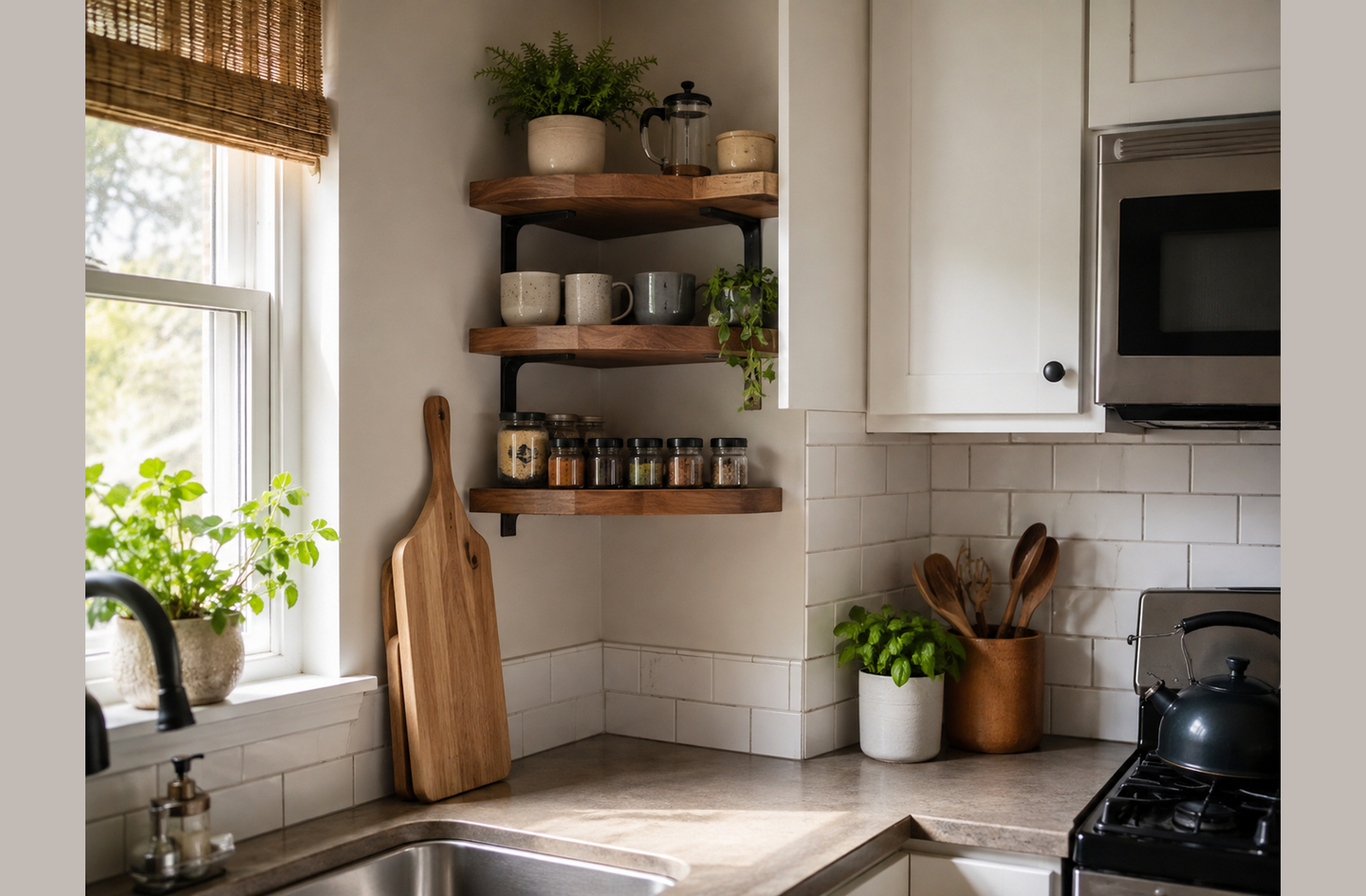
Floating corner shelves attach to the wall with no visible support beneath the shelf surface. They keep the floor completely open, allow you to set any height, and produce a lighter visual effect than a freestanding unit.
How floating corner shelves are built
A floating corner shelf is typically an L-shaped or triangular board supported by two hidden brackets, one in each wall. The bracket attaches to the wall via screws driven into studs or drywall anchors. The shelf slides over the bracket rods or rests on a ledger rail. The visible surface is the shelf face; brackets and fasteners are hidden inside the shelf body or behind the wall surface.
Most corner floating shelves extend 10 to 24 inches along each wall4. Smaller runs (10 to 14 inches per wall) suit decorative display and lightweight items. Larger runs (18 to 24 inches per wall) accommodate kitchen storage or bathroom linens, but check that the shelf does not project so far into the room that it interrupts movement or light.
Best for
Floating corner shelves work best when you own the space and have access to wall studs, you want to store light to medium items (plants, books, jars, ceramics), and the room needs visual breathing room at floor level. They are the most adaptable type because you control the height at install time.
They are also the best option for bathrooms and kitchens, where moisture-resistant materials (solid hardwood sealed with polyurethane, or powder-coated steel brackets with a waterproof shelf board) matter more than in living rooms or bedrooms.
Limitations
Floating corner shelves require drilling into at least two walls. In a rental, that means patching on move-out (minor, but a consideration). Load capacity is directly tied to whether the bracket catches a wall stud. When both anchor points land on studs, a medium shelf holds 35 to 50 lbs4. When both anchor into drywall only, the same shelf holds 10 to 25 lbs, which rules out heavier items. If your walls use metal studs (common in newer apartment construction), standard wood-stud techniques do not apply; consult the building’s maintenance team or a licensed contractor before drilling.
For rooms where drilling is not an option, move to the freestanding options below.
How to read the wall before you drill
Use a stud finder before you mark the wall. In most residential construction, studs sit 16 inches apart on center. In older or non-standard framing, spacing varies. The corner itself is often backed by a doubled stud assembly (two studs nailed together at the junction), which gives excellent anchor strength. Tap along the wall: a solid, less resonant knock typically indicates a stud. Confirm with a stud finder before drilling. If the corner stud assembly gives you only one anchor point per wall at the corner location, space the second bracket to catch the nearest available stud further along the wall.
For structural drilling questions specific to your home, consult a licensed contractor. Small Space Logic provides educational planning guidance; it does not provide project-specific structural or construction advice.
2. Freestanding Tiered Corner Shelves
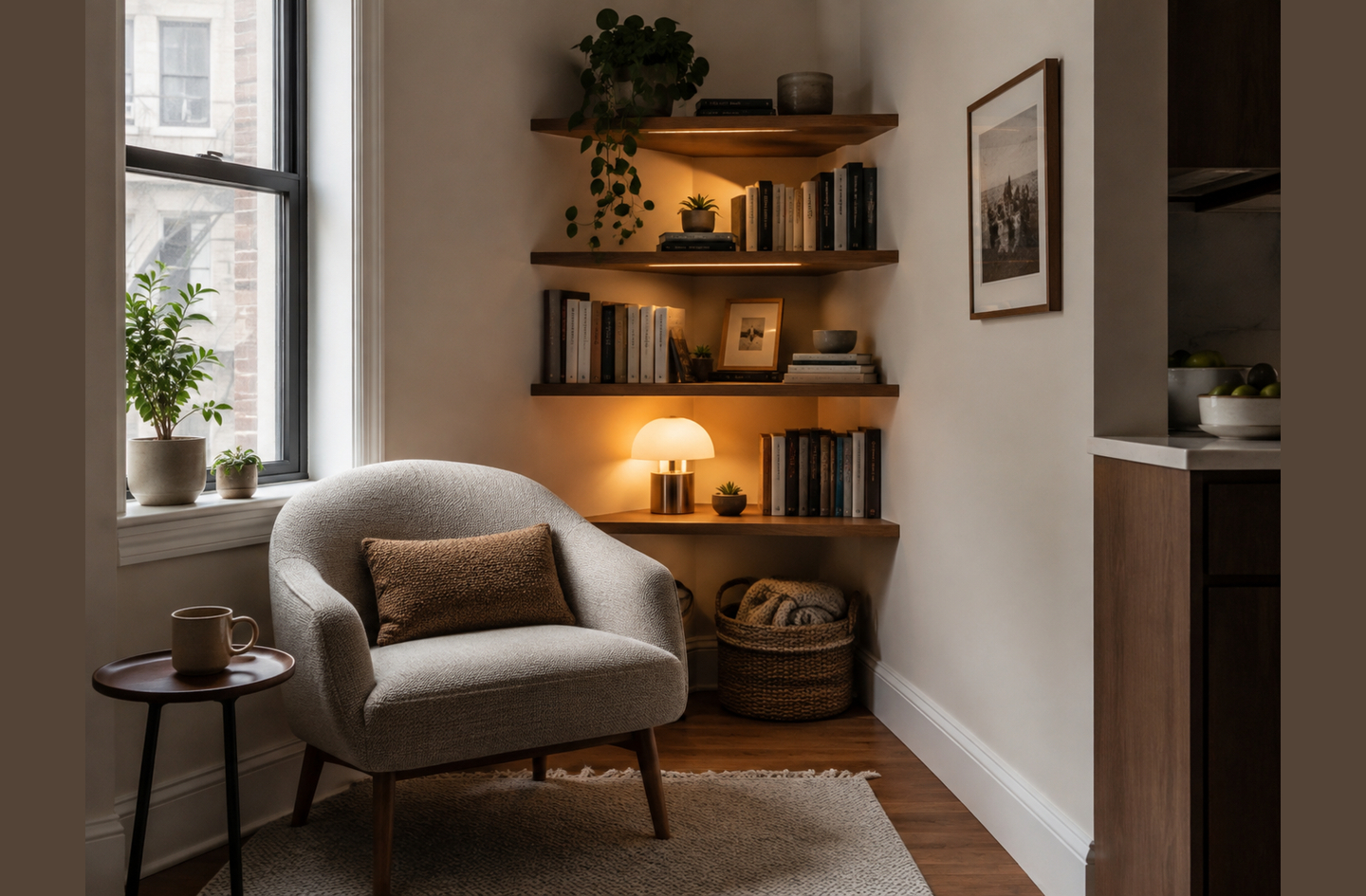
Freestanding tiered corner shelves sit on the floor and lean into the corner without attaching to the wall. They typically have three to five open shelves arranged in a triangular footprint, with each shelf running along one wall.
How freestanding tiered shelves are built
The most common freestanding corner shelf is a triangular stepped unit. Each shelf platform is a right-angle triangle or a curved half-circle cut, stacked at increasing heights on a central post or on vertical side rails. Some designs are symmetrical (equal shelf depth on each wall); others are asymmetrical (one wall run longer than the other). The unit rests on adjustable leveling feet, which matter on uneven floors.
Materials include particle board with laminate veneer (lightweight, affordable, moisture-sensitive), bamboo or solid wood (heavier, more durable, better for humid rooms), and powder-coated steel wire (ventilated, best for bathrooms and pantries where air circulation around stored items matters).
Best for
Freestanding tiered corner shelves are the strongest renter-friendly option. No drilling, no wall damage, and no patching required. They move with you. They work well in living rooms and bedrooms for books, plants, and decorative objects, and in bathrooms for towels, toiletries, and small baskets. A five-tier unit in a bathroom corner can hold everything that would otherwise be scattered across counters and the edge of the tub.
They also suit rooms where you want to reconfigure storage without replanning the whole wall. Moving the unit takes seconds.
Limitations
The triangular shelf footprint occupies some floor space, which floating shelves do not. Depending on the unit’s outer dimensions, you may lose 12 to 20 inches of floor clearance at the base. In a very small room (say, a bathroom under 40 square feet), that footprint can tighten the movement path between the door and the vanity. Measure the walking path before buying.
Freestanding units can tip. A unit holding heavy ceramics at the top and nothing at the bottom is a stability risk. Always load heavier items on the lower shelves. Some units include an optional wall anchor strap (a thin metal bracket that screws into the wall at one point and prevents tipping without a visible installation). In households with young children or pets, use the wall anchor strap even in a rental; a single small hole is easier to patch than a fallen shelf.
For taller freestanding units in homes with children or active pets, an anchor strap is a reasonable precaution. A licensed contractor or the unit’s installation guide can advise on anchor strap options for your specific wall type.
Sibling read: tall narrow shelving as an alternative
When a freestanding tiered corner shelf still feels too bulky, a slim vertical unit placed beside the corner can achieve similar storage density with a smaller floor footprint. See tall narrow shelving units for small spaces for width-to-height ratio guidance and stability considerations.
3. Corner Ladder Shelves
A corner ladder shelf is an A-frame or single-lean unit that uses two angled side rails to support shelves at increasing widths from top to bottom, or a single-lean unit where the top leans against the wall and the base rests on the floor several inches out.
How corner ladder shelves are built
The A-frame version opens like a stepladder and sits freestanding in the corner, with each shelf spanning the open angle. The single-lean version rests one end against the corner or a single wall and achieves stability through the angle. Most ladder shelves hold three to five shelves at increasing heights, with the narrowest shelves near the top and the widest at the base.
Height typically ranges from 60 to 72 inches, putting the top shelf at or above eye level. The base typically spans 18 to 28 inches on each wall, depending on the model.
Best for
Corner ladder shelves are the best option when you want to reach up to the full height of a room without mounting anything to the wall. The variable shelf width suits a natural storage logic: smaller items (framed photos, small plants, candles) on the upper narrow shelves, wider objects (books, baskets, folded towels) on the lower broad shelves.
They also photograph well, which matters in shared living situations where aesthetics carry as much weight as function. The open lean-and-angle construction reads lighter than a solid bookcase, even at 70 inches tall.
Limitations
Ladder shelves are less stable than freestanding tiered shelves because the lean-against-wall design depends on friction and angle. Place them only on hard, level floors; area rugs can cause the base to slip. Do not load the top shelf heavily. Most ladder shelf systems specify a per-shelf weight limit of 20 to 30 lbs, so they are not designed for books, pantry goods, or anything requiring significant structural support.
In homes with children, ladder shelves should be secured to the wall or replaced with a more stable alternative. For households where stability is a priority, the freestanding tiered shelf with a wall anchor strap is a more reliable choice.
Corner Shelf Depth: Shallower Usually Wins
Shelf depth is the horizontal distance from the wall to the front edge of the shelf. For corner shelves, this dimension has an outsized effect on how the room feels and how accessible the stored items actually are.
In smaller rooms, deeper shelves can reduce usable floor space and make the area feel cramped6. An 8 to 12 inch depth is a practical target for corner shelves in compact spaces: deep enough to hold a standard book, a small plant, or a row of pantry jars side by side, but shallow enough to keep items visually retrievable and to avoid creating an overhang that interrupts light or movement.
Floating corner shelves typically run shallower (4 to 8 inches when used for display; 8 to 12 inches for functional storage). Freestanding tiered shelves are determined by the unit’s factory dimensions, usually 9 to 12 inches per shelf. Ladder shelves tend to run 10 to 14 inches on the lower shelves, tapering to 6 to 8 inches at the top.
| Use type | Recommended depth | Reason |
|---|---|---|
| Decorative display (plants, art, candles) | 4 to 8 in. | Items are shallow; deeper shelves waste space and block light |
| Books and files | 8 to 10 in. | Standard paperback is 5 in. deep; hardcover up to 9 in. |
| Kitchen staples (jars, cans, spices) | 8 to 12 in. | Two rows of standard pantry jars fit in 10 to 12 in. comfortably |
| Bathroom linens and baskets | 10 to 12 in. | Folded hand towels average 10 in. wide when rolled |
| Bins, boxes, and tools (garage or utility) | 12 to 16 in. | Larger items need more depth; confirm the shelf can hold the load |
The practical rule for small rooms: if you cannot see the back of the shelf while standing normally in front of it, the shelf is too deep for that location. Items stored against the back wall of a deep corner shelf become invisible and then forgotten.
A shelf that functions well keeps every stored item visible and retrievable in one motion. If a corner shelf requires you to remove the front row to access the back row, the depth is working against the storage system, not with it. The engineering principle here is access density: the ratio of items you can retrieve per linear foot of shelf run, without moving other items first.
Shelf Spacing and the Three Vertical Zones
Vertical spacing between corner shelves determines which items fit and how easily you can reach them. The human body has a natural access range, and storage placed outside that range stops being useful within weeks of installation.
The universal placement guideline for wall shelves starts at 48 to 60 inches from the floor, which aligns with average adult eye level7. Frequently accessed items belong in the “golden zone” between 30 and 60 inches from the floor7. Beyond that, three distinct zones emerge:
- High zone (above 60 inches): Infrequent or seasonal items; requires reaching or a step stool. Load limit matters more here because retrieval is slower and a falling item is more dangerous.
- Eye-level zone (30 to 60 inches): Daily-use items, frequently rotated stock, anything that benefits from being visible at a glance. This is the zone that drives actual storage behavior; if items are not here, they do not get returned to the shelf.
- Low zone (floor to 30 inches): Heavier items (the low center of gravity reduces tipping risk), children’s items if relevant, or items accessed by bending down intentionally (seasonal shoes, cleaning supplies, spare rolls).
Vertical spacing between shelves should match the height of the items you plan to store. A general range: 10 to 12 inches clear space for books, decorative objects, or folded clothing; 12 to 15 inches for kitchen items (plates, bowls, small appliances); 15 to 24 inches for bulky bins or tools6.
What to Store at Each Zone
The three-zone system (low, eye-level, high) is not a rigid rule but a decision framework. Use it to match the frequency of access to the effort of retrieval.
High zone (above 60 inches)
The high zone is for infrequent retrieval: seasonal items (holiday decorations, spare bedding, rarely used equipment), overflow pantry stock you rotate monthly rather than daily, or visual display items you want at height but do not handle regularly. Because retrieval requires effort (reaching, a step stool, or bending back to see clearly), anything stored here should justify the friction. If you find yourself reaching into the high zone more than once or twice a week, move that item down.
Weight matters more here than in the lower zones. A heavy item at head height is a safety issue if the shelf fails or the item is knocked down. Keep the high zone to lighter items: lightweight baskets, soft goods, decorative objects, or small boxes that weigh under 15 lbs total per shelf.
Eye-level zone (30 to 60 inches)
This is where the storage system either works or fails. Items placed in the eye-level zone get used. Items placed outside it do not. Put daily-access items here: pantry staples you reach for every day, toiletries you use every morning, books currently in rotation, tools or supplies that belong to a daily routine. The eye-level zone is also where labeled containers earn their value; at eye height, labels face you and the system is self-maintaining.
For the small-space context, this zone is also where corner shelves interact most visibly with the room. A well-organized eye-level shelf reinforces the perception of a tidy, functional space. A cluttered one does the opposite. The reset system matters here more than anywhere else: if items cannot be returned in one motion, they will not be returned at all.
Low zone (floor to 30 inches)
Low-zone storage suits heavy items (lower center of gravity on the shelf, easier to lift from near the floor than from height), children’s items, or anything accessed from a seated position. In a bathroom, the low zone on a freestanding corner shelf holds cleaning supplies or extra toilet paper. In a living room, it holds larger books, board games, or media. In a kitchen, the low zone on a corner shelf might hold bulk dry goods in opaque labeled bins.
Do not put the most frequently used items in the low zone unless the access posture is natural (for a seated workspace, for example, a low corner shelf beside a desk works well). Bending repeatedly to a low shelf is a friction that defeats the reset habit faster than almost any other layout mistake.
How Much Weight Your Corner Shelf Can Hold
Weight capacity is the single most commonly misread specification in corner shelving. Most product listings show a maximum rating per shelf, but that number only applies when the shelf is correctly installed with the right fastener in the right substrate.
For floating corner shelves with both anchor points hitting wall studs, capacity runs 35 to 50 lbs for a medium hardwood shelf4. A floating shelf bracket attached to a single stud holds 45 to 50 lbs on its own5. A 36-inch shelf anchored into two studs can safely support approximately 100 lbs total5. When anchors go into drywall only, those numbers drop sharply: corner shelves anchored into drywall without hitting a stud hold 15 to 25 lbs4.
The shelf material also shapes capacity. A solid hardwood corner shelf with both brackets anchored into studs can hold 25 to 50 lbs depending on size4. MDF or particleboard shelves of the same span hold less. When the shelf material and the bracket are mismatched (heavy-duty steel bracket, thin MDF board), the shelf may sag or fail before the bracket does.
For structural questions about your specific wall construction or load requirements, consult a licensed contractor. This guidance reflects general product-category ranges, not project-specific engineering certification.
Corner Shelf Ideas at a Glance: Key Specs Compared
| Type | Renter-safe | Floor impact | Typical load per shelf | Height flexibility | Best use case |
|---|---|---|---|---|---|
| Floating corner shelf | No (drilling required) | None | 25 to 50+ lbs (stud-anchored) | High (set at install) | Owned spaces; medium loads; any room |
| Freestanding tiered | Yes | Small footprint at base | 20 to 40 lbs (unit-rated) | Low (fixed factory heights) | Rentals; bathrooms; living rooms |
| Corner ladder shelf | Yes (lean only) | Angled base clearance | 15 to 30 lbs per shelf | Low (fixed) | Light display; renters; visual accent |
For a related comparison of vertical storage strategies that go beyond the corner, the floor to ceiling shelves planning guide covers fixed versus adjustable systems, shelf depth across the full wall height, and visual weight management.
Frequently Asked Questions
How deep should corner shelves be in a small room?
Keep corner shelf depth between 8 and 12 inches for most small-room applications. Floating shelves run shallower (4 to 8 inches) for decorative use. In smaller rooms, deeper shelves can reduce usable floor space and make the area feel cramped6. If you cannot see the back of the shelf from a standing position in front of it, the shelf is too deep for that location.
What is the best corner shelf option for renters?
Freestanding tiered corner shelves are the strongest renter-compatible option because they require no drilling or permanent wall modification. Corner ladder shelves are a lighter alternative for decorative storage. When a wall anchor is used for stability (a single small-diameter screw), most landlords accept the minor wall repair on move-out, but check your lease before any drilling.
How much weight can a floating corner shelf hold?
With both anchor points in wall studs, a medium floating corner shelf holds 35 to 50 lbs4. A 36-inch shelf anchored into two studs can hold approximately 100 lbs total5. With drywall anchors only (no studs), capacity drops to 10 to 25 lbs. Shelf material also matters: MDF holds less than solid hardwood at the same mounting strength.
What height should I mount corner shelves?
Mount daily-use shelves in the eye-level “golden zone” between 30 and 60 inches from the floor7. The universal starting point for wall shelves is 48 to 60 inches, aligning with average adult eye level. Put infrequent items above 60 inches and heavier items below 30 inches where retrieval is safer and more stable.
How far apart should shelves be spaced vertically?
Space shelves 10 to 12 inches apart for books, decorative objects, or folded clothing. Allow 12 to 15 inches for kitchen items (plates, bowls, small appliances), and 15 to 24 inches for bulky bins or tools6. Always measure the tallest item you plan to store, add one to two inches of clearance, and use that as your minimum vertical spacing for that shelf run.
Limitations and Edge Cases
- Load figures in this article reflect general product-category ranges based on standard wood-stud construction. Metal-stud walls, hollow masonry, and non-standard framing require different fastener systems. Consult a licensed contractor for load questions specific to your home.
- Depth and spacing recommendations are based on residential use with standard household items. Workshop or utility storage with heavy tools and bins may need deeper shelves and stronger mounting than residential floating hardware provides.
- This article covers the standard 90-degree corner. Angled bay corners or rounded wall junctions require custom shelf shapes. The floor to ceiling shelves guide covers custom shelf configurations in more detail.
References
- RentCafe / Yardi Matrix – U.S. apartment sizes are growing: national average reaches 910 sq ft, studios average 460 sq ft. Published August 10, 2026. Based on Yardi Matrix data covering multifamily properties of 50+ units across 177 US markets.
- US Census Bureau – Nearly All U.S. Counties Had More Homeowners Than Renters, 2019-2023 American Community Survey 5-Year Estimates. Published December 12, 2024.
- Mordor Intelligence – United States Home Organizers and Storage Market Size and Share Analysis. Published September 12, 2025. Market valued at $12.05 billion in 2025, projected $15.21 billion by 2030 at 4.78% CAGR.
- Ashdeco – Corner Shelf Guide: Types, Sizes, Weight Limits and Buying Tips. Published April 24, 2026. Details load capacity by mounting type and shelf material for wall-mounted corner shelves.
- Shelfology – How Much Weight Can a Floating Shelf Hold? Published January 14, 2025. Per-stud bracket capacity and total load for a 36-inch shelf anchored into two studs.
- Enkle Designs – How Deep Should a Shelf Be? Published 2026. Depth guidance by use type and room size, plus vertical spacing recommendations for different item categories.
- Rack Review – How High Should a Shelf Be: Ideal Heights Guide. Published June 11, 2026. Eye-level zone and golden-zone height ranges for wall shelving.
- PR Newswire – Survey Finds 54 Percent of Americans are Overwhelmed with Clutter and Don’t Know What to Do With It. National Association of Professional Organizers and Decluttr partnership announcement. January 13, 2015. Quote attributed to Brett Lauer, President, Decluttr.
Conclusion
Corners are not awkward by nature. They are awkward when treated as residual space rather than as a structural opportunity. Floating corner shelves give the most flexibility and the highest load capacity when stud anchors are available. Freestanding tiered shelves give renters a practical no-drill alternative. Corner ladder shelves deliver visual height without requiring any wall work.
The depth, spacing, and zone decisions are the same regardless of type: keep shelves shallow enough to stay accessible, space them to match the items you store, and assign daily-use items to the eye-level zone. Square footage is fixed. Flow is a choice. See the overview in Vertical Storage: A Complete Guide for Small Spaces for how corner storage fits into the broader vertical planning sequence.